Leading Three P/C Insurers Dominate the Insurance AI Patent Landscape

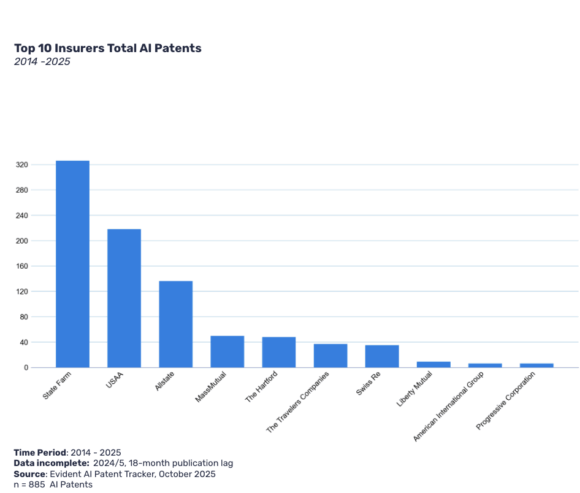
Since 2014, three major property and casualty insurers have led the charge in artificial intelligence (AI) patent activity within the industry. State Farm, USAA, and Allstate collectively account for an impressive 77% of all AI patents filed by insurers during this period, as reported by Evident, a benchmarking and intelligence platform specializing in financial services.
According to Evident, State Farm has filed a remarkable 326 AI-related patents since 2014, while USAA has pursued AI-specific patent rights 218 times. Allstate follows with 136 applications. Notably, the data indicates that 166 AI patents have been filed by 30 major insurers across North America and Europe since January 2023.
“Patents offer a rare window into where insurers are placing their biggest bets on AI,” stated Alexandra Mousavizadeh, cofounder and CEO of Evident. “This data shows that innovation is overwhelmingly being driven by a handful of U.S. firms, especially in P&C.”
Mousavizadeh emphasized that the insurance sector is at a pivotal moment. “Either patents remain the domain of a few frontrunners, or they become merely a signal of broader competitive intent,” she noted. “As generative and agentic AI reshape the value chain, insurers will need to decide whether to build IP defensively or lead from the front.”
While the volume of AI patent filings remains modest compared to the banking sector, Mousavizadeh observed a significant increase in generative and agentic capabilities. The intellectual property landscape is transitioning from protecting existing systems to enabling future innovations.
Follow-up correspondence from a PR representative revealed that insurers are primarily focusing on claims and underwriting AI patents. Customer service and risk modeling and pricing represent the second and third largest areas of patent activity, respectively. Notably, customer service patents are increasingly centered around generative AI, while risk modeling and pricing continue to rely on traditional machine learning techniques.
Overall, property and casualty insurers hold 89% of all insurer AI patents filed since 2014. This dominance reflects their structural advantages when it comes to filing AI-related intellectual property. “Their innovations often involve telematics, IoT-driven risk monitoring, and other sensor-based systems, which more easily meet the ‘technical contribution’ threshold required for patent eligibility in both the U.S. and Europe,” the press release stated.
Evident found that generative AI patents—primarily focused on customer service and claims—surged from 4% to 31% of filings between 2014 and October 2025. Meanwhile, agentic AI is emerging but remains rare; only three insurers have filed agentic patents, with USAA leading the way. Interestingly, patent activity peaked in 2020 and has not fully rebounded, despite increasing interest in generative AI among insurers.
In its annual AI insurance index, Evident highlighted that AI-specific patents can significantly foster innovation, although their value is a subject of intense debate. The June report indicated that while patents incentivize investment in research and development by providing protections for novel work, the AI community thrives on open-source models, data sharing, and transparent benchmarks. This stands in contrast to the proprietary methods often locked behind paywalls or legal threats.
“While AI-specific patents signal innovation and enable a functioning market for breakthrough ideas, ambiguous and overreaching filing activity risks undermining the collaborative, fast-moving nature of AI research and open innovation models,” Evident cautioned in the report.
Mousavizadeh anticipates an increase in agentic patent activity in 2026, with a growing focus on system-level designs, multi-agent coordination, control, and continuous feedback loops. This shift will help insurers formalize successful agentic use cases into patentable architectures, particularly in high-impact areas like underwriting and claims handling.
Below are descriptions of some notable AI patents tracked by Evident:
- USAA: Generative AI to clarify aerial imagery for property damage assessment.
- State Farm: Machine learning-driven claims triage and autonomous vehicle fault analysis.
- Allstate: In-vehicle AI assistant to automate claims and offer behavior-based discounts.
- Swiss Re: Predictive analytics for medical data and anomaly detection.
- MassMutual: Interpretable underwriting and AI-tagged document indexing.
- Liberty Mutual: AI-generated release notes for engineering teams.
- Zurich Insurance Group: A system for matching user-typed addresses to a clean, structured address database.
Topics
InsurTech
Carriers
Data Driven
Artificial Intelligence
Property Casualty
Numbers
Interested in AI?
Get automatic alerts for this topic.
Since 2014, three major property and casualty insurers have led the charge in artificial intelligence (AI) patent activity within the industry. State Farm, USAA, and Allstate collectively account for an impressive 77% of all AI patents filed by insurers during this period, as reported by Evident, a benchmarking and intelligence platform specializing in financial services.
According to Evident, State Farm has filed a remarkable 326 AI-related patents since 2014, while USAA has pursued AI-specific patent rights 218 times. Allstate follows with 136 applications. Notably, the data indicates that 166 AI patents have been filed by 30 major insurers across North America and Europe since January 2023.
“Patents offer a rare window into where insurers are placing their biggest bets on AI,” stated Alexandra Mousavizadeh, cofounder and CEO of Evident. “This data shows that innovation is overwhelmingly being driven by a handful of U.S. firms, especially in P&C.”
Mousavizadeh emphasized that the insurance sector is at a pivotal moment. “Either patents remain the domain of a few frontrunners, or they become merely a signal of broader competitive intent,” she noted. “As generative and agentic AI reshape the value chain, insurers will need to decide whether to build IP defensively or lead from the front.”
While the volume of AI patent filings remains modest compared to the banking sector, Mousavizadeh observed a significant increase in generative and agentic capabilities. The intellectual property landscape is transitioning from protecting existing systems to enabling future innovations.
Follow-up correspondence from a PR representative revealed that insurers are primarily focusing on claims and underwriting AI patents. Customer service and risk modeling and pricing represent the second and third largest areas of patent activity, respectively. Notably, customer service patents are increasingly centered around generative AI, while risk modeling and pricing continue to rely on traditional machine learning techniques.
Overall, property and casualty insurers hold 89% of all insurer AI patents filed since 2014. This dominance reflects their structural advantages when it comes to filing AI-related intellectual property. “Their innovations often involve telematics, IoT-driven risk monitoring, and other sensor-based systems, which more easily meet the ‘technical contribution’ threshold required for patent eligibility in both the U.S. and Europe,” the press release stated.
Evident found that generative AI patents—primarily focused on customer service and claims—surged from 4% to 31% of filings between 2014 and October 2025. Meanwhile, agentic AI is emerging but remains rare; only three insurers have filed agentic patents, with USAA leading the way. Interestingly, patent activity peaked in 2020 and has not fully rebounded, despite increasing interest in generative AI among insurers.
In its annual AI insurance index, Evident highlighted that AI-specific patents can significantly foster innovation, although their value is a subject of intense debate. The June report indicated that while patents incentivize investment in research and development by providing protections for novel work, the AI community thrives on open-source models, data sharing, and transparent benchmarks. This stands in contrast to the proprietary methods often locked behind paywalls or legal threats.
“While AI-specific patents signal innovation and enable a functioning market for breakthrough ideas, ambiguous and overreaching filing activity risks undermining the collaborative, fast-moving nature of AI research and open innovation models,” Evident cautioned in the report.
Mousavizadeh anticipates an increase in agentic patent activity in 2026, with a growing focus on system-level designs, multi-agent coordination, control, and continuous feedback loops. This shift will help insurers formalize successful agentic use cases into patentable architectures, particularly in high-impact areas like underwriting and claims handling.
Below are descriptions of some notable AI patents tracked by Evident:
- USAA: Generative AI to clarify aerial imagery for property damage assessment.
- State Farm: Machine learning-driven claims triage and autonomous vehicle fault analysis.
- Allstate: In-vehicle AI assistant to automate claims and offer behavior-based discounts.
- Swiss Re: Predictive analytics for medical data and anomaly detection.
- MassMutual: Interpretable underwriting and AI-tagged document indexing.
- Liberty Mutual: AI-generated release notes for engineering teams.
- Zurich Insurance Group: A system for matching user-typed addresses to a clean, structured address database.
Topics
InsurTech
Carriers
Data Driven
Artificial Intelligence
Property Casualty
Numbers
Interested in AI?
Get automatic alerts for this topic.