Positive Climate Developments to Wrap Up the Year
Planet-warming greenhouse gas emissions continued to rise in 2025, and country pledges to reduce them remain insufficient to avert catastrophic climate change. However, there are notable silver linings.
The world is decarbonizing faster than anticipated a decade ago. Investment in the clean energy transition, encompassing wind, solar, batteries, and grids, is projected to reach a record $2.2 trillion globally in 2025, according to research from the Energy and Climate Intelligence Unit (ECIU), a London-based non-profit.
“As climate change triggers more extreme weather events, catastrophe bonds are emerging as a new tool for funding disaster preparedness. Traditionally used to cover losses from climate-fueled natural disasters, these financial instruments are evolving. This year, hurricane-prone North Carolina expanded their use by issuing a new cat bond that incentivizes adaptation.”
“Is this enough to keep us safe? No, it clearly isn’t,” stated Gareth Redmond-King, international lead at the ECIU. “Is it remarkable progress compared to where we were headed? Clearly it is.”
This year also saw renewable power capacity reach new heights, battery prices plummet, and unprecedented protections for the high seas come into effect. Artificial intelligence (AI) has accelerated climate research and improved weather forecasting. Despite the visible impacts of climate change, economies and individuals are increasingly accessing tools to shield themselves.
Here’s a look at the investments, innovations, and policy changes that positively impacted climate in 2025:
Clean Energy Boom
Global investment in clean technology significantly outpaced funding for polluting industries. For every $1 invested in fossil fuel projects, $2 was allocated to clean power, according to the ECIU. In the case of the four largest polluters—China, the EU, the US, and India—the ratio was even higher at $2.60.
Funds directed toward renewable power set a new record in the first half of the year, increasing by 10% compared to the same period in 2024, totaling $386 billion, as reported by BloombergNEF.
Solar and wind energy grew rapidly enough to meet all new global electricity demand in the first three quarters of 2025, according to UK-based energy think tank Ember. This growth is expected to result in an 11% increase in renewable capacity from 2024.
Over the past three years, renewable capacity has expanded by nearly 30% on average, bringing the world closer to the goal set at COP 28 in Dubai in 2023 to triple clean power by 2030. China is leading this charge, contributing 66% of new solar capacity and 69% of new wind globally this year.
AI’s Climate Benefit
The surge in demand for artificial intelligence is reshaping green technology investment, which had previously declined. In the first three quarters of this year, global clean tech investment, particularly in next-generation nuclear reactors and renewable energy solutions for data centers, surpassed all of 2024’s investments. This marks the sector’s first annual increase since its peak in 2022.
Despite the rollback of climate policies during the Trump administration, the S&P’s main clean energy index has risen by about 50% this year, outperforming most other stock indexes and gold. This enthusiasm has also directed more capital into developing and upgrading the power grid, a crucial element of the global energy transition.
AI is enabling new climate solutions and expediting scientific research. For instance, Waymo’s self-driving electric vehicles utilize AI to optimize route planning, minimizing idling and reducing carbon footprints. AI-enabled scanning systems are also being used to safeguard critical infrastructure against extreme heat.
Cheaper Batteries
Battery prices, a critical factor in the electrification of various products, continue to decline. Prices per kilowatt-hour fell by 8% to a record $108 this year, with expectations of a further 3% decrease next year, according to BloombergNEF. This drop is attributed to improved manufacturing processes and a surplus of production, which have outweighed rising metal prices.
The declining costs enhance the economics of products ranging from lawn mowers to commercial drones. Carmakers are particularly poised to boost EV adoption with longer-range, lower-cost vehicles. The most significant impact will likely be seen in utility-scale storage systems that store energy from solar and wind farms for use during peak demand.
The US Energy Information Administration estimates that 18.2 gigawatts of storage capacity will come online in 2025, representing a 77% increase over the previous year and nearly one-third of the country’s new power. These facilities are becoming one of the most cost-effective options for utilities looking to build power plants.
International Progress
In a year marked by the US withdrawal from the Paris Agreement, the global community achieved significant milestones. The High Seas Treaty, adopted three years prior, finally received enough ratifications to take effect in January 2026. This treaty will protect 60% of the seas that fall outside any country’s jurisdiction, regulating activities in international waters for the first time.
This framework will facilitate the establishment of marine protected areas and mandate environmental impact assessments for activities that could harm the high seas. This is particularly timely, given the increasing interest in utilizing the ocean for carbon dioxide absorption and mineral extraction.
Climate Policy
While the US rolled back its environmental policies, other nations advanced their climate agendas. Australia, Denmark, and the UK announced more ambitious emissions goals. Although China’s targets were more conservative, many experts anticipate that it will exceed its goal of cutting emissions by 7 to 10% from peak levels by 2035, given the rapid expansion of its clean energy capacity.
Global cities traditionally dominated by cars are beginning to encourage walking and cycling. In January, New York City introduced measures to deter drivers from entering certain areas, resulting in reduced congestion and shorter journey times. Recent research indicates a 22% drop in harmful particulate pollution in the zones where these charges are enforced.
Wins for Adaptation
Funding for climate change adaptation is also on the rise. Bill Gates’s foundation announced a commitment of $1.4 billion over four years to enhance innovations that help farmers in Africa and Asia become more resilient. This year’s UN climate summit concluded with an agreement to triple adaptation finance to $120 billion per year by 2035.
The devastating Hurricane Melissa, which resulted in significant loss of life and economic impact in Jamaica, highlighted the potential of catastrophe bonds to transfer climate risks to capital markets. The storm triggered a full payout of Jamaica’s $150 million cat bond, demonstrating the effectiveness of such financial instruments.
North Carolina has also expanded the use of catastrophe bonds by issuing a new bond that incentivizes adaptation. If no major losses occur, $2 million will return to the North Carolina Insurance Underwriting Association, which will use the funds to install wind-resistant “super roofs.” This innovative approach is expected to lower insurance claims and reduce reinsurance costs.
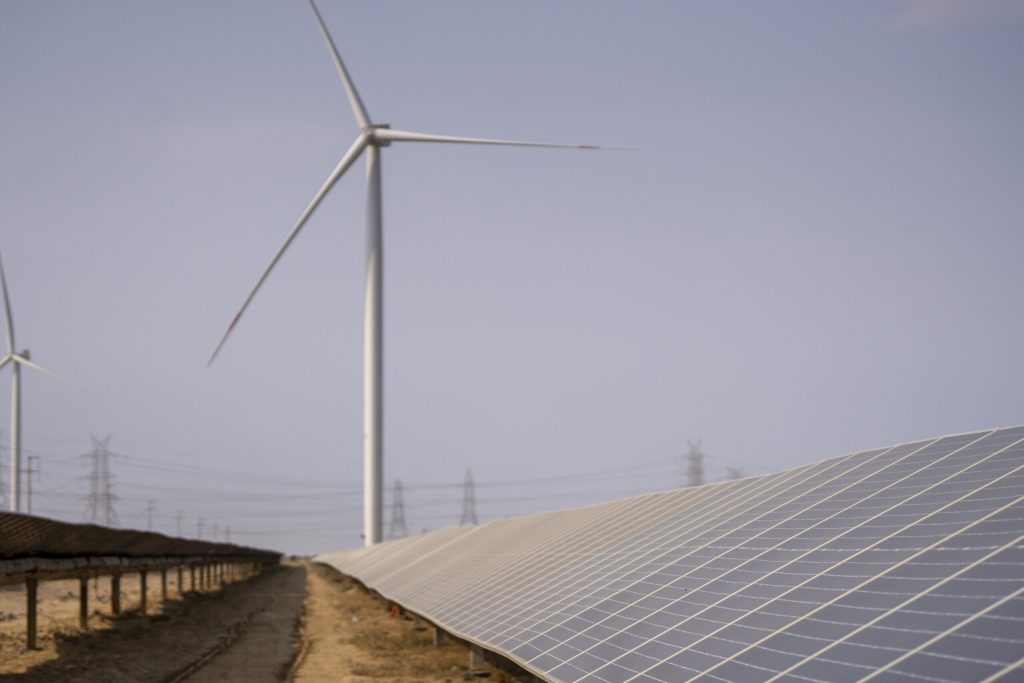
Top photograph: Wind turbines and solar panels in Khavda, Gujarat, India. Photo credit: Sumit Dayal/Bloomberg
Related:
Copyright 2025 Bloomberg.
Planet-warming greenhouse gas emissions continued to rise in 2025, and country pledges to reduce them remain insufficient to avert catastrophic climate change. However, there are notable silver linings.
The world is decarbonizing faster than anticipated a decade ago. Investment in the clean energy transition, encompassing wind, solar, batteries, and grids, is projected to reach a record $2.2 trillion globally in 2025, according to research from the Energy and Climate Intelligence Unit (ECIU), a London-based non-profit.
“As climate change triggers more extreme weather events, catastrophe bonds are emerging as a new tool for funding disaster preparedness. Traditionally used to cover losses from climate-fueled natural disasters, these financial instruments are evolving. This year, hurricane-prone North Carolina expanded their use by issuing a new cat bond that incentivizes adaptation.”
“Is this enough to keep us safe? No, it clearly isn’t,” stated Gareth Redmond-King, international lead at the ECIU. “Is it remarkable progress compared to where we were headed? Clearly it is.”
This year also saw renewable power capacity reach new heights, battery prices plummet, and unprecedented protections for the high seas come into effect. Artificial intelligence (AI) has accelerated climate research and improved weather forecasting. Despite the visible impacts of climate change, economies and individuals are increasingly accessing tools to shield themselves.
Here’s a look at the investments, innovations, and policy changes that positively impacted climate in 2025:
Clean Energy Boom
Global investment in clean technology significantly outpaced funding for polluting industries. For every $1 invested in fossil fuel projects, $2 was allocated to clean power, according to the ECIU. In the case of the four largest polluters—China, the EU, the US, and India—the ratio was even higher at $2.60.
Funds directed toward renewable power set a new record in the first half of the year, increasing by 10% compared to the same period in 2024, totaling $386 billion, as reported by BloombergNEF.
Solar and wind energy grew rapidly enough to meet all new global electricity demand in the first three quarters of 2025, according to UK-based energy think tank Ember. This growth is expected to result in an 11% increase in renewable capacity from 2024.
Over the past three years, renewable capacity has expanded by nearly 30% on average, bringing the world closer to the goal set at COP 28 in Dubai in 2023 to triple clean power by 2030. China is leading this charge, contributing 66% of new solar capacity and 69% of new wind globally this year.
AI’s Climate Benefit
The surge in demand for artificial intelligence is reshaping green technology investment, which had previously declined. In the first three quarters of this year, global clean tech investment, particularly in next-generation nuclear reactors and renewable energy solutions for data centers, surpassed all of 2024’s investments. This marks the sector’s first annual increase since its peak in 2022.
Despite the rollback of climate policies during the Trump administration, the S&P’s main clean energy index has risen by about 50% this year, outperforming most other stock indexes and gold. This enthusiasm has also directed more capital into developing and upgrading the power grid, a crucial element of the global energy transition.
AI is enabling new climate solutions and expediting scientific research. For instance, Waymo’s self-driving electric vehicles utilize AI to optimize route planning, minimizing idling and reducing carbon footprints. AI-enabled scanning systems are also being used to safeguard critical infrastructure against extreme heat.
Cheaper Batteries
Battery prices, a critical factor in the electrification of various products, continue to decline. Prices per kilowatt-hour fell by 8% to a record $108 this year, with expectations of a further 3% decrease next year, according to BloombergNEF. This drop is attributed to improved manufacturing processes and a surplus of production, which have outweighed rising metal prices.
The declining costs enhance the economics of products ranging from lawn mowers to commercial drones. Carmakers are particularly poised to boost EV adoption with longer-range, lower-cost vehicles. The most significant impact will likely be seen in utility-scale storage systems that store energy from solar and wind farms for use during peak demand.
The US Energy Information Administration estimates that 18.2 gigawatts of storage capacity will come online in 2025, representing a 77% increase over the previous year and nearly one-third of the country’s new power. These facilities are becoming one of the most cost-effective options for utilities looking to build power plants.
International Progress
In a year marked by the US withdrawal from the Paris Agreement, the global community achieved significant milestones. The High Seas Treaty, adopted three years prior, finally received enough ratifications to take effect in January 2026. This treaty will protect 60% of the seas that fall outside any country’s jurisdiction, regulating activities in international waters for the first time.
This framework will facilitate the establishment of marine protected areas and mandate environmental impact assessments for activities that could harm the high seas. This is particularly timely, given the increasing interest in utilizing the ocean for carbon dioxide absorption and mineral extraction.
Climate Policy
While the US rolled back its environmental policies, other nations advanced their climate agendas. Australia, Denmark, and the UK announced more ambitious emissions goals. Although China’s targets were more conservative, many experts anticipate that it will exceed its goal of cutting emissions by 7 to 10% from peak levels by 2035, given the rapid expansion of its clean energy capacity.
Global cities traditionally dominated by cars are beginning to encourage walking and cycling. In January, New York City introduced measures to deter drivers from entering certain areas, resulting in reduced congestion and shorter journey times. Recent research indicates a 22% drop in harmful particulate pollution in the zones where these charges are enforced.
Wins for Adaptation
Funding for climate change adaptation is also on the rise. Bill Gates’s foundation announced a commitment of $1.4 billion over four years to enhance innovations that help farmers in Africa and Asia become more resilient. This year’s UN climate summit concluded with an agreement to triple adaptation finance to $120 billion per year by 2035.
The devastating Hurricane Melissa, which resulted in significant loss of life and economic impact in Jamaica, highlighted the potential of catastrophe bonds to transfer climate risks to capital markets. The storm triggered a full payout of Jamaica’s $150 million cat bond, demonstrating the effectiveness of such financial instruments.
North Carolina has also expanded the use of catastrophe bonds by issuing a new bond that incentivizes adaptation. If no major losses occur, $2 million will return to the North Carolina Insurance Underwriting Association, which will use the funds to install wind-resistant “super roofs.” This innovative approach is expected to lower insurance claims and reduce reinsurance costs.
Top photograph: Wind turbines and solar panels in Khavda, Gujarat, India. Photo credit: Sumit Dayal/Bloomberg
Related:
Copyright 2025 Bloomberg.