2023 Economic Review: The Impact of President Trump’s Agenda on Current Trends
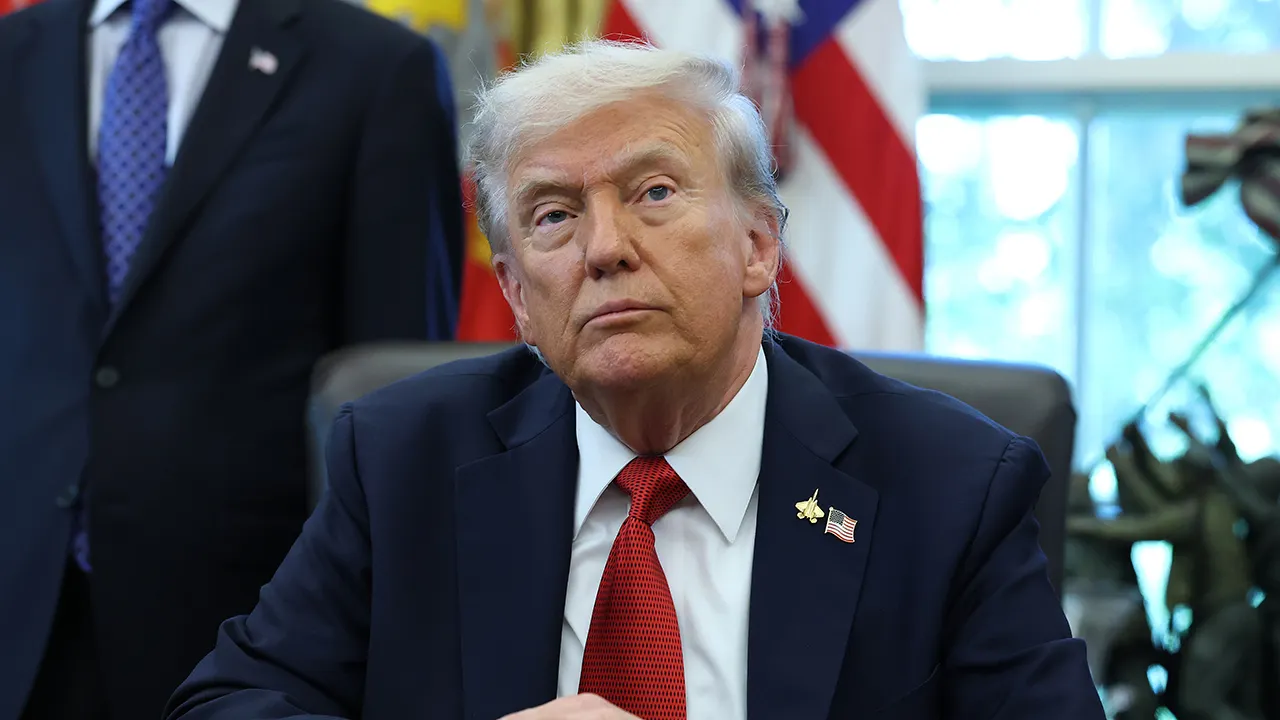
Yardeni Research president Ed Yardeni discusses economic drivers heading into 2026 on ‘Making Money.’
President Donald Trump’s economic agenda has yielded a mixed yet closely monitored set of outcomes. Economic growth has accelerated, inflation has decreased from recent peaks, and significant policy changes are beginning to reshape the landscape for businesses and households alike.
U.S. Stocks Rally
This year has also seen a robust performance in U.S. stocks, with the S&P 500, the broadest measure of the stock market, concluding 2025 with a remarkable gain of 17%.
Let’s explore the pivotal developments that have characterized Trump’s economy thus far.
Strong Growth, Easing Inflation
The economy outperformed expectations in late 2025, with overall output increasing at an annual rate of approximately 4% to 4.5% in the third quarter. Officials from the Trump administration attribute this growth to increased consumer spending and heightened business confidence, leading to more investments and hiring.
CONSERVATIVE STATES SEE LOWER INFLATION THAN LIBERAL ONES NATIONWIDE, WHITE HOUSE DATA SHOWS
Simultaneously, inflation has moderated. Prices rose by 2.7% in November compared to the previous year, falling short of the 3.1% forecasted by economists.
These trends could influence how Trump and the Federal Reserve approach interest rates and the broader economy moving forward. Market analysts predict that the Fed’s first rate cut may occur in April 2026, as indicated by the CME’s FedWatch Tool, which tracks the likelihood of rate changes.
Trump’s One Big Beautiful Bill Act
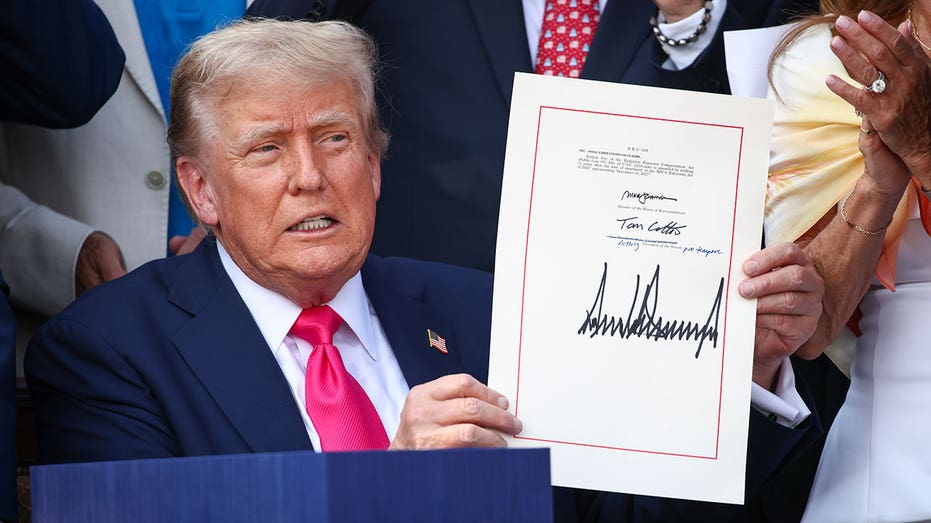
U.S. President Donald Trump, joined by Republican lawmakers, signs the One, Big Beautiful Bill Act into law during an Independence Day military family picnic on the South Lawn of the White House on July 04, 2025. (Samuel Corum/Getty Images / Getty Images)
On July 4, Trump signed into law his flagship One Big Beautiful Bill Act (OBBBA), a comprehensive tax and spending measure that builds upon the 2017 Tax Cuts and Jobs Act (TCJA) from his first term while introducing new federal initiatives.
FIVE MAJOR POLICIES TO KNOW FROM THE ONE BIG BEAUTIFUL BILL ACT
This legislation extends expiring TCJA tax cuts, averting a broad tax increase for individuals while making lower income tax rates and an expanded standard deduction permanent. Other provisions are temporarily extended, reshaping the tax landscape for households and businesses.
The bill also facilitates campaign promises like “No Tax on Tips” and “No Tax on Overtime,” set to take effect in 2026, while introducing new long-term savings programs.
Big Tax Refunds
Trump’s economic team is advising Americans to brace for some of the largest tax refunds in history, thanks to provisions in the OBBBA.
“I can see that we’re gonna have a gigantic refund year in the first quarter because working Americans did not change their withholdings,” said U.S. Treasury Scott Bessent during an appearance on the “All-In Podcast.” “I think households could see, depending on the number of workers, $1,000- $2,000 refunds.”
Bessent’s forecast aligns with a report from the Tax Foundation, a nonpartisan tax policy nonprofit, which indicated that “refunds will be larger than typical in the upcoming filing season due to the One Big Beautiful Bill Act’s (OBBBA) tax cuts for 2025.”
Trump Accounts
For children, Trump accounts operate similarly to traditional long-term investment vehicles, but with rules specifically designed to protect young savers. These accounts, available only to those under 18, are funded through federal seed money, private contributions from families, and, when applicable, supplemental deposits from employers or nonprofit organizations.
Individuals can contribute up to $5,000 per year to a Trump account, with governments and nonprofits also permitted to make eligible contributions. Additionally, funds from another Trump account can be rolled over, allowing money already held in one account to be transferred directly into a new or different Trump account without counting toward the annual contribution limit. Employers participating in a Trump account program may contribute up to $2,500 per year.
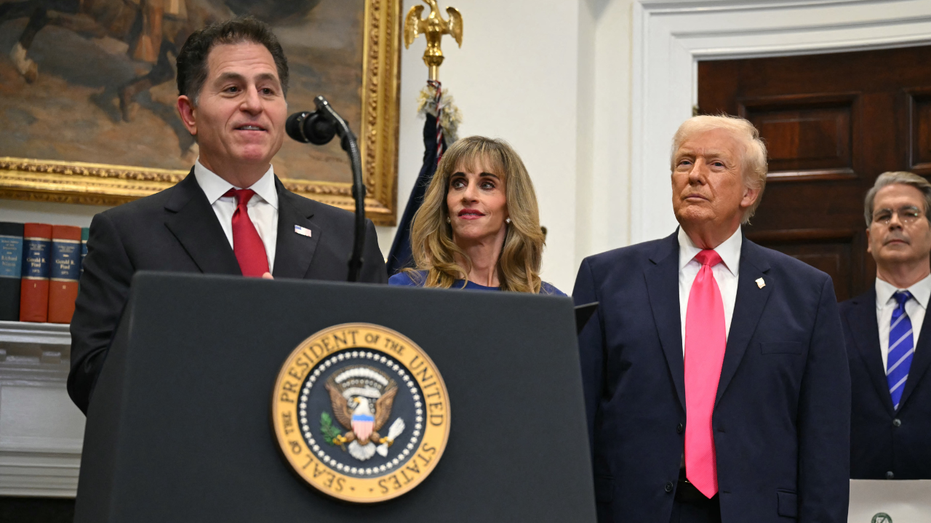
Michael Dell (L), CEO of Dell Technologies, and his wife Susan (2nd-L) speak during an announcement of a $6.25 billion donation from the Dell family to “Trump Accounts,” in the Roosevelt Room of the White House in Washington, DC on December 2, 2025. (Andrew Caballero-Reynolds/ AFP/Getty Images / Getty Images)
In December, two prominent billionaires joined the funding for Trump accounts. Michael and Susan Dell were the first to pledge over $6 billion, followed by investor Ray Dalio.
Launch of ‘Liberation Day’ Tariffs
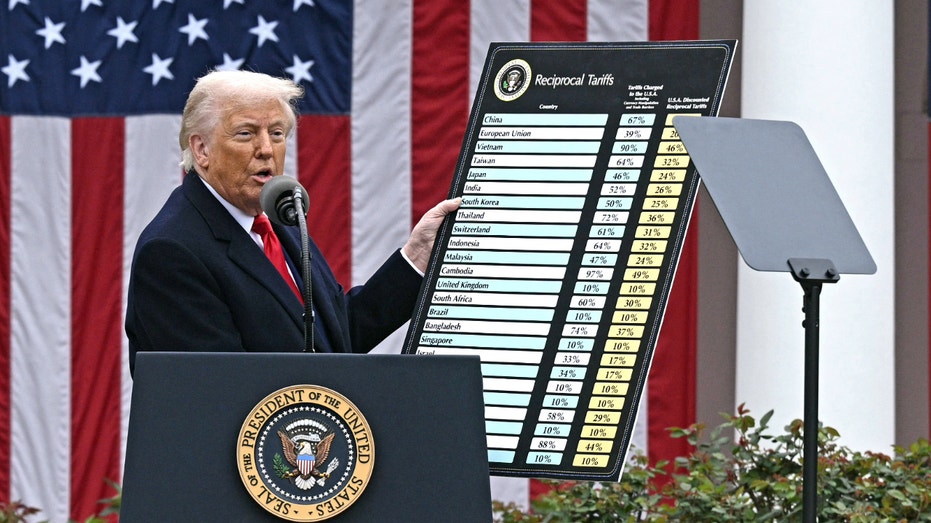
President Donald Trump announces reciprocal tariffs during an event in the Rose Garden at the White House. (Brendan Smialowski/AFP via Getty Images / Getty Images)
In April, Trump unveiled sweeping “Liberation Day” tariffs aimed at addressing long-standing trade imbalances, revitalizing U.S. manufacturing, and bolstering national security. Critics argue that these higher tariffs could lead to increased consumer prices and provoke retaliation from trading partners.
TRUMP SAYS TARIFF REVENUE TO FUND $2K CHECKS FOR AMERICANS, LOWER NATION’S $38T DEBT
Despite the criticism, total duty revenue reached $215.2 billion in fiscal year 2025, which concluded on September 30, according to the Treasury Department’s Customs and Certain Excise Taxes report. This momentum has continued into the new fiscal year, with $96.5 billion collected since October 1, as per Treasury data.
The strategy now faces legal scrutiny, with the Supreme Court expected to rule in January on Trump’s authority to impose certain tariffs. The cases—Learning Resources Inc. v. Trump and Trump v. V.O.S. Selections Inc.—focus on whether the International Emergency Economic Powers Act grants the president that power or exceeds constitutional limits.
Nonetheless, Trump maintains that aggressive tariffs are essential to confront what he perceives as years of unfair global trade, underscoring how deeply trade policy is embedded in his broader economic strategy.
He has also pledged that revenue generated from these tariffs could fund a $2,000 dividend for low- and middle-income Americans.
Yardeni Research president Ed Yardeni discusses economic drivers heading into 2026 on ‘Making Money.’
President Donald Trump’s economic agenda has yielded a mixed yet closely monitored set of outcomes. Economic growth has accelerated, inflation has decreased from recent peaks, and significant policy changes are beginning to reshape the landscape for businesses and households alike.
U.S. Stocks Rally
This year has also seen a robust performance in U.S. stocks, with the S&P 500, the broadest measure of the stock market, concluding 2025 with a remarkable gain of 17%.
Let’s explore the pivotal developments that have characterized Trump’s economy thus far.
Strong Growth, Easing Inflation
The economy outperformed expectations in late 2025, with overall output increasing at an annual rate of approximately 4% to 4.5% in the third quarter. Officials from the Trump administration attribute this growth to increased consumer spending and heightened business confidence, leading to more investments and hiring.
CONSERVATIVE STATES SEE LOWER INFLATION THAN LIBERAL ONES NATIONWIDE, WHITE HOUSE DATA SHOWS
Simultaneously, inflation has moderated. Prices rose by 2.7% in November compared to the previous year, falling short of the 3.1% forecasted by economists.
These trends could influence how Trump and the Federal Reserve approach interest rates and the broader economy moving forward. Market analysts predict that the Fed’s first rate cut may occur in April 2026, as indicated by the CME’s FedWatch Tool, which tracks the likelihood of rate changes.
Trump’s One Big Beautiful Bill Act
U.S. President Donald Trump, joined by Republican lawmakers, signs the One, Big Beautiful Bill Act into law during an Independence Day military family picnic on the South Lawn of the White House on July 04, 2025. (Samuel Corum/Getty Images / Getty Images)
On July 4, Trump signed into law his flagship One Big Beautiful Bill Act (OBBBA), a comprehensive tax and spending measure that builds upon the 2017 Tax Cuts and Jobs Act (TCJA) from his first term while introducing new federal initiatives.
FIVE MAJOR POLICIES TO KNOW FROM THE ONE BIG BEAUTIFUL BILL ACT
This legislation extends expiring TCJA tax cuts, averting a broad tax increase for individuals while making lower income tax rates and an expanded standard deduction permanent. Other provisions are temporarily extended, reshaping the tax landscape for households and businesses.
The bill also facilitates campaign promises like “No Tax on Tips” and “No Tax on Overtime,” set to take effect in 2026, while introducing new long-term savings programs.
Big Tax Refunds
Trump’s economic team is advising Americans to brace for some of the largest tax refunds in history, thanks to provisions in the OBBBA.
“I can see that we’re gonna have a gigantic refund year in the first quarter because working Americans did not change their withholdings,” said U.S. Treasury Scott Bessent during an appearance on the “All-In Podcast.” “I think households could see, depending on the number of workers, $1,000- $2,000 refunds.”
Bessent’s forecast aligns with a report from the Tax Foundation, a nonpartisan tax policy nonprofit, which indicated that “refunds will be larger than typical in the upcoming filing season due to the One Big Beautiful Bill Act’s (OBBBA) tax cuts for 2025.”
Trump Accounts
For children, Trump accounts operate similarly to traditional long-term investment vehicles, but with rules specifically designed to protect young savers. These accounts, available only to those under 18, are funded through federal seed money, private contributions from families, and, when applicable, supplemental deposits from employers or nonprofit organizations.
Individuals can contribute up to $5,000 per year to a Trump account, with governments and nonprofits also permitted to make eligible contributions. Additionally, funds from another Trump account can be rolled over, allowing money already held in one account to be transferred directly into a new or different Trump account without counting toward the annual contribution limit. Employers participating in a Trump account program may contribute up to $2,500 per year.
Michael Dell (L), CEO of Dell Technologies, and his wife Susan (2nd-L) speak during an announcement of a $6.25 billion donation from the Dell family to “Trump Accounts,” in the Roosevelt Room of the White House in Washington, DC on December 2, 2025. (Andrew Caballero-Reynolds/ AFP/Getty Images / Getty Images)
In December, two prominent billionaires joined the funding for Trump accounts. Michael and Susan Dell were the first to pledge over $6 billion, followed by investor Ray Dalio.
Launch of ‘Liberation Day’ Tariffs
President Donald Trump announces reciprocal tariffs during an event in the Rose Garden at the White House. (Brendan Smialowski/AFP via Getty Images / Getty Images)
In April, Trump unveiled sweeping “Liberation Day” tariffs aimed at addressing long-standing trade imbalances, revitalizing U.S. manufacturing, and bolstering national security. Critics argue that these higher tariffs could lead to increased consumer prices and provoke retaliation from trading partners.
TRUMP SAYS TARIFF REVENUE TO FUND $2K CHECKS FOR AMERICANS, LOWER NATION’S $38T DEBT
Despite the criticism, total duty revenue reached $215.2 billion in fiscal year 2025, which concluded on September 30, according to the Treasury Department’s Customs and Certain Excise Taxes report. This momentum has continued into the new fiscal year, with $96.5 billion collected since October 1, as per Treasury data.
The strategy now faces legal scrutiny, with the Supreme Court expected to rule in January on Trump’s authority to impose certain tariffs. The cases—Learning Resources Inc. v. Trump and Trump v. V.O.S. Selections Inc.—focus on whether the International Emergency Economic Powers Act grants the president that power or exceeds constitutional limits.
Nonetheless, Trump maintains that aggressive tariffs are essential to confront what he perceives as years of unfair global trade, underscoring how deeply trade policy is embedded in his broader economic strategy.
He has also pledged that revenue generated from these tariffs could fund a $2,000 dividend for low- and middle-income Americans.