Taiwan Remains Vigilant as Chinese Naval Forces Withdraw Following Extensive Exercises
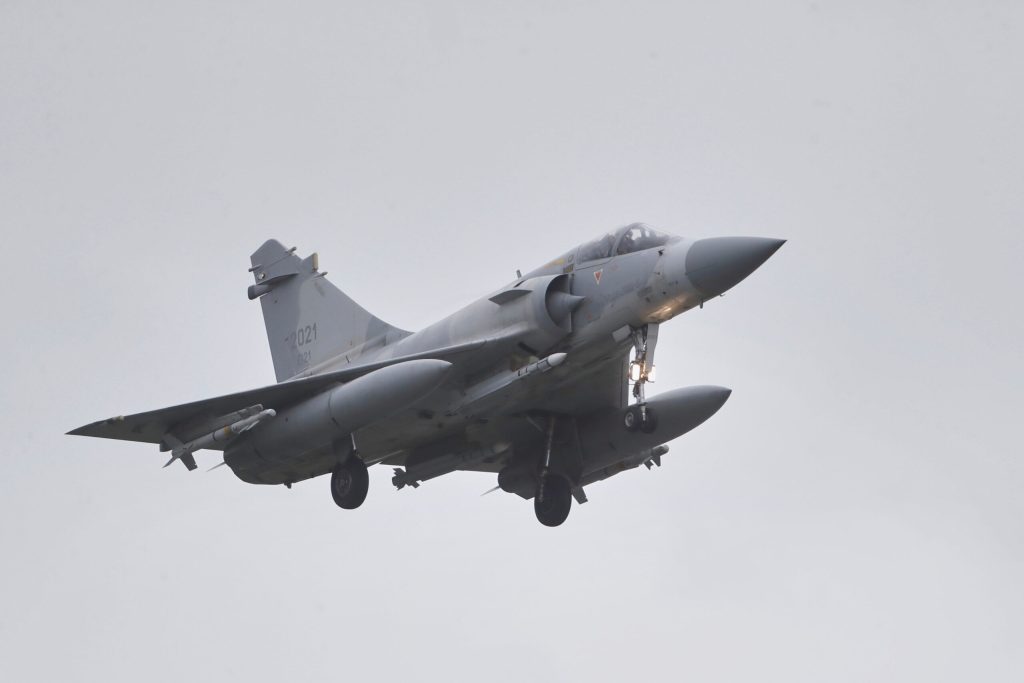
The recent military exercises dubbed “Justice Mission 2025” have seen China launch dozens of rockets towards Taiwan, alongside the deployment of a significant number of warships and aircraft in the vicinity of the island. This display of military might has raised alarms among regional allies and Western nations alike.
On Wednesday, Beijing announced the conclusion of these drills, asserting that its military would remain on high alert and continue to enhance its combat readiness. In response, Taiwan’s defense ministry indicated that a considerable number of Chinese aircraft and vessels were still present in its response area, prompting its armed forces to maintain an “appropriate contingency mechanism,” though no further details were provided.
“The Chinese Communist Party’s aggressive and militaristic provocations endanger regional security and stability, and have been condemned by democratic allies in the international community,” the ministry stated.
In a recent New Year address, Chinese President Xi Jinping reiterated his stance on Taiwan, warning against forces he perceives as advocating for Taiwan’s independence. “Compatriots on both sides of the Taiwan Strait are bound by blood ties thicker than water, and the historical trend toward national reunification is unstoppable,” he declared during a televised speech on state broadcaster CCTV.
China claims Taiwan, which operates as a democratically governed entity, as its territory and has not dismissed the possibility of using force to assert control. Taiwan, rejecting these claims, condemned the recent military drills as a direct threat to regional security and a blatant provocation.
According to Kuan Bi-ling, head of Taiwan’s Ocean Affairs Council, Chinese ships began to withdraw from the area by Tuesday night. “The maritime situation has calmed down, with ships and vessels gradually departing,” she noted in a Facebook post.
A Taiwan coast guard official confirmed to Reuters that all 11 Chinese coast guard ships had vacated the waters near Taiwan and were continuing to move away. Additionally, a Taiwan security official stated that emergency response centers for the military and coast guard remained operational.
Earlier, reports indicated that over 90 Chinese naval and coast guard vessels were active in the region, many positioned in the South China Sea, near Taiwan, and the East China Sea. Security officials, speaking on condition of anonymity due to the sensitive nature of the situation, noted that the scale of China’s maritime deployment had steadily increased since the beginning of the week.
China is currently engaged in a busy season of military exercises. Taiwan’s defense ministry reported that in the past 24 hours, 77 Chinese military aircraft and 25 navy and coast guard vessels had been operating around the island. Notably, 35 military planes crossed the median line of the Taiwan Strait, which serves as an unofficial boundary between the two sides.
‘Stern Warning’
As the military exercises unfolded, U.S. Ambassador to China David Perdue shared a photo on X with ambassadors from the Quad nations—comprising the U.S., Australia, Japan, and India. He referred to the Quad as a “force for good” committed to maintaining a free and open Indo-Pacific, although he did not disclose specifics about the discussions or the timing of the meeting.
The U.S. State Department confirmed that Perdue regularly meets with diplomats and Chinese officials to further the U.S. president’s agenda. “In line with these routine meetings, he met with Quad Ambassadors in Beijing on December 19,” a spokesperson told Reuters.
These drills represent China’s most extensive military exercises to date, forcing Taiwan to cancel numerous domestic flights and mobilize jets and warships for monitoring purposes. Soldiers conducted rapid-response drills, including erecting barricades at various locations.
China’s Taiwan Affairs Office spokesperson, Zhang Han, characterized the exercises as a “necessary and just measure” to safeguard national sovereignty and territorial integrity. She described them as “a stern warning against Taiwan independence separatist forces and external interference.”
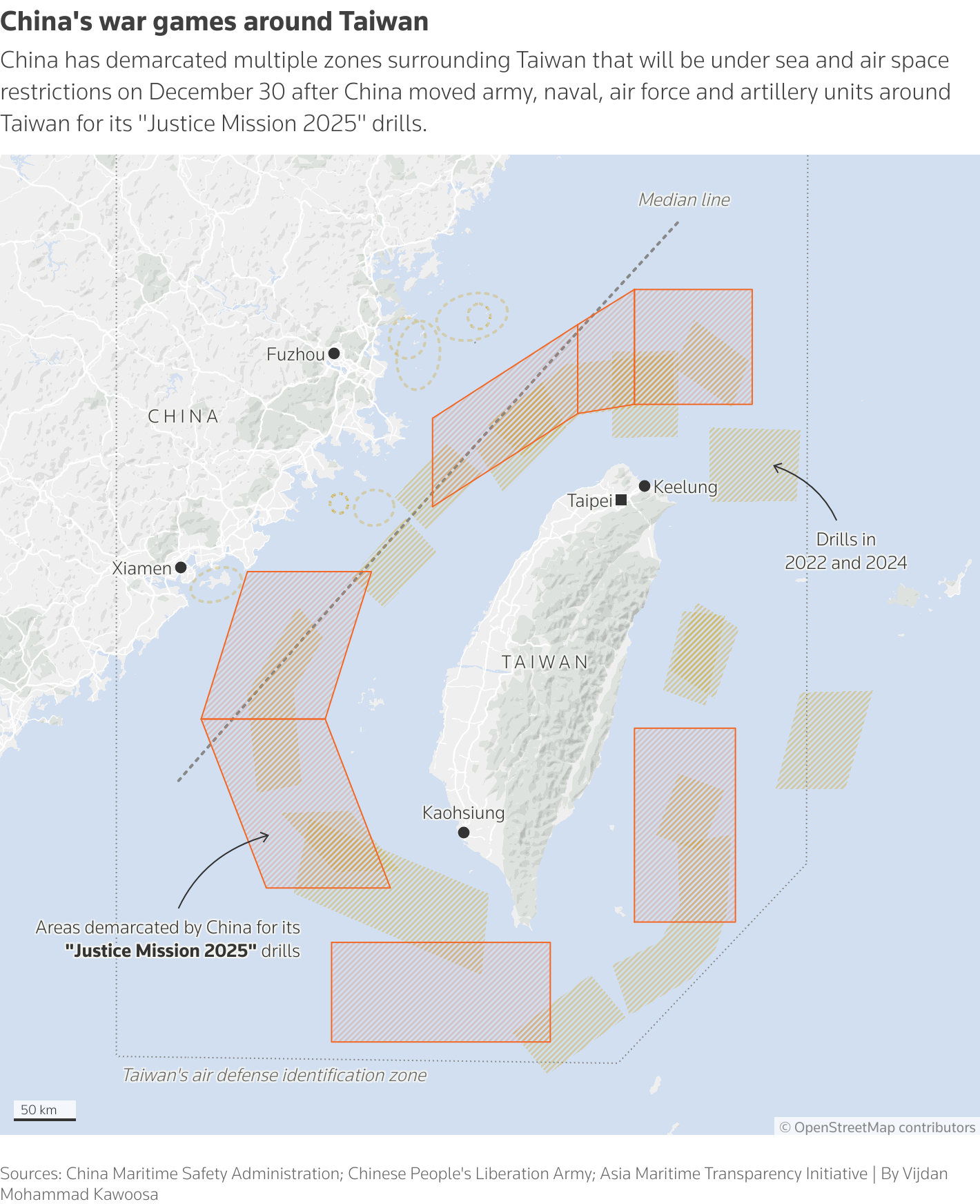
China’s state news agency Xinhua highlighted “three key takeaways” from the drills, which commenced shortly after the U.S. announced a record $11.1 billion arms package for Taiwan. The simulated “encirclement” showcased the People’s Liberation Army’s capability to “press and contain separatist forces while denying access to external interference.” This strategy was summarized as ‘sealing internally and blocking externally,’ according to Zhang Chi, a professor at the PLA National Defence University.
Despite the escalating intensity of China’s military exercises, experts suggest that Beijing is unlikely to initiate a conflict that could damage its international standing. Lyle Goldstein, head of the Asia program at the U.S. think tank Defense Priorities, remarked, “They threaten and bluster a lot, but ultimately (a war) would be very costly for China no matter what.”
The recent military exercises dubbed “Justice Mission 2025” have seen China launch dozens of rockets towards Taiwan, alongside the deployment of a significant number of warships and aircraft in the vicinity of the island. This display of military might has raised alarms among regional allies and Western nations alike.
On Wednesday, Beijing announced the conclusion of these drills, asserting that its military would remain on high alert and continue to enhance its combat readiness. In response, Taiwan’s defense ministry indicated that a considerable number of Chinese aircraft and vessels were still present in its response area, prompting its armed forces to maintain an “appropriate contingency mechanism,” though no further details were provided.
“The Chinese Communist Party’s aggressive and militaristic provocations endanger regional security and stability, and have been condemned by democratic allies in the international community,” the ministry stated.
In a recent New Year address, Chinese President Xi Jinping reiterated his stance on Taiwan, warning against forces he perceives as advocating for Taiwan’s independence. “Compatriots on both sides of the Taiwan Strait are bound by blood ties thicker than water, and the historical trend toward national reunification is unstoppable,” he declared during a televised speech on state broadcaster CCTV.
China claims Taiwan, which operates as a democratically governed entity, as its territory and has not dismissed the possibility of using force to assert control. Taiwan, rejecting these claims, condemned the recent military drills as a direct threat to regional security and a blatant provocation.
According to Kuan Bi-ling, head of Taiwan’s Ocean Affairs Council, Chinese ships began to withdraw from the area by Tuesday night. “The maritime situation has calmed down, with ships and vessels gradually departing,” she noted in a Facebook post.
A Taiwan coast guard official confirmed to Reuters that all 11 Chinese coast guard ships had vacated the waters near Taiwan and were continuing to move away. Additionally, a Taiwan security official stated that emergency response centers for the military and coast guard remained operational.
Earlier, reports indicated that over 90 Chinese naval and coast guard vessels were active in the region, many positioned in the South China Sea, near Taiwan, and the East China Sea. Security officials, speaking on condition of anonymity due to the sensitive nature of the situation, noted that the scale of China’s maritime deployment had steadily increased since the beginning of the week.
China is currently engaged in a busy season of military exercises. Taiwan’s defense ministry reported that in the past 24 hours, 77 Chinese military aircraft and 25 navy and coast guard vessels had been operating around the island. Notably, 35 military planes crossed the median line of the Taiwan Strait, which serves as an unofficial boundary between the two sides.
‘Stern Warning’
As the military exercises unfolded, U.S. Ambassador to China David Perdue shared a photo on X with ambassadors from the Quad nations—comprising the U.S., Australia, Japan, and India. He referred to the Quad as a “force for good” committed to maintaining a free and open Indo-Pacific, although he did not disclose specifics about the discussions or the timing of the meeting.
The U.S. State Department confirmed that Perdue regularly meets with diplomats and Chinese officials to further the U.S. president’s agenda. “In line with these routine meetings, he met with Quad Ambassadors in Beijing on December 19,” a spokesperson told Reuters.
These drills represent China’s most extensive military exercises to date, forcing Taiwan to cancel numerous domestic flights and mobilize jets and warships for monitoring purposes. Soldiers conducted rapid-response drills, including erecting barricades at various locations.
China’s Taiwan Affairs Office spokesperson, Zhang Han, characterized the exercises as a “necessary and just measure” to safeguard national sovereignty and territorial integrity. She described them as “a stern warning against Taiwan independence separatist forces and external interference.”
China’s state news agency Xinhua highlighted “three key takeaways” from the drills, which commenced shortly after the U.S. announced a record $11.1 billion arms package for Taiwan. The simulated “encirclement” showcased the People’s Liberation Army’s capability to “press and contain separatist forces while denying access to external interference.” This strategy was summarized as ‘sealing internally and blocking externally,’ according to Zhang Chi, a professor at the PLA National Defence University.
Despite the escalating intensity of China’s military exercises, experts suggest that Beijing is unlikely to initiate a conflict that could damage its international standing. Lyle Goldstein, head of the Asia program at the U.S. think tank Defense Priorities, remarked, “They threaten and bluster a lot, but ultimately (a war) would be very costly for China no matter what.”