Swarm Defense Drone Training Equips US Troops for Contemporary Warfare
FOX Business’ Kelly Saberi joins ‘Varney & Co’ to report on how Midwest drone startups are training US troops for the future of warfare amid growing competition from China.
In an unassuming town outside Detroit, a small American startup is quietly preparing U.S. troops for the next era of warfare — where battles won’t be fought by soldiers, but by swarms of machines.
Swarm Defense originally built its business around large-scale drone light shows but has since pivoted into military applications. Today, the same coordination and precision once used for entertainment are being applied to help replicate one of the most complex threats facing modern soldiers: coordinated drone-swarm attacks.
Rep. Rick Crawford, R-Ark., discusses the Trump administration’s ban on foreign-made drones, concerns over Chinese spying and more on ‘Mornings with Maria.’
FOX Business’ Kelly Saberi reported on “Varney & Co.” that Swarm Defense’s technology allows thousands of drones to be launched simultaneously. The system is designed to approximate what it feels like for soldiers to face a coordinated drone swarm in realistic combat scenarios.
The company’s simulation platform utilizes custom-built software that enables each drone to share data and react in real time, similar to how a flock of birds moves in concert. This level of coordination is what makes drone swarms difficult to counter, highlighting the importance of realistic training for U.S. forces facing increasingly autonomous threats.
Recent conflicts, such as Russia’s invasion of Ukraine, have underscored the rapid weaponization of drones and the widespread use of inexpensive foreign-made systems on battlefields. Saberi noted that many troops abroad have operated drones manufactured by Chinese companies, raising concerns about supply-chain vulnerabilities and national security. This situation emphasizes the need for strict compliance with federal regulations, such as those outlined in the National Defense Authorization Act, governing the sourcing of U.S. defense technology.
Anduril founder Palmer Luckey addresses the capture of former Venezuelan President Nicolas Maduro, being sanctioned by China over arms sales to Taiwan and more on ‘The Claman Countdown.’
The Department of Defense and other federal agencies have long sought to restrict purchases of drones with Chinese components due to security concerns, including potential data-transfer risks associated with foreign infrastructure. In late 2025, the Federal Communications Commission added Chinese drone makers DJI and Autel, along with foreign-made drones and components, to a list of equipment posing “unacceptable risks” to U.S. national security. This effectively barred the approval of new models for import or sale without a defense agency determination, following broader congressional scrutiny aimed at reducing reliance on foreign suppliers.
Industry experts highlight that China remains the dominant global drone manufacturer, producing far more units annually than U.S. companies. This gap has put firms like Swarm Defense in the spotlight as Washington seeks to rebuild domestic drone capabilities and reduce reliance on foreign technology.
CEO Kyle Dorosz emphasized the urgency of scaling American production, stating, “We have a tall task ahead of us to… continue supplying drones without the dependency on foreign nations. We need to be ready to scale, we need to be ready to react, and we need to be ready to support American drone dominance.”
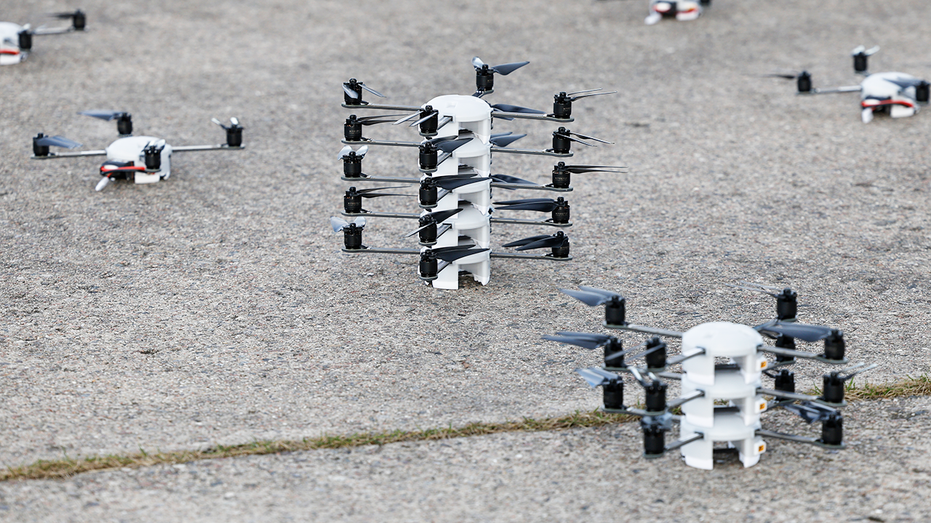
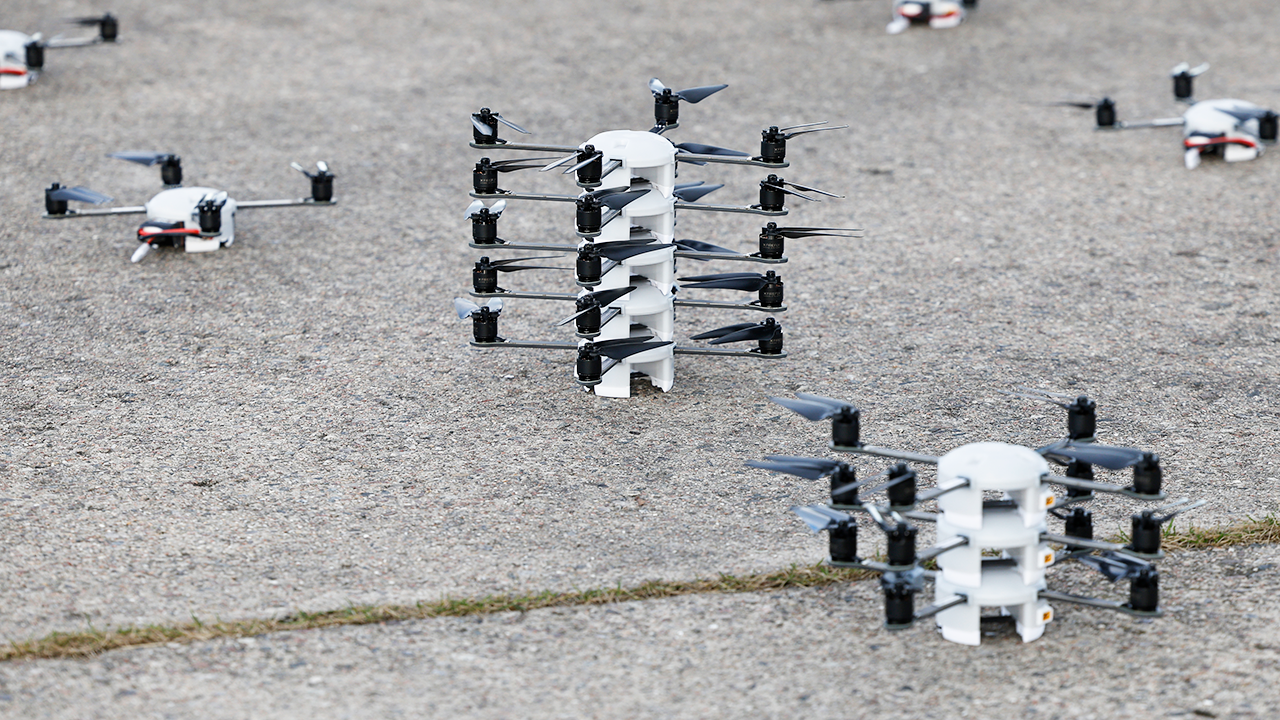
Defense Swarm Technologies’ drones on pavement ready to take flight during the day. (Getty Images)
TRUMP SIGNS ORDER TO BLOCK DEFENSE COMPANIES FROM BUYING BACK STOCK UNTIL ARMS PRODUCTION IMPROVES
Beyond manufacturing, the training component remains a major focus. Saberi described the experience as intense and highly coordinated, designed to prepare troops for the sights, sounds, and physical stressors of future combat scenarios involving autonomous systems.
As global threats evolve, small factories in places like Auburn Hills are becoming essential to America’s defense strategy — quiet workshops where the next generation of warfare is being shaped, one American-built drone at a time.
FOX Business’ Kelly Saberi joins ‘Varney & Co’ to report on how Midwest drone startups are training US troops for the future of warfare amid growing competition from China.
In an unassuming town outside Detroit, a small American startup is quietly preparing U.S. troops for the next era of warfare — where battles won’t be fought by soldiers, but by swarms of machines.
Swarm Defense originally built its business around large-scale drone light shows but has since pivoted into military applications. Today, the same coordination and precision once used for entertainment are being applied to help replicate one of the most complex threats facing modern soldiers: coordinated drone-swarm attacks.
Rep. Rick Crawford, R-Ark., discusses the Trump administration’s ban on foreign-made drones, concerns over Chinese spying and more on ‘Mornings with Maria.’
FOX Business’ Kelly Saberi reported on “Varney & Co.” that Swarm Defense’s technology allows thousands of drones to be launched simultaneously. The system is designed to approximate what it feels like for soldiers to face a coordinated drone swarm in realistic combat scenarios.
The company’s simulation platform utilizes custom-built software that enables each drone to share data and react in real time, similar to how a flock of birds moves in concert. This level of coordination is what makes drone swarms difficult to counter, highlighting the importance of realistic training for U.S. forces facing increasingly autonomous threats.
Recent conflicts, such as Russia’s invasion of Ukraine, have underscored the rapid weaponization of drones and the widespread use of inexpensive foreign-made systems on battlefields. Saberi noted that many troops abroad have operated drones manufactured by Chinese companies, raising concerns about supply-chain vulnerabilities and national security. This situation emphasizes the need for strict compliance with federal regulations, such as those outlined in the National Defense Authorization Act, governing the sourcing of U.S. defense technology.
Anduril founder Palmer Luckey addresses the capture of former Venezuelan President Nicolas Maduro, being sanctioned by China over arms sales to Taiwan and more on ‘The Claman Countdown.’
The Department of Defense and other federal agencies have long sought to restrict purchases of drones with Chinese components due to security concerns, including potential data-transfer risks associated with foreign infrastructure. In late 2025, the Federal Communications Commission added Chinese drone makers DJI and Autel, along with foreign-made drones and components, to a list of equipment posing “unacceptable risks” to U.S. national security. This effectively barred the approval of new models for import or sale without a defense agency determination, following broader congressional scrutiny aimed at reducing reliance on foreign suppliers.
Industry experts highlight that China remains the dominant global drone manufacturer, producing far more units annually than U.S. companies. This gap has put firms like Swarm Defense in the spotlight as Washington seeks to rebuild domestic drone capabilities and reduce reliance on foreign technology.
CEO Kyle Dorosz emphasized the urgency of scaling American production, stating, “We have a tall task ahead of us to… continue supplying drones without the dependency on foreign nations. We need to be ready to scale, we need to be ready to react, and we need to be ready to support American drone dominance.”
Defense Swarm Technologies’ drones on pavement ready to take flight during the day. (Getty Images)
TRUMP SIGNS ORDER TO BLOCK DEFENSE COMPANIES FROM BUYING BACK STOCK UNTIL ARMS PRODUCTION IMPROVES
Beyond manufacturing, the training component remains a major focus. Saberi described the experience as intense and highly coordinated, designed to prepare troops for the sights, sounds, and physical stressors of future combat scenarios involving autonomous systems.
As global threats evolve, small factories in places like Auburn Hills are becoming essential to America’s defense strategy — quiet workshops where the next generation of warfare is being shaped, one American-built drone at a time.