Supreme Court Considers FCC Authority to Impose Fines in Latest Regulatory Showdown
The US Supreme Court is set to review a significant case that could challenge the Federal Communications Commission’s (FCC) authority to impose financial penalties, potentially reshaping the power dynamics between federal regulators and corporations.
On Friday, the justices announced they would hear arguments from AT&T Inc. and Verizon Communications Inc., who claim their constitutional right to a jury trial was violated when the FCC fined them over $40 million each for alleged breaches of customer privacy.
This case presents an opportunity for the six-justice conservative majority to build on a 2024 ruling that limited the ability of federal agencies to impose fines without judicial oversight. That decision previously curtailed the Securities and Exchange Commission’s (SEC) use of in-house administrative law judges for handling fraud cases.
The Trump administration is backing the FCC’s adjudication system, asserting that it provides sufficient avenues for companies and individuals to contest penalties before they are enforced. The administration is appealing a ruling from the 5th US Circuit Court of Appeals, which deemed the FCC’s rules unconstitutional in the context of AT&T. Notably, two other appellate courts have sided with the FCC in similar cases.
US Solicitor General D. John Sauer, the administration’s chief lawyer for the Supreme Court, argued that the 5th Circuit’s ruling undermines one of the FCC’s key regulatory tools and significantly hampers the agency’s ability to enforce federal communications laws.
The dispute arises from allegations that major wireless carriers, including AT&T and Verizon, improperly shared access to customer location data and failed to implement adequate safeguards against unauthorized disclosures. In 2024, the FCC imposed fines of $57 million on AT&T, $47 million on Verizon, and $92 million on T-Mobile US Inc., which included a $12 million penalty against Sprint Corp., acquired by T-Mobile during the investigation.
Courts Divided
Both AT&T and Verizon have urged the Supreme Court to review the case, seeking to overturn the existing system. AT&T highlighted that conflicting decisions among appellate courts have created uncertainty regarding the legal status of FCC forfeiture orders that impose substantial civil penalties.
The 1934 Communications Act provides two avenues for contesting FCC-imposed fines through administrative proceedings. Companies can either pay the penalty and seek a review in a federal appeals court or allow the Justice Department to sue for collection in federal district court, where the right to a jury trial is guaranteed.
In a unanimous 3-0 decision regarding the AT&T case, the 5th Circuit rejected the FCC’s argument that the latter option fulfills the Seventh Amendment’s jury trial requirement. Judge Stuart Kyle Duncan stated, “The commission cites no authority supporting the proposition that the constitutional guarantee of a jury trial is honored by a trial occurring after an agency has already found the facts, interpreted the law, adjudged guilt, and levied punishment.”
Conversely, the New York-based 2nd Circuit disagreed in the Verizon case, asserting that no fine can be enforced without a jury trial. Judge Alison Nathan noted, “An FCC order does not, by itself, compel payment. The government needs to initiate a collection action to do that.”
Verizon has emphasized that companies can face “serious practical and reputational harms” even before any payment is enforced, as federal law allows the Justice Department five years to decide on pursuing a collection suit.
The Supreme Court is expected to hear arguments in April, with a ruling anticipated by July.
The cases are Federal Communications Commission v. AT&T, 25-406, and Verizon v. Federal Communications Commission, 25-567.
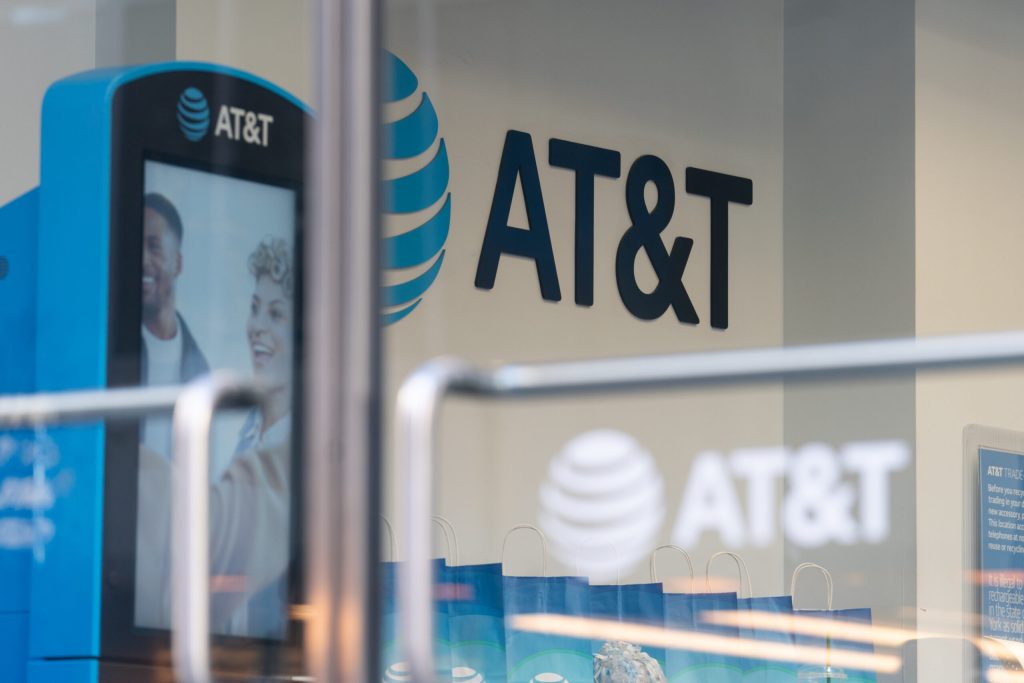
Photo: An AT&T store in New York. Photographer: Jeenah Moon/Bloomberg
Copyright 2026 Bloomberg.
Topics
Legislation
Interested in Legislation?
Get automatic alerts for this topic.
The US Supreme Court is set to review a significant case that could challenge the Federal Communications Commission’s (FCC) authority to impose financial penalties, potentially reshaping the power dynamics between federal regulators and corporations.
On Friday, the justices announced they would hear arguments from AT&T Inc. and Verizon Communications Inc., who claim their constitutional right to a jury trial was violated when the FCC fined them over $40 million each for alleged breaches of customer privacy.
This case presents an opportunity for the six-justice conservative majority to build on a 2024 ruling that limited the ability of federal agencies to impose fines without judicial oversight. That decision previously curtailed the Securities and Exchange Commission’s (SEC) use of in-house administrative law judges for handling fraud cases.
The Trump administration is backing the FCC’s adjudication system, asserting that it provides sufficient avenues for companies and individuals to contest penalties before they are enforced. The administration is appealing a ruling from the 5th US Circuit Court of Appeals, which deemed the FCC’s rules unconstitutional in the context of AT&T. Notably, two other appellate courts have sided with the FCC in similar cases.
US Solicitor General D. John Sauer, the administration’s chief lawyer for the Supreme Court, argued that the 5th Circuit’s ruling undermines one of the FCC’s key regulatory tools and significantly hampers the agency’s ability to enforce federal communications laws.
The dispute arises from allegations that major wireless carriers, including AT&T and Verizon, improperly shared access to customer location data and failed to implement adequate safeguards against unauthorized disclosures. In 2024, the FCC imposed fines of $57 million on AT&T, $47 million on Verizon, and $92 million on T-Mobile US Inc., which included a $12 million penalty against Sprint Corp., acquired by T-Mobile during the investigation.
Courts Divided
Both AT&T and Verizon have urged the Supreme Court to review the case, seeking to overturn the existing system. AT&T highlighted that conflicting decisions among appellate courts have created uncertainty regarding the legal status of FCC forfeiture orders that impose substantial civil penalties.
The 1934 Communications Act provides two avenues for contesting FCC-imposed fines through administrative proceedings. Companies can either pay the penalty and seek a review in a federal appeals court or allow the Justice Department to sue for collection in federal district court, where the right to a jury trial is guaranteed.
In a unanimous 3-0 decision regarding the AT&T case, the 5th Circuit rejected the FCC’s argument that the latter option fulfills the Seventh Amendment’s jury trial requirement. Judge Stuart Kyle Duncan stated, “The commission cites no authority supporting the proposition that the constitutional guarantee of a jury trial is honored by a trial occurring after an agency has already found the facts, interpreted the law, adjudged guilt, and levied punishment.”
Conversely, the New York-based 2nd Circuit disagreed in the Verizon case, asserting that no fine can be enforced without a jury trial. Judge Alison Nathan noted, “An FCC order does not, by itself, compel payment. The government needs to initiate a collection action to do that.”
Verizon has emphasized that companies can face “serious practical and reputational harms” even before any payment is enforced, as federal law allows the Justice Department five years to decide on pursuing a collection suit.
The Supreme Court is expected to hear arguments in April, with a ruling anticipated by July.
The cases are Federal Communications Commission v. AT&T, 25-406, and Verizon v. Federal Communications Commission, 25-567.
Photo: An AT&T store in New York. Photographer: Jeenah Moon/Bloomberg
Copyright 2026 Bloomberg.
Topics
Legislation
Interested in Legislation?
Get automatic alerts for this topic.