Munich Re Report: $108 Billion in Insured Losses Driven by Wildfires and Storms in 2025
In a recent report, Munich Re revealed that insured losses from natural disasters in 2025 reached an estimated $107 billion. This figure is notably lower than the inflation-adjusted $147 billion recorded in 2024, a year marked by significant hurricane activity on the U.S. mainland, which experienced no hurricanes for the first time in a decade.
Munich Re’s total estimate slightly surpasses that of Swiss Re, which reported $107 billion in December. The primary drivers of these insured losses were floods, wildfires, and severe storms, which collectively accounted for a staggering $98 billion. This amount significantly exceeds the inflation-adjusted average of $60 billion over the past decade, highlighting a concerning trend in extreme weather events.
“The year got off to a rough start, with very high losses caused by the wildfires in Los Angeles,” stated Thomas Blunck, a member of Munich Re’s management board. He emphasized that while the U.S. was fortunate to avoid hurricane landfalls in 2025, it still leads the world in loss statistics.
The most significant insured disaster of 2025 was the Los Angeles wildfires, followed closely by severe thunderstorms that affected central and southern U.S. states in March. These events underscore the increasing frequency and intensity of natural disasters, a trend that experts attribute to climate change.
“A warming world makes extreme weather disasters more likely,” noted Tobias Grimm, Munich Re’s chief climate scientist. The European Environment Agency reported that the global mean temperature between 2015 and 2024 was 1.24 to 1.28°C warmer than pre-industrial levels, marking it as the warmest decade on record.
Despite the alarming figures, total losses from natural catastrophes—including those not covered by insurance—were reported at $224 billion in 2025. This figure is lower than the 10-year average and represents a significant decrease from the $368 billion recorded in 2024.
Among the notable disasters, a 7.7 magnitude earthquake in Myanmar in March ranked as the second most expensive disaster in terms of overall losses for 2025, although only a small portion of these losses were insured.
(Reporting by Christina Amann, writing by Linda Pasquini, editing by Alexander Smith)
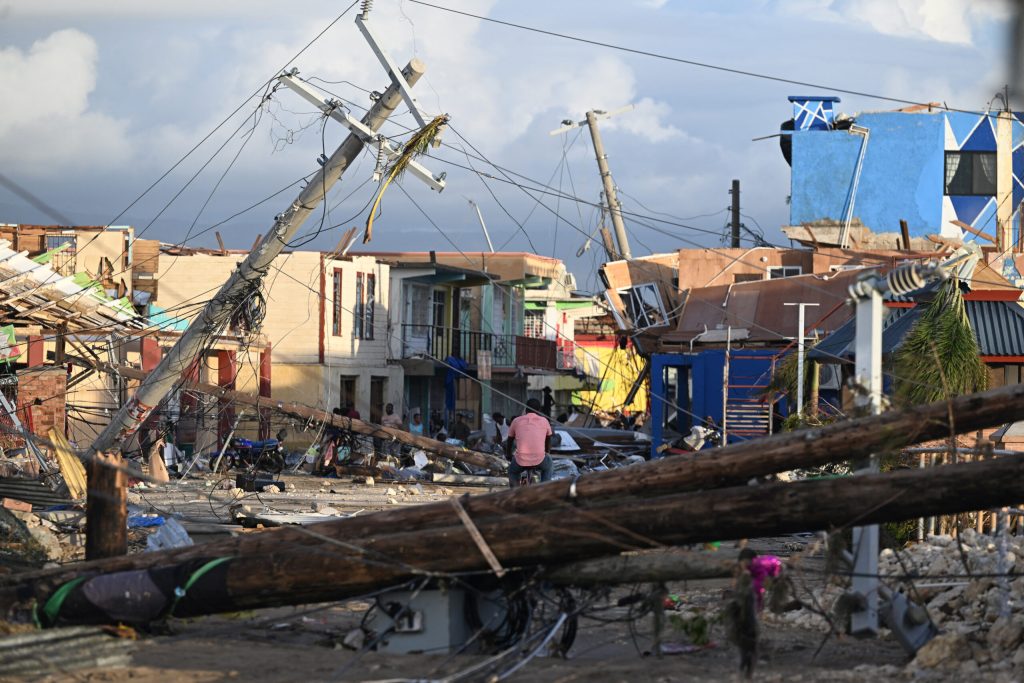
Photograph: Damage from Hurricane Melissa, in Black River, Jamaica; photo credit: Ricardo Makyn/AFP/Getty Images
In a recent report, Munich Re revealed that insured losses from natural disasters in 2025 reached an estimated $107 billion. This figure is notably lower than the inflation-adjusted $147 billion recorded in 2024, a year marked by significant hurricane activity on the U.S. mainland, which experienced no hurricanes for the first time in a decade.
Munich Re’s total estimate slightly surpasses that of Swiss Re, which reported $107 billion in December. The primary drivers of these insured losses were floods, wildfires, and severe storms, which collectively accounted for a staggering $98 billion. This amount significantly exceeds the inflation-adjusted average of $60 billion over the past decade, highlighting a concerning trend in extreme weather events.
“The year got off to a rough start, with very high losses caused by the wildfires in Los Angeles,” stated Thomas Blunck, a member of Munich Re’s management board. He emphasized that while the U.S. was fortunate to avoid hurricane landfalls in 2025, it still leads the world in loss statistics.
The most significant insured disaster of 2025 was the Los Angeles wildfires, followed closely by severe thunderstorms that affected central and southern U.S. states in March. These events underscore the increasing frequency and intensity of natural disasters, a trend that experts attribute to climate change.
“A warming world makes extreme weather disasters more likely,” noted Tobias Grimm, Munich Re’s chief climate scientist. The European Environment Agency reported that the global mean temperature between 2015 and 2024 was 1.24 to 1.28°C warmer than pre-industrial levels, marking it as the warmest decade on record.
Despite the alarming figures, total losses from natural catastrophes—including those not covered by insurance—were reported at $224 billion in 2025. This figure is lower than the 10-year average and represents a significant decrease from the $368 billion recorded in 2024.
Among the notable disasters, a 7.7 magnitude earthquake in Myanmar in March ranked as the second most expensive disaster in terms of overall losses for 2025, although only a small portion of these losses were insured.
(Reporting by Christina Amann, writing by Linda Pasquini, editing by Alexander Smith)
Photograph: Damage from Hurricane Melissa, in Black River, Jamaica; photo credit: Ricardo Makyn/AFP/Getty Images