EU Scientists Confirm 2025 as the Third-Hottest Year Recorded Globally
In 2025, the planet recorded its third-warmest year ever, with average temperatures surpassing 1.5 degrees Celsius of global warming for the longest stretch since records began, according to EU scientists. This alarming trend highlights the urgent need for climate action.
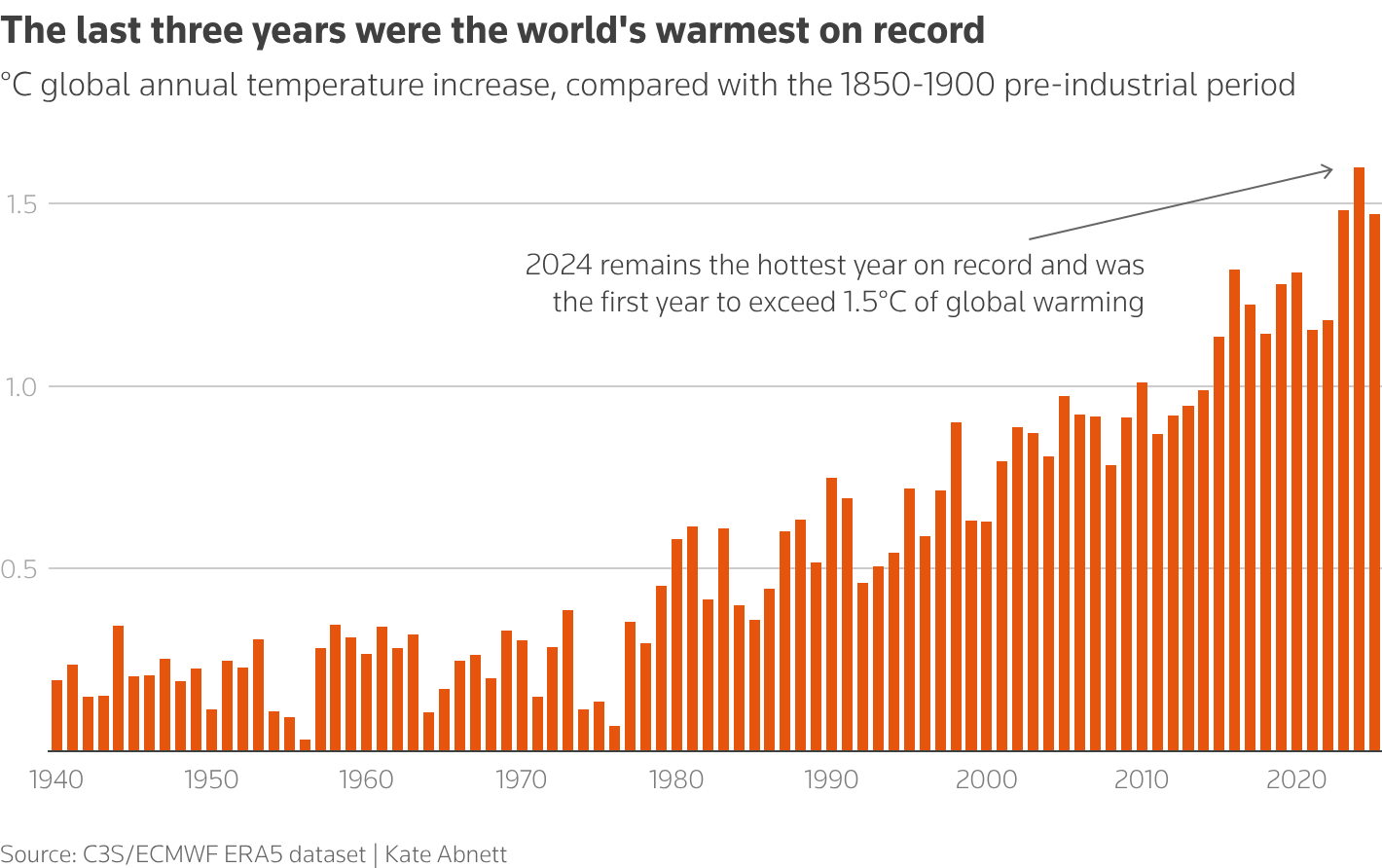
The European Centre for Medium-Range Weather Forecasts (ECMWF) reported that the last three years have been the hottest on record, with 2025 being only marginally cooler than 2023, by a mere 0.01°C. The UK Met Office corroborated this data, confirming that 2025 ranks as the third-warmest year since 1850. The World Meteorological Organization is expected to release its own temperature data later today.
The hottest year recorded was 2024, setting a concerning precedent for future climate patterns.
Extreme Weather Events
According to ECMWF, the planet has now experienced its first three-year period where the average global temperature exceeded 1.5°C above pre-industrial levels. This threshold is critical, as scientists warn that surpassing it could trigger severe and potentially irreversible impacts on the environment.
“1.5°C is not a cliff edge. However, we know that every fraction of a degree matters, particularly for worsening extreme weather events,” stated Samantha Burgess, strategic lead for climate at ECMWF.
Governments worldwide committed to limiting global warming to 1.5°C under the 2015 Paris Agreement. However, the failure to significantly reduce greenhouse gas emissions raises concerns that this limit could be breached as early as 2030—ten years sooner than initially anticipated.
“We are bound to pass it,” remarked Carlo Buontempo, director of the EU’s Copernicus Climate Change Service. “The choice we now have is how to best manage the inevitable overshoot and its consequences on societies and natural systems.”
Political Pushback
Currently, the long-term global warming level stands at approximately 1.4°C above pre-industrial levels. On a short-term basis, the world already exceeded 1.5°C in 2024. Surpassing this long-term limit, even temporarily, could lead to more extreme weather events, including prolonged heatwaves and intensified storms and floods.
Read more: Wildfires, Storms Fuel 2025 Insured Losses of $108 Billion: Munich Re Report
In 2025, wildfires in Europe generated the highest total emissions on record. Scientific studies have confirmed that specific weather events, such as Hurricane Melissa in the Caribbean and devastating monsoon rains in Pakistan, were exacerbated by climate change, resulting in over 1,000 fatalities from flooding.
Despite the escalating impacts of climate change, political resistance is growing. U.S. President Donald Trump, who has previously labeled climate change as “the greatest con job,” recently withdrew from numerous U.N. entities, including the scientific Intergovernmental Panel on Climate Change.
The scientific consensus remains clear: climate change is real, predominantly driven by human activities, and is worsening. The primary culprit is greenhouse gas emissions from burning fossil fuels like coal, oil, and gas, which trap heat in the atmosphere.
(Reporting by Kate Abnett; additional reporting by William James and Emma Farge; editing by Alison Williams)
In 2025, the planet recorded its third-warmest year ever, with average temperatures surpassing 1.5 degrees Celsius of global warming for the longest stretch since records began, according to EU scientists. This alarming trend highlights the urgent need for climate action.
The European Centre for Medium-Range Weather Forecasts (ECMWF) reported that the last three years have been the hottest on record, with 2025 being only marginally cooler than 2023, by a mere 0.01°C. The UK Met Office corroborated this data, confirming that 2025 ranks as the third-warmest year since 1850. The World Meteorological Organization is expected to release its own temperature data later today.
The hottest year recorded was 2024, setting a concerning precedent for future climate patterns.
Extreme Weather Events
According to ECMWF, the planet has now experienced its first three-year period where the average global temperature exceeded 1.5°C above pre-industrial levels. This threshold is critical, as scientists warn that surpassing it could trigger severe and potentially irreversible impacts on the environment.
“1.5°C is not a cliff edge. However, we know that every fraction of a degree matters, particularly for worsening extreme weather events,” stated Samantha Burgess, strategic lead for climate at ECMWF.
Governments worldwide committed to limiting global warming to 1.5°C under the 2015 Paris Agreement. However, the failure to significantly reduce greenhouse gas emissions raises concerns that this limit could be breached as early as 2030—ten years sooner than initially anticipated.
“We are bound to pass it,” remarked Carlo Buontempo, director of the EU’s Copernicus Climate Change Service. “The choice we now have is how to best manage the inevitable overshoot and its consequences on societies and natural systems.”
Political Pushback
Currently, the long-term global warming level stands at approximately 1.4°C above pre-industrial levels. On a short-term basis, the world already exceeded 1.5°C in 2024. Surpassing this long-term limit, even temporarily, could lead to more extreme weather events, including prolonged heatwaves and intensified storms and floods.
Read more: Wildfires, Storms Fuel 2025 Insured Losses of $108 Billion: Munich Re Report
In 2025, wildfires in Europe generated the highest total emissions on record. Scientific studies have confirmed that specific weather events, such as Hurricane Melissa in the Caribbean and devastating monsoon rains in Pakistan, were exacerbated by climate change, resulting in over 1,000 fatalities from flooding.
Despite the escalating impacts of climate change, political resistance is growing. U.S. President Donald Trump, who has previously labeled climate change as “the greatest con job,” recently withdrew from numerous U.N. entities, including the scientific Intergovernmental Panel on Climate Change.
The scientific consensus remains clear: climate change is real, predominantly driven by human activities, and is worsening. The primary culprit is greenhouse gas emissions from burning fossil fuels like coal, oil, and gas, which trap heat in the atmosphere.
(Reporting by Kate Abnett; additional reporting by William James and Emma Farge; editing by Alison Williams)