Global Trade and Conflict Concerns Loom Over Davos: WEF Survey Reveals World on the Brink
A global backdrop increasingly threatened by trade disputes and inter-state conflict is how respondents in a World Economic Forum survey envision the landscape in 2026.
The annual poll of 1,300 leaders and experts conducted by the World Economic Forum (WEF) highlights that the crises anticipated in the coming year are likely to stem from either commercial tensions or military confrontations.
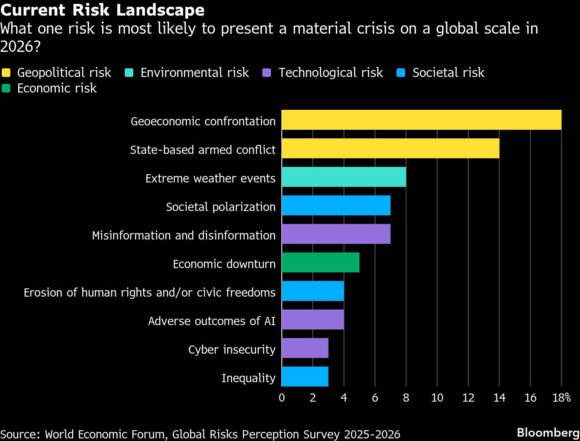
Respondents identified “geoeconomic confrontation” and “state-based armed conflict” as the two most significant risks. These insights were gathered even before US President Donald Trump’s high-stakes trade negotiations with his Chinese counterpart in October, as well as his recent military actions in Venezuela and intentions regarding Greenland.
The perceived dangers resonate with the geopolitical tone of the upcoming gathering in Davos. An unusually large assembly of over 60 heads of state and government—including Trump and several of his Group of Seven peers—may overshadow the usual presence of business leaders.
Last year’s Global Risks Report from the WEF focused heavily on the implications of the Ukraine conflict, while earlier reports highlighted concerns over fake news and inflation.
This year, the assessment reflects the anxieties of decision-makers who are increasingly unsettled by the current U.S. administration’s unpredictable approach to trade and geopolitics, as well as Beijing’s readiness to respond in kind.
“A new competitive order is taking shape,” stated Saadia Zahidi, managing director at the WEF, in her preface to the report. “We are witnessing the turmoil caused by kinetic wars, the deployment of economic weapons for strategic advantage, and growing fragmentation across societies.”
Her report characterizes the world as “balancing on a precipice,” with “geopolitical and geoeconomic” risks at the forefront. This analysis is based on a survey of global leaders and experts from various sectors, conducted between August 12 and September 22.
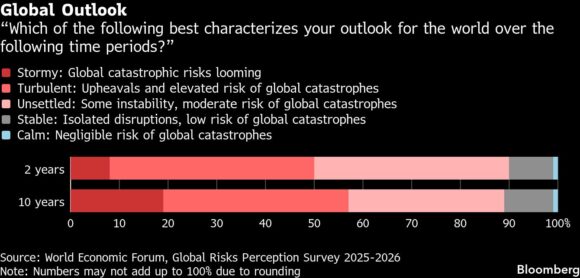
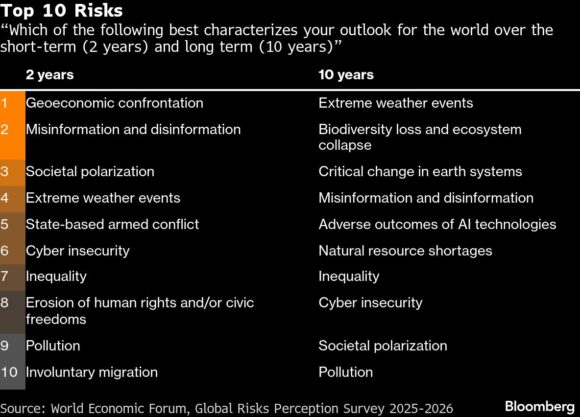
Half of the respondents expect a “stormy” or “turbulent” outlook over the next two years, a significant increase from the previous year’s report. This figure rises to 57% when considering a decade-long perspective, although this represents an improvement from last time.
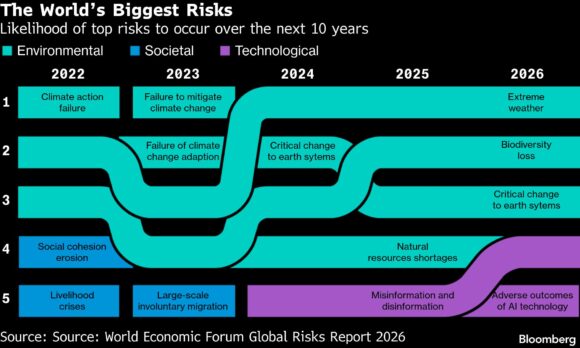
The most notable decline in perception regarding a two-year outlook was observed in the “economic risks” category. Concerns about a potential downturn, inflation, and the risk of bursting asset bubbles have all intensified.
The key figure in much of the report’s narrative will be a star attraction at the upcoming event. Trump is scheduled to speak in Davos at 2:30 p.m. local time on Wednesday, accompanied by U.S. Treasury Secretary Scott Bessent, Secretary of State Marco Rubio, and the largest U.S. delegation ever to attend the forum. Six G-7 leaders are expected to be present, along with Ukrainian President Volodymyr Zelenskiy.
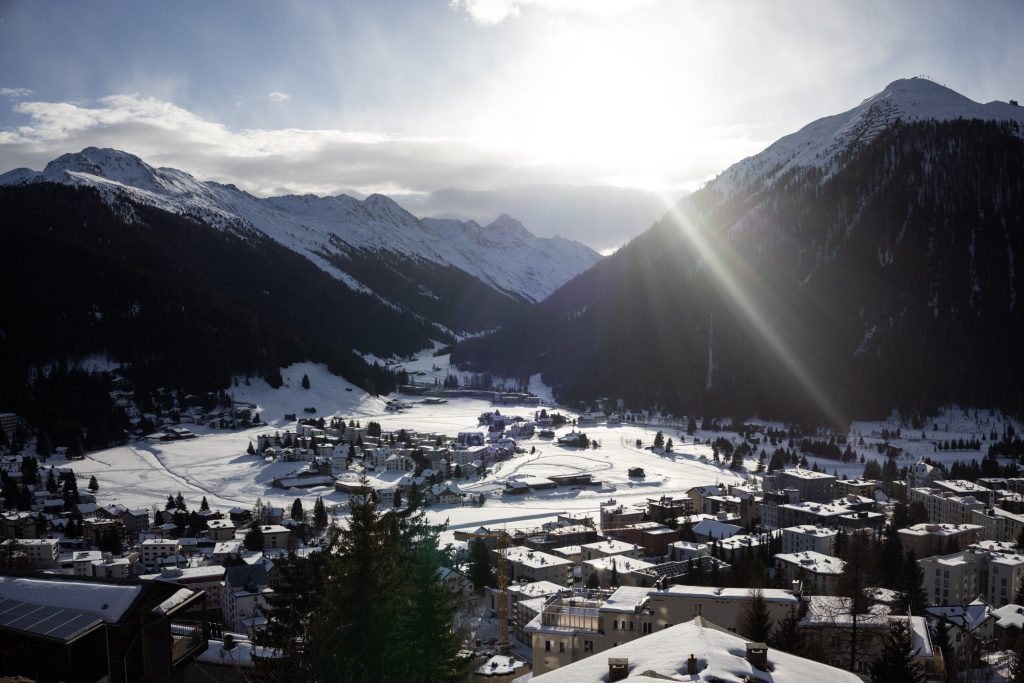
Photograph: Snow-covered residential buildings in Davos, Switzerland; photo credit: Chris Ratcliffe/Bloomberg
Related:
Copyright 2026 Bloomberg.
Topics
Trends
Interested in Trends?
Get automatic alerts for this topic.
A global backdrop increasingly threatened by trade disputes and inter-state conflict is how respondents in a World Economic Forum survey envision the landscape in 2026.
The annual poll of 1,300 leaders and experts conducted by the World Economic Forum (WEF) highlights that the crises anticipated in the coming year are likely to stem from either commercial tensions or military confrontations.
Respondents identified “geoeconomic confrontation” and “state-based armed conflict” as the two most significant risks. These insights were gathered even before US President Donald Trump’s high-stakes trade negotiations with his Chinese counterpart in October, as well as his recent military actions in Venezuela and intentions regarding Greenland.
The perceived dangers resonate with the geopolitical tone of the upcoming gathering in Davos. An unusually large assembly of over 60 heads of state and government—including Trump and several of his Group of Seven peers—may overshadow the usual presence of business leaders.
Last year’s Global Risks Report from the WEF focused heavily on the implications of the Ukraine conflict, while earlier reports highlighted concerns over fake news and inflation.
This year, the assessment reflects the anxieties of decision-makers who are increasingly unsettled by the current U.S. administration’s unpredictable approach to trade and geopolitics, as well as Beijing’s readiness to respond in kind.
“A new competitive order is taking shape,” stated Saadia Zahidi, managing director at the WEF, in her preface to the report. “We are witnessing the turmoil caused by kinetic wars, the deployment of economic weapons for strategic advantage, and growing fragmentation across societies.”
Her report characterizes the world as “balancing on a precipice,” with “geopolitical and geoeconomic” risks at the forefront. This analysis is based on a survey of global leaders and experts from various sectors, conducted between August 12 and September 22.
Half of the respondents expect a “stormy” or “turbulent” outlook over the next two years, a significant increase from the previous year’s report. This figure rises to 57% when considering a decade-long perspective, although this represents an improvement from last time.
The most notable decline in perception regarding a two-year outlook was observed in the “economic risks” category. Concerns about a potential downturn, inflation, and the risk of bursting asset bubbles have all intensified.
The key figure in much of the report’s narrative will be a star attraction at the upcoming event. Trump is scheduled to speak in Davos at 2:30 p.m. local time on Wednesday, accompanied by U.S. Treasury Secretary Scott Bessent, Secretary of State Marco Rubio, and the largest U.S. delegation ever to attend the forum. Six G-7 leaders are expected to be present, along with Ukrainian President Volodymyr Zelenskiy.
Photograph: Snow-covered residential buildings in Davos, Switzerland; photo credit: Chris Ratcliffe/Bloomberg
Related:
Copyright 2026 Bloomberg.
Topics
Trends
Interested in Trends?
Get automatic alerts for this topic.