FAA Finalizes New Airport Regulations Following Army Helicopter and Airliner Collision
The temporary safety rules implemented following last year’s tragic collision between an airliner and an Army helicopter are now being made permanent, as announced by the government on Thursday. This decision aims to enhance safety in the congested airspace surrounding Washington D.C.
In response to the investigation into the January 29 crash, the Federal Aviation Administration (FAA) took immediate action to ensure that helicopters and airplanes would no longer share the same airspace around Reagan National Airport. The new regulations also prohibit air traffic controllers from depending on visual separation and mandate that all military aircraft broadcast their locations.
The National Transportation Safety Board (NTSB) is set to hold a hearing next Tuesday to discuss the factors that contributed to the deadliest plane crash on American soil since 2001. Transportation Secretary Sean Duffy emphasized the administration’s commitment to securing the skies over the nation’s capital, stating, “After that horrific night in January, this administration made a promise to do whatever it takes to secure the skies over our nation’s capital and ensure such a tragedy would never happen again. Today’s announcement reaffirms that commitment.”
The families of the 67 victims, who lost their lives when an Army Black Hawk helicopter collided with an American Airlines jet preparing to land, are hopeful that Duffy and Congress will act on the recommendations expected from the NTSB next week. These recommendations aim to prevent future tragedies.
Matt Collins, who lost his younger brother Chris in the disaster, expressed determination to keep pressure on lawmakers until meaningful changes are made. “I hope to have some hearings done in the Senate and Congress, and I hope results come out of these hearings that they have,” said Collins, a resident of Dighton, Massachusetts. “I hope we’re not just placated and it falls off into the background until another big news story comes up.”
The FAA announced that the new final rule will take effect on Friday. This rule will continue to require military aircraft to broadcast their locations using their ADS-B Out systems, a practice that was often neglected prior to the crash. Additionally, air traffic controllers are now prohibited from relying on pilots to ensure visual separation between aircraft within five miles (eight kilometers) of Reagan airport.
The NTSB has indicated that the Black Hawk helicopter involved in the crash was flying 78 feet (24 meters) above the 200-foot (61-meter) limit on its route and likely had a malfunctioning altimeter. Even if the helicopter had adhered to the altitude limit, the NTSB noted that the route design did not provide sufficient separation to guarantee safety.
Air traffic controllers had previously warned the FAA about the dangers posed by the numerous helicopters in the vicinity of the nation’s capital. Alarmingly, the agency failed to recognize a troubling pattern of 85 near misses in the three years leading up to the crash.
Despite the tragedy, Collins continues to fly for work and leisure, although his parents have not boarded a plane since the incident. “I still think flying is probably the safest mode of transportation, but I think it could be a heck of a lot safer,” he remarked.
Many of the victims were young figure skaters, along with their parents and coaches, who had just attended a development camp in Wichita, Kansas, following the U.S. figure skating championships.
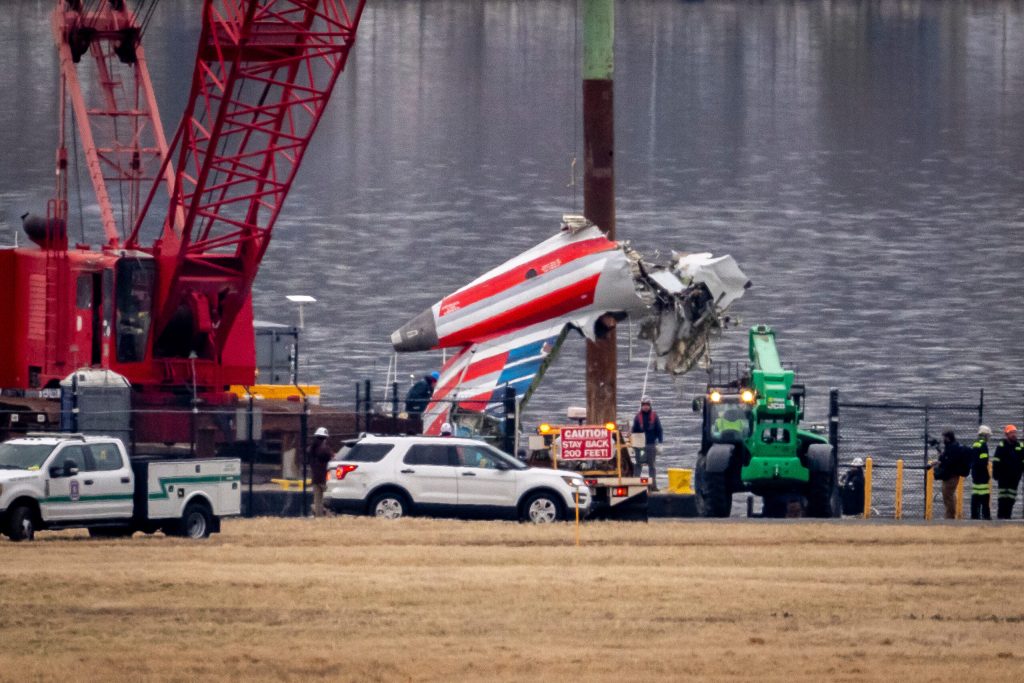
Top Photo: FILE – A crane offloads a piece of wreckage from a salvage vessel onto a flatbed truck, near the wreckage site in the Potomac River of a mid-air collision between an American Airlines jet and a Black Hawk helicopter, at Ronald Reagan Washington National Airport, Feb. 5, 2025, in Arlington, Va. (AP Photo/Ben Curtis, File)
Copyright 2026 Associated Press. All rights reserved. This material may not be published, broadcast, rewritten or redistributed.
Interested in Aerospace?
Get automatic alerts for this topic.
The temporary safety rules implemented following last year’s tragic collision between an airliner and an Army helicopter are now being made permanent, as announced by the government on Thursday. This decision aims to enhance safety in the congested airspace surrounding Washington D.C.
In response to the investigation into the January 29 crash, the Federal Aviation Administration (FAA) took immediate action to ensure that helicopters and airplanes would no longer share the same airspace around Reagan National Airport. The new regulations also prohibit air traffic controllers from depending on visual separation and mandate that all military aircraft broadcast their locations.
The National Transportation Safety Board (NTSB) is set to hold a hearing next Tuesday to discuss the factors that contributed to the deadliest plane crash on American soil since 2001. Transportation Secretary Sean Duffy emphasized the administration’s commitment to securing the skies over the nation’s capital, stating, “After that horrific night in January, this administration made a promise to do whatever it takes to secure the skies over our nation’s capital and ensure such a tragedy would never happen again. Today’s announcement reaffirms that commitment.”
The families of the 67 victims, who lost their lives when an Army Black Hawk helicopter collided with an American Airlines jet preparing to land, are hopeful that Duffy and Congress will act on the recommendations expected from the NTSB next week. These recommendations aim to prevent future tragedies.
Matt Collins, who lost his younger brother Chris in the disaster, expressed determination to keep pressure on lawmakers until meaningful changes are made. “I hope to have some hearings done in the Senate and Congress, and I hope results come out of these hearings that they have,” said Collins, a resident of Dighton, Massachusetts. “I hope we’re not just placated and it falls off into the background until another big news story comes up.”
The FAA announced that the new final rule will take effect on Friday. This rule will continue to require military aircraft to broadcast their locations using their ADS-B Out systems, a practice that was often neglected prior to the crash. Additionally, air traffic controllers are now prohibited from relying on pilots to ensure visual separation between aircraft within five miles (eight kilometers) of Reagan airport.
The NTSB has indicated that the Black Hawk helicopter involved in the crash was flying 78 feet (24 meters) above the 200-foot (61-meter) limit on its route and likely had a malfunctioning altimeter. Even if the helicopter had adhered to the altitude limit, the NTSB noted that the route design did not provide sufficient separation to guarantee safety.
Air traffic controllers had previously warned the FAA about the dangers posed by the numerous helicopters in the vicinity of the nation’s capital. Alarmingly, the agency failed to recognize a troubling pattern of 85 near misses in the three years leading up to the crash.
Despite the tragedy, Collins continues to fly for work and leisure, although his parents have not boarded a plane since the incident. “I still think flying is probably the safest mode of transportation, but I think it could be a heck of a lot safer,” he remarked.
Many of the victims were young figure skaters, along with their parents and coaches, who had just attended a development camp in Wichita, Kansas, following the U.S. figure skating championships.
Top Photo: FILE – A crane offloads a piece of wreckage from a salvage vessel onto a flatbed truck, near the wreckage site in the Potomac River of a mid-air collision between an American Airlines jet and a Black Hawk helicopter, at Ronald Reagan Washington National Airport, Feb. 5, 2025, in Arlington, Va. (AP Photo/Ben Curtis, File)
Copyright 2026 Associated Press. All rights reserved. This material may not be published, broadcast, rewritten or redistributed.
Interested in Aerospace?
Get automatic alerts for this topic.