Post-Storm Freeze Challenges US Power Grids Amid Rising Demand

US power grids are facing an unprecedented challenge as they contend with seasonal demand spikes and the looming threat of blackouts. A recent winter storm has coated parts of the South and Mid-Atlantic in ice, leaving behind brutal cold temperatures that are expected to persist.
Currently, over 800,000 homes and businesses across the nation are without electricity due to the havoc wreaked by snow and ice on local distribution lines. While larger system-level cuts have been avoided so far, the frigid wind chills are likely to test seasonal power-demand records from New England to Texas throughout the week.
The PJM Interconnection grid, which spans from Chicago to Washington, D.C., issued a warning late Sunday, indicating it is preparing for seven consecutive days of extreme demand—an unprecedented situation for PJM. Meanwhile, the Electric Reliability Council of Texas (Ercot) is forecasting record demand of 86 gigawatts on Monday, surpassing the previous high set in August 2023.
In response to the potential supply squeeze, PJM is taking the unusual step of compensating major customers, such as manufacturers, to reduce power usage and help avert rolling blackouts for residential areas. Ercot is implementing similar measures to manage the situation.
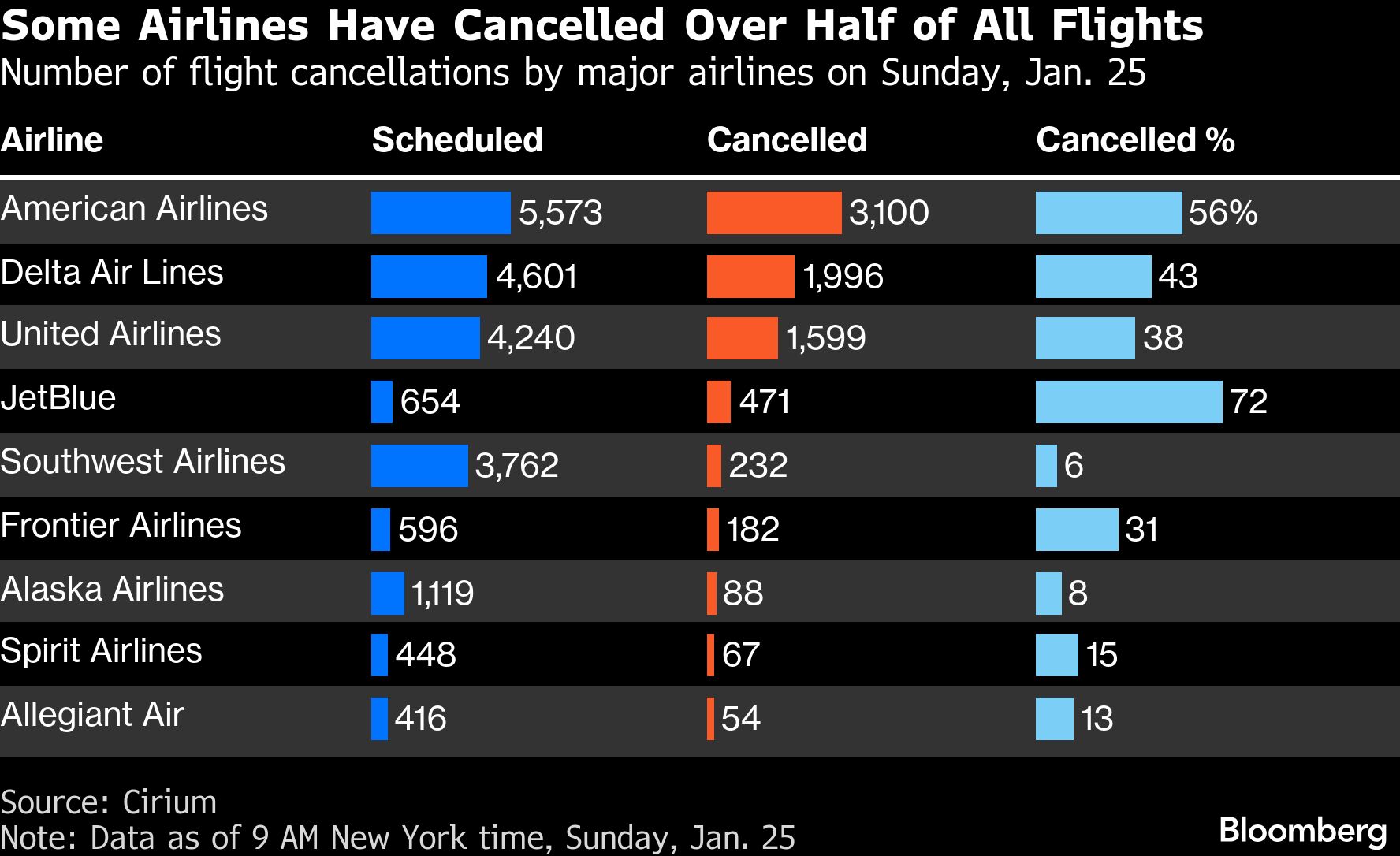
Monday is set to be a significant test for infrastructure and patience across many of the nation’s major population centers. The combination of brutal cold, heavy snowfall, and destructive ice accumulations will disrupt highway, rail, and air travel, affecting public transit systems in New York, New Jersey, and beyond. Airlines are facing a monumental task in untangling the chaos caused by thousands of flight cancellations since the storm began late last week.
The US natural gas benchmark surged by as much as 19%, reaching over $6 per million British thermal units when trading opened late Sunday, a level not seen since 2022.
Dallas is currently under an extreme cold warning until Tuesday, with wind chills expected to plummet to as low as -10°F (-23°C). Overnight lows in Washington, D.C., are projected to struggle to reach 10°F for most of the week, while the upper Midwest is experiencing wind chills around -40°F.
Electricity prices have skyrocketed, prompting grid operators to seek federal waivers from pollution limits to utilize dirtier fuels like diesel and coal. The US government has also requested grid operators to ensure backup power is available from facilities, including data centers.
Utilities are scrambling to recover from widespread outages, with approximately 822,000 homes and businesses in the US without power as of 2:35 a.m. New York time, according to PowerOutage.us. The majority of these outages are concentrated in Tennessee, Mississippi, and Louisiana, regions severely impacted by freezing rain.
The prolonged freeze in the coming days raises the risk of further power outages as the weight of the ice continues to snap tree limbs and power lines. In Mississippi, ice-related outages have knocked some weather stations offline, leaving forecasters and first responders without critical information about conditions.
President Donald Trump has approved emergency aid for a dozen states affected by the storm, enabling federal resources and reimbursement for services such as sheltering and evacuations.
The storm has resulted in thousands of flight cancellations, reminiscent of disruptions not seen since the pandemic. As of late Sunday evening, more than 3,500 weekday flights across the US had already been canceled, according to FlightAware statistics.
In New York City, officials announced that approximately 500,000 public-school students would have remote instruction on Monday due to the ongoing weather conditions.
Day-ahead power prices for Monday in the PJM grid territory have reached their highest levels since the polar vortex of early 2014. In the grids covering New York City and parts of New England, on-peak average prices for Monday also hit all-time highs.
PJM on-peak power for Monday surged to an average of $638.73 per megawatt-hour, according to data compiled by MCG Energy Solutions LLC. In Ercot’s North hub, which includes Dallas, power for Monday’s peak-demand hours skyrocketed by 1,200% from the Sunday average to $516.25 per megawatt-hour, marking the highest level since August 2023.
On Sunday, the Energy Department issued emergency orders authorizing PJM to operate power plants at maximum capacity, including those powered by coal and oil, regardless of environmental regulations. Similar orders were issued for ISO New England and Ercot late Sunday evening to mitigate potential blackouts.
In Texas, the grid is expected to experience tight conditions through Monday, with reports of generation loss and transmission line issues in the San Antonio and Houston areas reported Sunday night. The Energy Department has directed the state’s grid operator to utilize backup diesel generators at data centers during periods of extreme stress.
In the South, northern Mississippi, including the college town of Oxford, is expected to see heavy ice accumulation, with forecasts predicting up to an inch through Monday.
The area is currently facing “an absolute mess of downed trees and power lines due to the added weight of ice,” according to forecasters from the National Weather Service, who also noted widespread power outages. “Roads in these areas are extremely dangerous and at times, impassable.”
Photo: A pedestrian during a winter storm in downtown Pittsburgh on Sunday, Jan. 25, 2026. Photographer: Justin Merriman/Bloomberg
Copyright 2026 Bloomberg.
US power grids are facing an unprecedented challenge as they contend with seasonal demand spikes and the looming threat of blackouts. A recent winter storm has coated parts of the South and Mid-Atlantic in ice, leaving behind brutal cold temperatures that are expected to persist.
Currently, over 800,000 homes and businesses across the nation are without electricity due to the havoc wreaked by snow and ice on local distribution lines. While larger system-level cuts have been avoided so far, the frigid wind chills are likely to test seasonal power-demand records from New England to Texas throughout the week.
The PJM Interconnection grid, which spans from Chicago to Washington, D.C., issued a warning late Sunday, indicating it is preparing for seven consecutive days of extreme demand—an unprecedented situation for PJM. Meanwhile, the Electric Reliability Council of Texas (Ercot) is forecasting record demand of 86 gigawatts on Monday, surpassing the previous high set in August 2023.
In response to the potential supply squeeze, PJM is taking the unusual step of compensating major customers, such as manufacturers, to reduce power usage and help avert rolling blackouts for residential areas. Ercot is implementing similar measures to manage the situation.
Monday is set to be a significant test for infrastructure and patience across many of the nation’s major population centers. The combination of brutal cold, heavy snowfall, and destructive ice accumulations will disrupt highway, rail, and air travel, affecting public transit systems in New York, New Jersey, and beyond. Airlines are facing a monumental task in untangling the chaos caused by thousands of flight cancellations since the storm began late last week.
The US natural gas benchmark surged by as much as 19%, reaching over $6 per million British thermal units when trading opened late Sunday, a level not seen since 2022.
Dallas is currently under an extreme cold warning until Tuesday, with wind chills expected to plummet to as low as -10°F (-23°C). Overnight lows in Washington, D.C., are projected to struggle to reach 10°F for most of the week, while the upper Midwest is experiencing wind chills around -40°F.
Electricity prices have skyrocketed, prompting grid operators to seek federal waivers from pollution limits to utilize dirtier fuels like diesel and coal. The US government has also requested grid operators to ensure backup power is available from facilities, including data centers.
Utilities are scrambling to recover from widespread outages, with approximately 822,000 homes and businesses in the US without power as of 2:35 a.m. New York time, according to PowerOutage.us. The majority of these outages are concentrated in Tennessee, Mississippi, and Louisiana, regions severely impacted by freezing rain.
The prolonged freeze in the coming days raises the risk of further power outages as the weight of the ice continues to snap tree limbs and power lines. In Mississippi, ice-related outages have knocked some weather stations offline, leaving forecasters and first responders without critical information about conditions.
President Donald Trump has approved emergency aid for a dozen states affected by the storm, enabling federal resources and reimbursement for services such as sheltering and evacuations.
The storm has resulted in thousands of flight cancellations, reminiscent of disruptions not seen since the pandemic. As of late Sunday evening, more than 3,500 weekday flights across the US had already been canceled, according to FlightAware statistics.
In New York City, officials announced that approximately 500,000 public-school students would have remote instruction on Monday due to the ongoing weather conditions.
Day-ahead power prices for Monday in the PJM grid territory have reached their highest levels since the polar vortex of early 2014. In the grids covering New York City and parts of New England, on-peak average prices for Monday also hit all-time highs.
PJM on-peak power for Monday surged to an average of $638.73 per megawatt-hour, according to data compiled by MCG Energy Solutions LLC. In Ercot’s North hub, which includes Dallas, power for Monday’s peak-demand hours skyrocketed by 1,200% from the Sunday average to $516.25 per megawatt-hour, marking the highest level since August 2023.
On Sunday, the Energy Department issued emergency orders authorizing PJM to operate power plants at maximum capacity, including those powered by coal and oil, regardless of environmental regulations. Similar orders were issued for ISO New England and Ercot late Sunday evening to mitigate potential blackouts.
In Texas, the grid is expected to experience tight conditions through Monday, with reports of generation loss and transmission line issues in the San Antonio and Houston areas reported Sunday night. The Energy Department has directed the state’s grid operator to utilize backup diesel generators at data centers during periods of extreme stress.
In the South, northern Mississippi, including the college town of Oxford, is expected to see heavy ice accumulation, with forecasts predicting up to an inch through Monday.
The area is currently facing “an absolute mess of downed trees and power lines due to the added weight of ice,” according to forecasters from the National Weather Service, who also noted widespread power outages. “Roads in these areas are extremely dangerous and at times, impassable.”
Photo: A pedestrian during a winter storm in downtown Pittsburgh on Sunday, Jan. 25, 2026. Photographer: Justin Merriman/Bloomberg
Copyright 2026 Bloomberg.