North Sea Wind Surge Prompts Industry Commitment to Invest €9.5 Billion
The offshore wind industry has pledged to invest €9.5 billion ($11.3 billion) in its supply chain by 2030. This initiative aims to expand capacity in the North Sea, transforming it into what German Chancellor Friedrich Merz describes as “the world’s largest clean energy reservoir.”
On Monday, leaders and energy ministers from nine nations, including the UK and Norway, convened in Hamburg to sign a declaration focused on accelerating offshore wind technology. The sector is set to mobilize €1 trillion of capital across Europe, create 91,000 jobs, and reduce power production costs by 30% by 2040, according to the industry group WindEurope.
“We have already built a large number of offshore facilities, and this should continue apace,” Merz stated, emphasizing the importance of safety in the North Sea, especially in light of recent events.
This commitment highlights Europe’s ongoing support for offshore wind technology, despite recent criticisms from US President Donald Trump, who has disparaged European wind initiatives. Germany’s economy minister, Katherina Reiche, referred to the North Sea conference as a “nice answer” to Trump’s remarks made at the World Economic Forum in Davos.
The participating nations aim to jointly develop 100 gigawatts of offshore wind capacity by 2050, aligning with the bloc’s climate-neutrality target. This effort will also enhance protections for energy infrastructure, as reported by Bloomberg News on January 22. The initiative includes wind farms that will be interconnected across multiple countries.
Grid operator Tennet Germany and the UK’s National Grid Plc have agreed to construct an interconnector with a capacity of 3.8 gigawatts, linking offshore wind parks to both nations’ coasts. This project is expected to become operational by the end of the 2030s, pending a final investment decision.
“Today’s investment pact provides reliable perspectives for the offshore sector, secures value creation in Europe, and brings future-proof jobs,” Reiche noted. UK Energy Secretary Ed Miliband added that clean energy could liberate the nation from reliance on fossil fuels, granting energy sovereignty and abundance.
The governments also committed to enhancing their clean power initiatives. While the UK has increased support for offshore wind technology, resulting in a record wind auction earlier this month, Germany’s recent zero-subsidy tender attracted no bidders, raising concerns for future rounds.
“We will adjust the tender design and areas to create a favorable investment framework,” Reiche explained, mentioning that these changes will be accompanied by contracts for difference, which establish a minimum subsidy and an upper cap.
The North Sea summit follows two previous gatherings since 2022, where coastal states outlined plans to install 300 gigawatts of capacity—up from approximately 35 gigawatts currently—responding to the energy crisis exacerbated by Russia’s invasion of Ukraine. The North Atlantic Treaty Organization and the European Commission are also involved, with Iceland participating despite not being a North Sea nation.
Additionally, Berlin and Copenhagen have agreed to invest in an offshore wind development on the Danish island of Bornholm, which will provide power to around 3 million households.
According to climate nonprofit 350.org, oil and gas extraction in the North Sea has contributed to over 9% of historical global greenhouse gas emissions. “Transforming the North Sea into a renewable energy hub would not erase that damage, but it could begin to correct it,” stated Clémence Dubois, the group’s campaign manager.
Closer cooperation among countries may also aid in protecting conservation areas, as noted by Felix Schmidt, policy adviser for WWF Germany. “Currently, biodiversity does not have priority in marine-protected areas in the North Sea, given the numerous economic activities occurring within these zones,” he remarked.
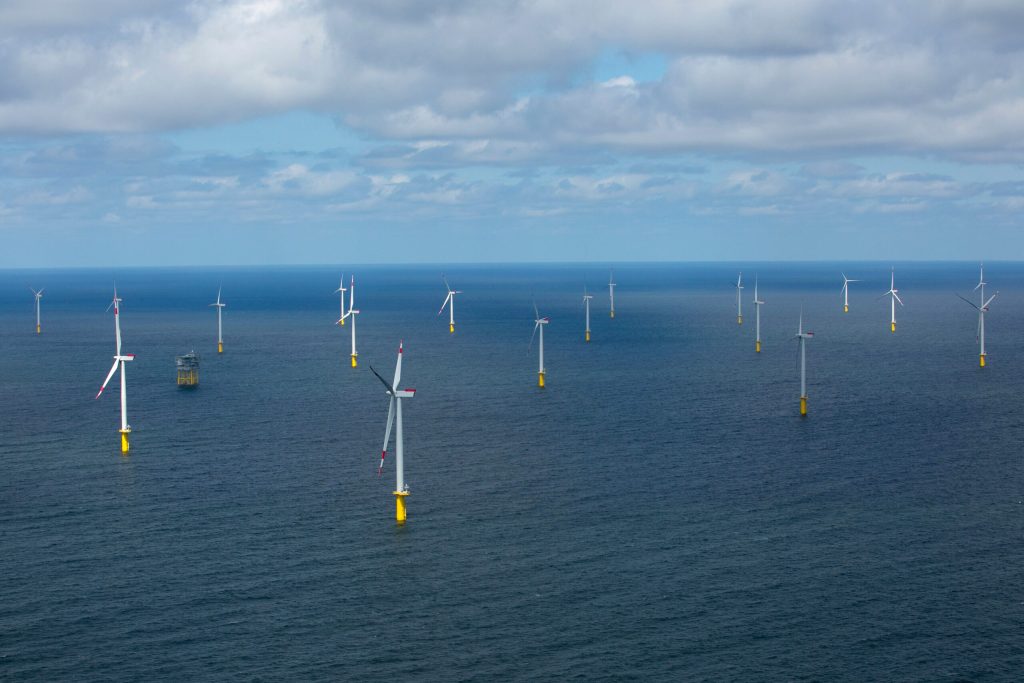
Photograph: Offshore wind turbines. Photo credit: Krisztian Bocsi/Bloomberg
Related:
Copyright 2026 Bloomberg.
The most important insurance news, in your inbox every business day.
Get the insurance industry’s trusted newsletter
The offshore wind industry has pledged to invest €9.5 billion ($11.3 billion) in its supply chain by 2030. This initiative aims to expand capacity in the North Sea, transforming it into what German Chancellor Friedrich Merz describes as “the world’s largest clean energy reservoir.”
On Monday, leaders and energy ministers from nine nations, including the UK and Norway, convened in Hamburg to sign a declaration focused on accelerating offshore wind technology. The sector is set to mobilize €1 trillion of capital across Europe, create 91,000 jobs, and reduce power production costs by 30% by 2040, according to the industry group WindEurope.
“We have already built a large number of offshore facilities, and this should continue apace,” Merz stated, emphasizing the importance of safety in the North Sea, especially in light of recent events.
This commitment highlights Europe’s ongoing support for offshore wind technology, despite recent criticisms from US President Donald Trump, who has disparaged European wind initiatives. Germany’s economy minister, Katherina Reiche, referred to the North Sea conference as a “nice answer” to Trump’s remarks made at the World Economic Forum in Davos.
The participating nations aim to jointly develop 100 gigawatts of offshore wind capacity by 2050, aligning with the bloc’s climate-neutrality target. This effort will also enhance protections for energy infrastructure, as reported by Bloomberg News on January 22. The initiative includes wind farms that will be interconnected across multiple countries.
Grid operator Tennet Germany and the UK’s National Grid Plc have agreed to construct an interconnector with a capacity of 3.8 gigawatts, linking offshore wind parks to both nations’ coasts. This project is expected to become operational by the end of the 2030s, pending a final investment decision.
“Today’s investment pact provides reliable perspectives for the offshore sector, secures value creation in Europe, and brings future-proof jobs,” Reiche noted. UK Energy Secretary Ed Miliband added that clean energy could liberate the nation from reliance on fossil fuels, granting energy sovereignty and abundance.
The governments also committed to enhancing their clean power initiatives. While the UK has increased support for offshore wind technology, resulting in a record wind auction earlier this month, Germany’s recent zero-subsidy tender attracted no bidders, raising concerns for future rounds.
“We will adjust the tender design and areas to create a favorable investment framework,” Reiche explained, mentioning that these changes will be accompanied by contracts for difference, which establish a minimum subsidy and an upper cap.
The North Sea summit follows two previous gatherings since 2022, where coastal states outlined plans to install 300 gigawatts of capacity—up from approximately 35 gigawatts currently—responding to the energy crisis exacerbated by Russia’s invasion of Ukraine. The North Atlantic Treaty Organization and the European Commission are also involved, with Iceland participating despite not being a North Sea nation.
Additionally, Berlin and Copenhagen have agreed to invest in an offshore wind development on the Danish island of Bornholm, which will provide power to around 3 million households.
According to climate nonprofit 350.org, oil and gas extraction in the North Sea has contributed to over 9% of historical global greenhouse gas emissions. “Transforming the North Sea into a renewable energy hub would not erase that damage, but it could begin to correct it,” stated Clémence Dubois, the group’s campaign manager.
Closer cooperation among countries may also aid in protecting conservation areas, as noted by Felix Schmidt, policy adviser for WWF Germany. “Currently, biodiversity does not have priority in marine-protected areas in the North Sea, given the numerous economic activities occurring within these zones,” he remarked.
Photograph: Offshore wind turbines. Photo credit: Krisztian Bocsi/Bloomberg
Related:
Copyright 2026 Bloomberg.
The most important insurance news, in your inbox every business day.
Get the insurance industry’s trusted newsletter