Expert Warns California Billionaire Tax Could Lead to Economic Disaster
FOX Business host Marcus Lemonis discusses billionaires fleeing California to avoid a proposed wealth tax on ‘The Bottom Line.’
A proposed tax targeting California’s wealthiest residents is gaining traction among likely voters. However, critics caution that it could deter investment and lead to an exodus of high-income earners and businesses from the state.
“I think it’s a really economically disastrous idea,” stated Adam Michel, director of tax policy studies at the Cato Institute, in an interview with Fox News Digital. “It is both diagnosing the problem incorrectly and also won’t fix the problem that is being diagnosed.”
The “2026 California Billionaire Tax Act” proposes a one-time tax of 5% on the net worth of individuals earning over $1 billion, as outlined by California’s Legislative Analyst’s Office (LAO). This tax would encompass various assets, including businesses, securities, art, collectibles, and intellectual property.
Notably, the measure excludes real estate owned personally or through a revocable trust. However, properties held through a business entity could still be taxed, as they may enhance the overall value of that business.
TAX FIGHT PUTS CALIFORNIA ON COLLISION COURSE AS BILLIONAIRES LEAVE FOR RED STATES
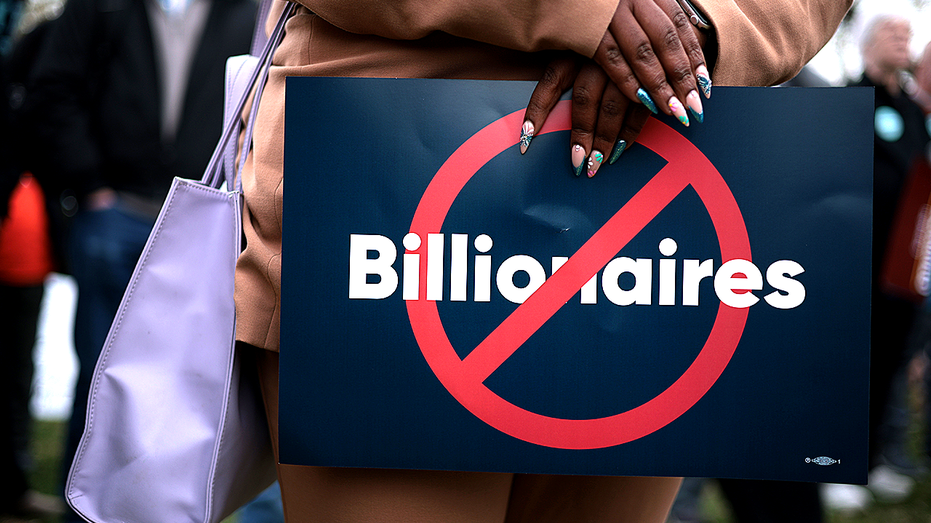
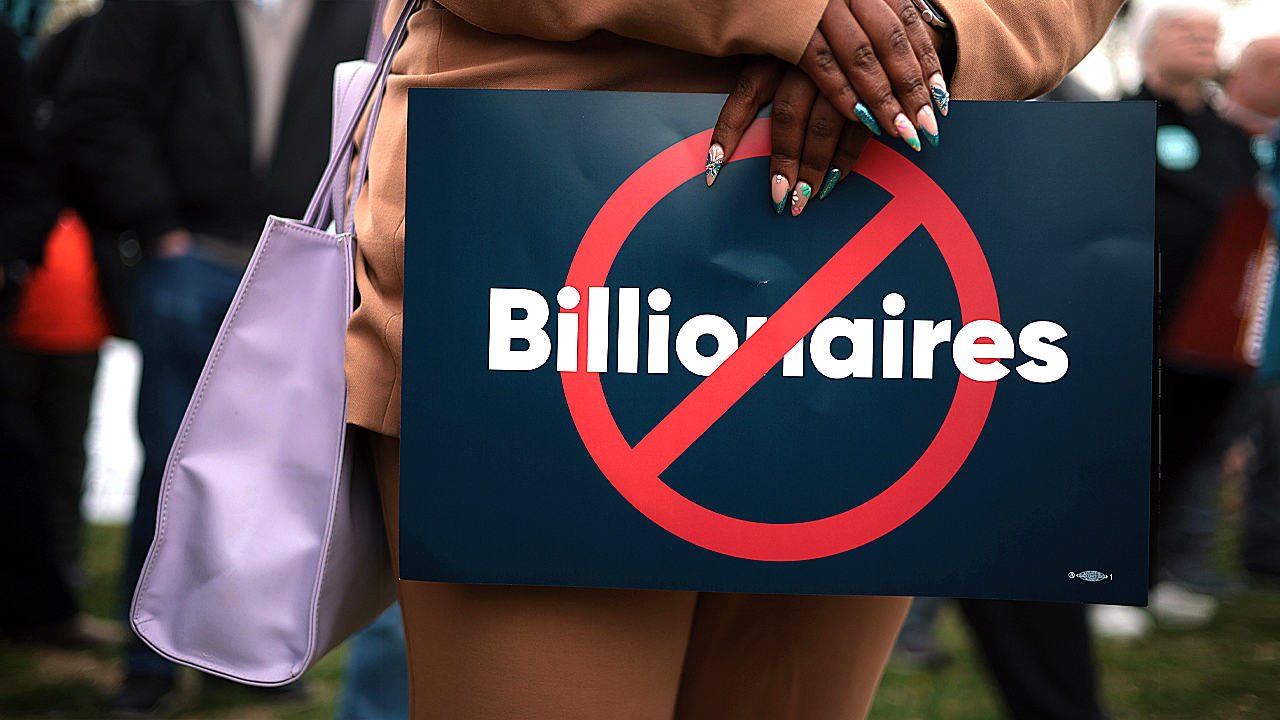
An activist holds a sign during a “Rally to Say No to Tax Breaks for Billionaires and Corporations” at the Upper Senate Park on Capitol Hill on April 10, 2025, in Washington, D.C. (Alex Wong/Getty Images / Getty Images)
Supporters, including SEIU-United Healthcare Workers West (SEIU-UHW), argue that the measure is a necessary response to prevent the collapse of California’s healthcare system due to potential federal funding cuts.
The LAO analysis indicates that “90 percent of the money would have to be spent on health care services for the public,” with the remainder allocated for administrative costs, education, and food assistance.
However, Michel contends that wealth taxes are ineffective, asserting they diminish incentives for business growth, create administrative complexities, and have yielded disappointing revenue in other countries. He argues that these taxes are based on a flawed understanding of the economy, which assumes wealth can be easily redistributed through taxation, ultimately leading to slower growth and negative outcomes for everyone.

Michel says a 5% wealth tax would siphon money from businesses, leaving owners with less to reinvest, expand, and hire. (iStock / iStock)
Michel further explains that a wealth tax differs from an income tax, as it is levied on accumulated assets rather than annual earnings. This can lead to a significantly higher burden on business owners. If a business earns less than a 5% return, every dollar of profit is taxed, effectively resulting in an income tax rate exceeding 100%, which disincentivizes entrepreneurship.
Interestingly, even California Governor Gavin Newsom has expressed concerns about the proposal. Michel noted, “He’s very aware of the fact that this proposal will actually lead to an exodus of the California tax base.”
CALIFORNIA IS BROKE, BUT IT’S NOT TOO LATE FOR THE REST OF US
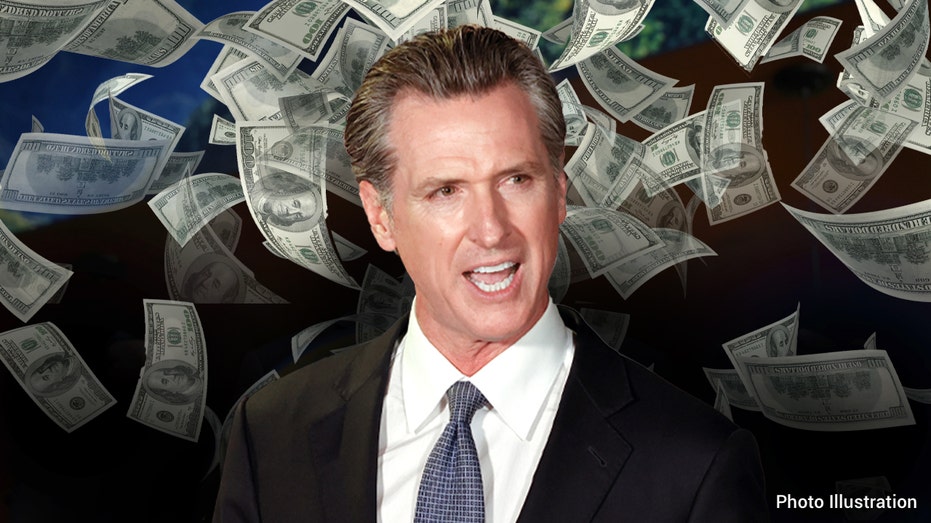
California Governor Gavin Newsom has come out against the 2026 Billionaire Tax Act. (Fred Greaves/Reuters / Reuters Photos)
Michel warns that the impact of the tax would extend beyond the approximately 200 billionaires it targets. Since most wealth is tied up in “productive assets” like stocks, real estate, and machinery, the tax could hinder investments that are crucial for the broader economy. “We will get less housing, less investment in machinery and equipment, and fewer new companies,” he cautioned, emphasizing that this would ultimately harm everyone.
California already boasts the most progressive tax system in the industrialized world, according to the Fraser Institute.
Wealth taxes have been attempted globally and have largely failed, with only a few OECD countries maintaining them since their peak in the 1990s. Michel cited Spain as an example, where a temporary levy became a permanent tax on the wealthy. He warns that California could face a similar fate if the tax is implemented. “States like California have an insatiable hunger for taking other people’s money,” he remarked. “If they’re successful this time, there’s nothing stopping them from renewing this tax in future years.”
CALIFORNIA WILL REGRET BILLIONAIRE EXODUS, WASHINGTON POST WARNS
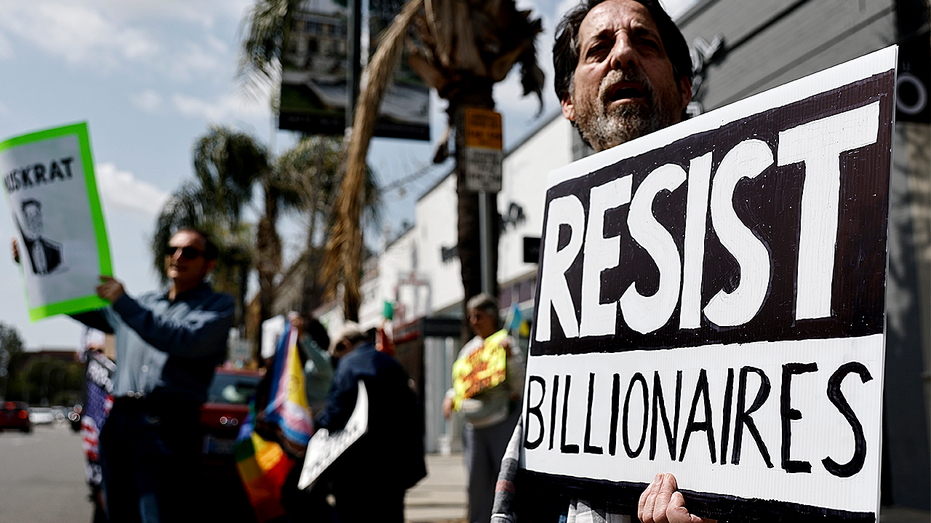
A person holds a ‘Resist Billionaires’ sign as protesters demonstrate against Tesla CEO Elon Musk’s Department of Government Efficiency (DOGE) initiatives during a nationwide “Tesla Takedown” rally outside a Tesla dealership on March 29, 2025, in Pas (Mario Tama/Getty Images)
Michel emphasized that the mere threat of such a tax could prompt high-income residents to leave California. The bill’s sponsors at SEIU-United Healthcare Workers West argue that it aims to ensure billionaires pay their “fair share.” Suzanne Jimenez, chief of staff at SEIU-UHW, stated, “California’s billionaires pay much lower tax rates than working families do out of every paycheck. And soon, massive federal healthcare funding cuts will collapse key parts of the California healthcare system.”
She warned that “local hospitals and emergency rooms will shut their doors forever” unless voters approve the Billionaire Tax, which she describes as a “one-time emergency 5% tax.” CLICK HERE FOR MORE COVERAGE OF MEDIA AND CULTURE
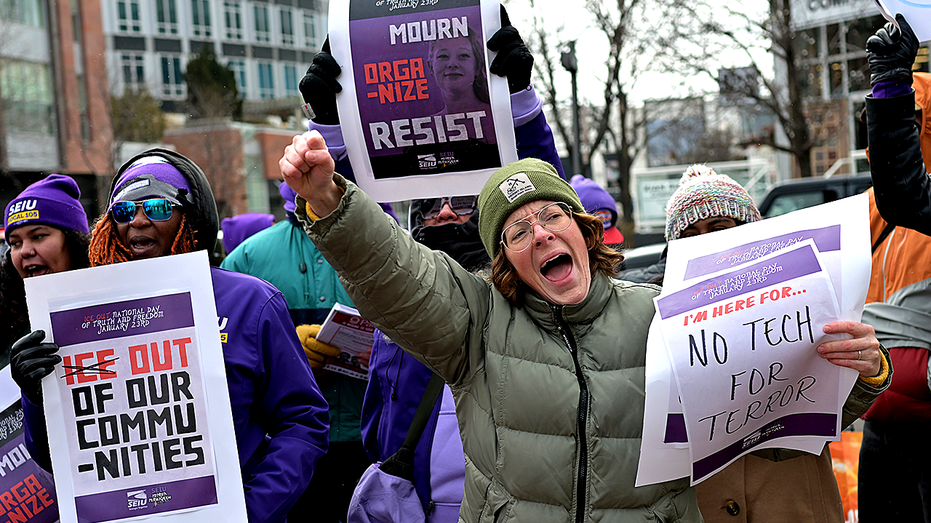
SEIU members protesting ICE on Friday, Jan. 23, 2026. (Hyoung Chang/The Denver Post / Getty Images)
Jimenez dismissed “sensationalized claims” from “a handful of billionaires and their highly-paid consultants” regarding an exodus from California before the January 1, 2026, residency deadline. She noted a lack of public reports or confirmations, asserting that “the overwhelming majority” of the roughly 200 billionaires “appear to have opted to remain.”
She emphasized that nurses, healthcare workers, teachers, and firefighters “pay taxes on nearly every dollar they earn,” arguing that without the measure, “higher healthcare costs and higher taxes will be shifted onto millions of Californians” already facing “skyrocketing healthcare and prescription costs.”
Jimenez framed the debate as a “convenient distraction” while her union’s “120,000 healthcare workers” focus on keeping hospitals and emergency rooms open for California’s 40 million residents.
Even though the proposal is still in the signature-gathering phase to qualify for the November ballot, it has garnered strong support from likely voters. A February 2026 Nestpoint survey revealed that 60% of likely voters back the wealth tax, despite a majority of those respondents acknowledging that the move could lead to a business exodus and job losses.
Fox News’ Kristen Altus contributed to this report.
FOX Business host Marcus Lemonis discusses billionaires fleeing California to avoid a proposed wealth tax on ‘The Bottom Line.’
A proposed tax targeting California’s wealthiest residents is gaining traction among likely voters. However, critics caution that it could deter investment and lead to an exodus of high-income earners and businesses from the state.
“I think it’s a really economically disastrous idea,” stated Adam Michel, director of tax policy studies at the Cato Institute, in an interview with Fox News Digital. “It is both diagnosing the problem incorrectly and also won’t fix the problem that is being diagnosed.”
The “2026 California Billionaire Tax Act” proposes a one-time tax of 5% on the net worth of individuals earning over $1 billion, as outlined by California’s Legislative Analyst’s Office (LAO). This tax would encompass various assets, including businesses, securities, art, collectibles, and intellectual property.
Notably, the measure excludes real estate owned personally or through a revocable trust. However, properties held through a business entity could still be taxed, as they may enhance the overall value of that business.
TAX FIGHT PUTS CALIFORNIA ON COLLISION COURSE AS BILLIONAIRES LEAVE FOR RED STATES
An activist holds a sign during a “Rally to Say No to Tax Breaks for Billionaires and Corporations” at the Upper Senate Park on Capitol Hill on April 10, 2025, in Washington, D.C. (Alex Wong/Getty Images / Getty Images)
Supporters, including SEIU-United Healthcare Workers West (SEIU-UHW), argue that the measure is a necessary response to prevent the collapse of California’s healthcare system due to potential federal funding cuts.
The LAO analysis indicates that “90 percent of the money would have to be spent on health care services for the public,” with the remainder allocated for administrative costs, education, and food assistance.
However, Michel contends that wealth taxes are ineffective, asserting they diminish incentives for business growth, create administrative complexities, and have yielded disappointing revenue in other countries. He argues that these taxes are based on a flawed understanding of the economy, which assumes wealth can be easily redistributed through taxation, ultimately leading to slower growth and negative outcomes for everyone.
Michel says a 5% wealth tax would siphon money from businesses, leaving owners with less to reinvest, expand, and hire. (iStock / iStock)
Michel further explains that a wealth tax differs from an income tax, as it is levied on accumulated assets rather than annual earnings. This can lead to a significantly higher burden on business owners. If a business earns less than a 5% return, every dollar of profit is taxed, effectively resulting in an income tax rate exceeding 100%, which disincentivizes entrepreneurship.
Interestingly, even California Governor Gavin Newsom has expressed concerns about the proposal. Michel noted, “He’s very aware of the fact that this proposal will actually lead to an exodus of the California tax base.”
CALIFORNIA IS BROKE, BUT IT’S NOT TOO LATE FOR THE REST OF US
California Governor Gavin Newsom has come out against the 2026 Billionaire Tax Act. (Fred Greaves/Reuters / Reuters Photos)
Michel warns that the impact of the tax would extend beyond the approximately 200 billionaires it targets. Since most wealth is tied up in “productive assets” like stocks, real estate, and machinery, the tax could hinder investments that are crucial for the broader economy. “We will get less housing, less investment in machinery and equipment, and fewer new companies,” he cautioned, emphasizing that this would ultimately harm everyone.
California already boasts the most progressive tax system in the industrialized world, according to the Fraser Institute.
Wealth taxes have been attempted globally and have largely failed, with only a few OECD countries maintaining them since their peak in the 1990s. Michel cited Spain as an example, where a temporary levy became a permanent tax on the wealthy. He warns that California could face a similar fate if the tax is implemented. “States like California have an insatiable hunger for taking other people’s money,” he remarked. “If they’re successful this time, there’s nothing stopping them from renewing this tax in future years.”
CALIFORNIA WILL REGRET BILLIONAIRE EXODUS, WASHINGTON POST WARNS
A person holds a ‘Resist Billionaires’ sign as protesters demonstrate against Tesla CEO Elon Musk’s Department of Government Efficiency (DOGE) initiatives during a nationwide “Tesla Takedown” rally outside a Tesla dealership on March 29, 2025, in Pas (Mario Tama/Getty Images)
Michel emphasized that the mere threat of such a tax could prompt high-income residents to leave California. The bill’s sponsors at SEIU-United Healthcare Workers West argue that it aims to ensure billionaires pay their “fair share.” Suzanne Jimenez, chief of staff at SEIU-UHW, stated, “California’s billionaires pay much lower tax rates than working families do out of every paycheck. And soon, massive federal healthcare funding cuts will collapse key parts of the California healthcare system.”
She warned that “local hospitals and emergency rooms will shut their doors forever” unless voters approve the Billionaire Tax, which she describes as a “one-time emergency 5% tax.” CLICK HERE FOR MORE COVERAGE OF MEDIA AND CULTURE
SEIU members protesting ICE on Friday, Jan. 23, 2026. (Hyoung Chang/The Denver Post / Getty Images)
Jimenez dismissed “sensationalized claims” from “a handful of billionaires and their highly-paid consultants” regarding an exodus from California before the January 1, 2026, residency deadline. She noted a lack of public reports or confirmations, asserting that “the overwhelming majority” of the roughly 200 billionaires “appear to have opted to remain.”
She emphasized that nurses, healthcare workers, teachers, and firefighters “pay taxes on nearly every dollar they earn,” arguing that without the measure, “higher healthcare costs and higher taxes will be shifted onto millions of Californians” already facing “skyrocketing healthcare and prescription costs.”
Jimenez framed the debate as a “convenient distraction” while her union’s “120,000 healthcare workers” focus on keeping hospitals and emergency rooms open for California’s 40 million residents.
Even though the proposal is still in the signature-gathering phase to qualify for the November ballot, it has garnered strong support from likely voters. A February 2026 Nestpoint survey revealed that 60% of likely voters back the wealth tax, despite a majority of those respondents acknowledging that the move could lead to a business exodus and job losses.
Fox News’ Kristen Altus contributed to this report.