Why Winds Below 110 mph Won’t Harm Concrete Tiles
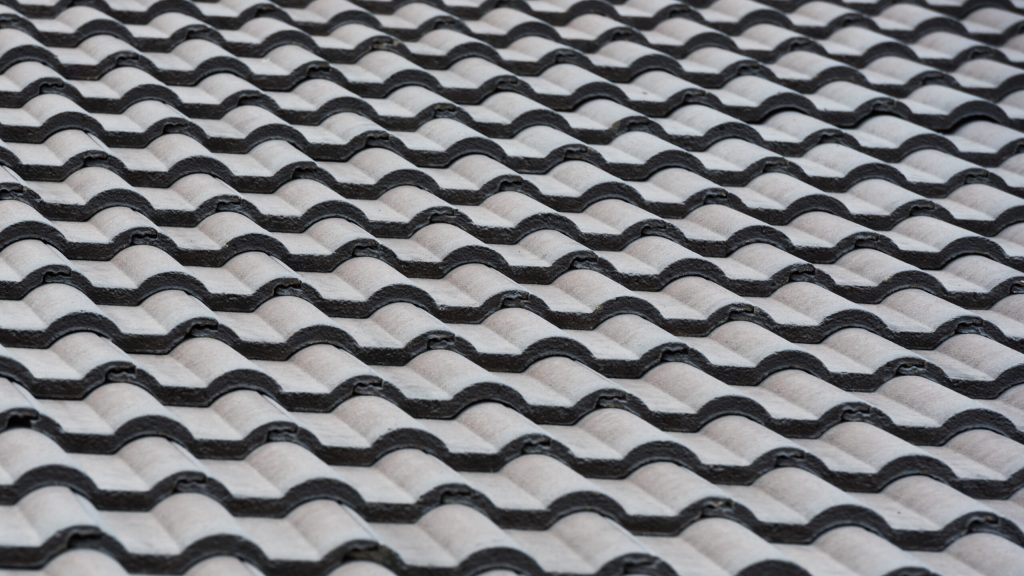
With tile roofs being a common sight across Florida, concerns about roof damage have emerged, particularly regarding questionable claims in insurance and engineering circles. To assist engineers, attorneys, adjusters, and property owners in assessing wind damage to concrete tile roofs, two Florida consulting engineers have provided this comprehensive guide. It aims to clarify the dynamics of wind and its effects, with key points highlighted in boldface type.
Introduction
Buildings act as barriers to wind currents, causing alterations in airflow direction. This redirection leads to varying magnitudes of negative and positive wind pressure on building surfaces. Generally, inward-acting (positive) pressures are found on windward surfaces, while outward-acting (negative) pressures occur on other surfaces (Dalgliesh, 1965). Airflow struggles to navigate sharp discontinuities in building surfaces, such as wall corners and roof ridges, resulting in separation and outward-acting pressures. Consequently, cladding failures often occur first in these areas, followed by damage to unsupported components or loosely fastened structural elements. The American Society of Civil Engineers (ASCE) outlines the evaluation of wind effects on structures in its Minimum Design Loads for Buildings and Other Structures, with the 2010, 2016, and 2022 editions (ASCE 7-10, 7-16, or 7-22) being the most frequently referenced.
Understanding the areas of highest pressures and evaluating concrete roof tiles according to ASCE 7 is crucial. A proper analysis requires a foundational knowledge of wind dynamics, and calculations must be based on approved sources to ensure accuracy.
The shielding effects of nearby buildings, trees, and other ground-level obstructions are well-documented. Research indicates that, except during the most severe windstorms (like hurricanes and tornadoes), most conventionally built structures typically do not suffer significant wind damage to their primary structural systems. Notably, structural performance can vary widely during storm events, even among buildings in close proximity. Factors such as location, orientation to wind direction, and the quality of original construction or repairs play a significant role.

Even during localized severe weather events like tornadoes, the strongest winds are often straight-line winds. In hurricanes, winds are typically straight-line at the site, while larger wind patterns are circular. Therefore, damage evaluation should adhere to the principles outlined above. Seemingly inexplicable wind behavior is rare and can be verified or dismissed through close examination of the damaged structure. If damage occurs to the structural frame, displacement will be evident in the attached finish materials. Typically, substantial damage to exterior cladding precedes damage to interior finishes. Wind damage is not “hidden” or concealed within the structure, only to manifest later.
Type of Damage to Tile Roofs from Storm Forces
Wind forces are typically heightened at sharp discontinuities in building surfaces, such as wall corners and roof eaves. Initial roof tile failures usually occur first along the edges, corners, and ridges, progressing inward as pressure forces increase (Florida Roofing and Sheet Metal Contractors, December 31, 2020). Building codes recognize this behavior, requiring these areas to be designed to resist higher forces than other parts of the building. Enhanced resistance to uplift at eaves and ridges is often achieved through stronger attachment methods, such as mechanical anchorage or additional fastenings. Testing has shown that uplift forces exceeding 230 pounds are needed to dislodge adhesive-set tiles, and over 500 pounds for mortar-set tiles (Mirmiran, 2006).
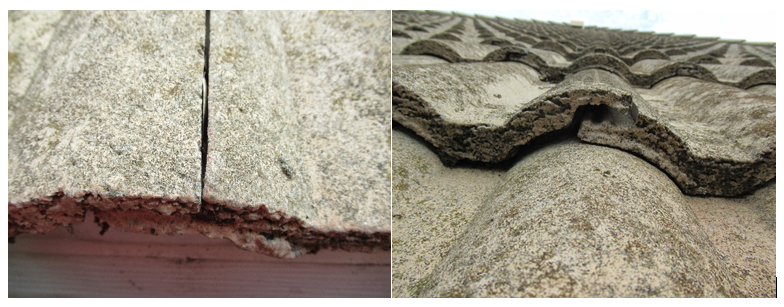
Initial wind-related damage to a tile roof typically results from one of two mechanisms: wind-uplift forces strong enough to overcome the tile’s securement to the roof substrate, or collateral impact damage from wind-borne debris, such as loose tiles or tree limbs. The latter often manifests as shattered tiles or those with a “spider web” crack pattern.
In contrast, damage from footfall is characterized by individual cracks extending horizontally, vertically, or diagonally across the tile. Cracks at the lower corners of tiles are often related to footfall or thermal expansion and contraction between tiles or between tiles and the substrate (Tile Roofing Institute, 1999) (Boral, 2000).
Improper alignment of tiles can lead to point loading, causing irregular pressure on corners and resulting in fractures. This often occurs when tiles are installed too tightly together. Most tiles are designed for a 1/16″ separation between bodies. If this separation is not maintained, foot traffic or thermal expansion can cause damage. Debris left in the channel during installation may also lead to point loading that fractures corners under foot traffic.
Fractured tiles can occur if wind speeds lift a tile without removing it from the roof assembly. Such fracturing typically does not happen at speeds below 100 mph in the field.
A critical aspect of evaluating wind damage to tile roofs is the condition of hip and ridge tiles. Loose or unbonded hip and ridge tiles are at risk of being blown off. These tiles, along with edge tiles, experience the highest wind pressures. If these tiles are loose but not displaced, it indicates that the roof has not experienced a wind event strong enough to remove or damage the field tiles. Checking for loose hip, ridge, and rake tiles that can be easily lifted yet remain in place can help refute claims of wind damage due to tile lifting.
Wind-Speed Pressures
Pressure can fluctuate during an event. It is essential to perform minimum calculations to determine maximum and minimum values on a roof covering. Corners, hips, ridges, gables, and angle changes lead to elevated positive and negative pressures. These key locations can experience high pressures even at low wind speeds, but the impacted areas are typically minimal, often less than 3% of the total roof area. The entire roof is immersed in relatively uniform airflow, and further changes in slope or shape will not significantly affect pressures.
Design Wind Pressure
It is often claimed that low wind speeds can damage concrete tile roofs. Tiles have undergone extensive testing using wind tunnels and calculations. For instance, Miami-Dade testing standards date back to 1994, beginning with wind speeds of 110 mph. Generalized calculations indicate that wind velocities sufficient to generate damaging wind pressures below 110 mph are typically limited to low-slope roofs covered with modified bitumen or shingles. Damage to concrete tiles from uplift or displacement at wind speeds below 110 mph does not occur, and any claims of such damage are unfounded.
The design pressure is calculated after adjusting for obstacles or structures. In essence, wind pressure determines the actual pressure used for design and can vary by location. Design pressure is generally greater than site conditions, which typically will not be exceeded during a normal storm event. Extreme weather events with a once-in-500-year occurrence are not accounted for.
Tile Movement
A common misconception regarding roof damage is that many engineers do not utilize the full calculation for a roof. Concrete tile roofs require a moment calculation to assess lifting potential. Even if uplift exceeds the tile’s weight, it does not guarantee tile movement.
Reviewing standards reveals that uplift must be calculated at the components and cladding areas to obtain reasonable pressure values. Uplift pressure is greater at building corners and along hips and ridges. To determine wind pressure, one must also consider uplift due to air migration under the roof tiles. Calculations require assessing the uplift moment and the restoring moment due to gravity. The difference between these moments will indicate the potential for roof tile movement. If the moment difference is zero or negative, the roof tile will not move.
The gravity moment is also included in approval notices for each roof tile. Identifying a roof tile and knowing the installation year can help locate an approval sheet, providing the gravity moment and saving time on calculations.
Rain Adds Weight to Tiles
Concrete tiles are constructed with minimal water for a dry pack, resulting in a density of 130 pounds per cubic foot (lb/cf), compared to normal concrete at 150 lb/cf. This means concrete tiles have a mass 14% less than standard concrete, leading to voids that can fill with water during storms. Testing has shown that tiles can gain over 9% in weight due to water absorption, increasing the restoring moment due to gravity.
Over time, the bottom corners of tiles can chip, with small broken pieces often found on the roof. This is also true for fractured tiles with multiple sections. Small tile fragments have minimal weight, and if they remain on the roof, it indicates that wind speeds were not high enough to displace them. Chipped corners are not wind-related and are common for tightly placed tiles, thermal stresses, debris in interlocks, and point loads on corners. Manufacturers provide bulletins addressing chipped corners and their causes.
High Winds Will Likely Blow Tiles Off
When uplift forces are strong enough to overcome both the weight of roof tiles and their securement to the substrate, affected tiles are likely to be blown off or displaced from their installed positions. Wind effects may cause some already loose tiles to slide or misalign with adjacent tiles. Wind uplift forces will not lift large numbers of well-attached ridge/hip caps and return them to their original positions. The ability of tiles to be lifted does not indicate damage.
It is crucial to question professional claims of damage at low wind speeds, especially if there are no missing or displaced roof tiles and no supporting documentation. Claims of concrete tile damage from low-speed winds lack support from testing standards, wind tunnel testing, ASCE 7-10 or 7-22, or other mathematical formulas mentioned above.
George Miles is an engineer with Alligator Consulting Engineers, based in Daytona Beach. He has testified and drafted reports for insurance claims litigation. Daniel Frates is senior principal engineer at SDII Global, an engineering firm with offices in Tampa.
Topics
Florida
With tile roofs being a common sight across Florida, concerns about roof damage have emerged, particularly regarding questionable claims in insurance and engineering circles. To assist engineers, attorneys, adjusters, and property owners in assessing wind damage to concrete tile roofs, two Florida consulting engineers have provided this comprehensive guide. It aims to clarify the dynamics of wind and its effects, with key points highlighted in boldface type.
Introduction
Buildings act as barriers to wind currents, causing alterations in airflow direction. This redirection leads to varying magnitudes of negative and positive wind pressure on building surfaces. Generally, inward-acting (positive) pressures are found on windward surfaces, while outward-acting (negative) pressures occur on other surfaces (Dalgliesh, 1965). Airflow struggles to navigate sharp discontinuities in building surfaces, such as wall corners and roof ridges, resulting in separation and outward-acting pressures. Consequently, cladding failures often occur first in these areas, followed by damage to unsupported components or loosely fastened structural elements. The American Society of Civil Engineers (ASCE) outlines the evaluation of wind effects on structures in its Minimum Design Loads for Buildings and Other Structures, with the 2010, 2016, and 2022 editions (ASCE 7-10, 7-16, or 7-22) being the most frequently referenced.
Understanding the areas of highest pressures and evaluating concrete roof tiles according to ASCE 7 is crucial. A proper analysis requires a foundational knowledge of wind dynamics, and calculations must be based on approved sources to ensure accuracy.
The shielding effects of nearby buildings, trees, and other ground-level obstructions are well-documented. Research indicates that, except during the most severe windstorms (like hurricanes and tornadoes), most conventionally built structures typically do not suffer significant wind damage to their primary structural systems. Notably, structural performance can vary widely during storm events, even among buildings in close proximity. Factors such as location, orientation to wind direction, and the quality of original construction or repairs play a significant role.
Even during localized severe weather events like tornadoes, the strongest winds are often straight-line winds. In hurricanes, winds are typically straight-line at the site, while larger wind patterns are circular. Therefore, damage evaluation should adhere to the principles outlined above. Seemingly inexplicable wind behavior is rare and can be verified or dismissed through close examination of the damaged structure. If damage occurs to the structural frame, displacement will be evident in the attached finish materials. Typically, substantial damage to exterior cladding precedes damage to interior finishes. Wind damage is not “hidden” or concealed within the structure, only to manifest later.
Type of Damage to Tile Roofs from Storm Forces
Wind forces are typically heightened at sharp discontinuities in building surfaces, such as wall corners and roof eaves. Initial roof tile failures usually occur first along the edges, corners, and ridges, progressing inward as pressure forces increase (Florida Roofing and Sheet Metal Contractors, December 31, 2020). Building codes recognize this behavior, requiring these areas to be designed to resist higher forces than other parts of the building. Enhanced resistance to uplift at eaves and ridges is often achieved through stronger attachment methods, such as mechanical anchorage or additional fastenings. Testing has shown that uplift forces exceeding 230 pounds are needed to dislodge adhesive-set tiles, and over 500 pounds for mortar-set tiles (Mirmiran, 2006).
Initial wind-related damage to a tile roof typically results from one of two mechanisms: wind-uplift forces strong enough to overcome the tile’s securement to the roof substrate, or collateral impact damage from wind-borne debris, such as loose tiles or tree limbs. The latter often manifests as shattered tiles or those with a “spider web” crack pattern.
In contrast, damage from footfall is characterized by individual cracks extending horizontally, vertically, or diagonally across the tile. Cracks at the lower corners of tiles are often related to footfall or thermal expansion and contraction between tiles or between tiles and the substrate (Tile Roofing Institute, 1999) (Boral, 2000).
Improper alignment of tiles can lead to point loading, causing irregular pressure on corners and resulting in fractures. This often occurs when tiles are installed too tightly together. Most tiles are designed for a 1/16″ separation between bodies. If this separation is not maintained, foot traffic or thermal expansion can cause damage. Debris left in the channel during installation may also lead to point loading that fractures corners under foot traffic.
Fractured tiles can occur if wind speeds lift a tile without removing it from the roof assembly. Such fracturing typically does not happen at speeds below 100 mph in the field.
A critical aspect of evaluating wind damage to tile roofs is the condition of hip and ridge tiles. Loose or unbonded hip and ridge tiles are at risk of being blown off. These tiles, along with edge tiles, experience the highest wind pressures. If these tiles are loose but not displaced, it indicates that the roof has not experienced a wind event strong enough to remove or damage the field tiles. Checking for loose hip, ridge, and rake tiles that can be easily lifted yet remain in place can help refute claims of wind damage due to tile lifting.
Wind-Speed Pressures
Pressure can fluctuate during an event. It is essential to perform minimum calculations to determine maximum and minimum values on a roof covering. Corners, hips, ridges, gables, and angle changes lead to elevated positive and negative pressures. These key locations can experience high pressures even at low wind speeds, but the impacted areas are typically minimal, often less than 3% of the total roof area. The entire roof is immersed in relatively uniform airflow, and further changes in slope or shape will not significantly affect pressures.
Design Wind Pressure
It is often claimed that low wind speeds can damage concrete tile roofs. Tiles have undergone extensive testing using wind tunnels and calculations. For instance, Miami-Dade testing standards date back to 1994, beginning with wind speeds of 110 mph. Generalized calculations indicate that wind velocities sufficient to generate damaging wind pressures below 110 mph are typically limited to low-slope roofs covered with modified bitumen or shingles. Damage to concrete tiles from uplift or displacement at wind speeds below 110 mph does not occur, and any claims of such damage are unfounded.
The design pressure is calculated after adjusting for obstacles or structures. In essence, wind pressure determines the actual pressure used for design and can vary by location. Design pressure is generally greater than site conditions, which typically will not be exceeded during a normal storm event. Extreme weather events with a once-in-500-year occurrence are not accounted for.
Tile Movement
A common misconception regarding roof damage is that many engineers do not utilize the full calculation for a roof. Concrete tile roofs require a moment calculation to assess lifting potential. Even if uplift exceeds the tile’s weight, it does not guarantee tile movement.
Reviewing standards reveals that uplift must be calculated at the components and cladding areas to obtain reasonable pressure values. Uplift pressure is greater at building corners and along hips and ridges. To determine wind pressure, one must also consider uplift due to air migration under the roof tiles. Calculations require assessing the uplift moment and the restoring moment due to gravity. The difference between these moments will indicate the potential for roof tile movement. If the moment difference is zero or negative, the roof tile will not move.
The gravity moment is also included in approval notices for each roof tile. Identifying a roof tile and knowing the installation year can help locate an approval sheet, providing the gravity moment and saving time on calculations.
Rain Adds Weight to Tiles
Concrete tiles are constructed with minimal water for a dry pack, resulting in a density of 130 pounds per cubic foot (lb/cf), compared to normal concrete at 150 lb/cf. This means concrete tiles have a mass 14% less than standard concrete, leading to voids that can fill with water during storms. Testing has shown that tiles can gain over 9% in weight due to water absorption, increasing the restoring moment due to gravity.
Over time, the bottom corners of tiles can chip, with small broken pieces often found on the roof. This is also true for fractured tiles with multiple sections. Small tile fragments have minimal weight, and if they remain on the roof, it indicates that wind speeds were not high enough to displace them. Chipped corners are not wind-related and are common for tightly placed tiles, thermal stresses, debris in interlocks, and point loads on corners. Manufacturers provide bulletins addressing chipped corners and their causes.
High Winds Will Likely Blow Tiles Off
When uplift forces are strong enough to overcome both the weight of roof tiles and their securement to the substrate, affected tiles are likely to be blown off or displaced from their installed positions. Wind effects may cause some already loose tiles to slide or misalign with adjacent tiles. Wind uplift forces will not lift large numbers of well-attached ridge/hip caps and return them to their original positions. The ability of tiles to be lifted does not indicate damage.
It is crucial to question professional claims of damage at low wind speeds, especially if there are no missing or displaced roof tiles and no supporting documentation. Claims of concrete tile damage from low-speed winds lack support from testing standards, wind tunnel testing, ASCE 7-10 or 7-22, or other mathematical formulas mentioned above.
George Miles is an engineer with Alligator Consulting Engineers, based in Daytona Beach. He has testified and drafted reports for insurance claims litigation. Daniel Frates is senior principal engineer at SDII Global, an engineering firm with offices in Tampa.
Topics
Florida