UK Floods Highlight Risks of ‘Mortgage Prisoners’ for Financial Institutions
As the threat of flood damage looms over an increasing number of homes in the UK, banks are facing mounting pressure to accurately assess the risks within their mortgage portfolios.
Nationwide Building Society, once considered an outlier for halting loans to properties at risk of flooding in 2024, has now positioned itself as a forward-thinking leader amidst rising concerns from other financial institutions. Mark Cunningham, managing director at PriceHubble, a property data firm, highlights this shift in perspective.
Cunningham warns that banks could find themselves with “mortgage prisoners” if they continue lending to properties deemed risky by others. In such scenarios, banks may struggle to recover funds as customers face difficulties in refinancing their mortgages.
“There’s still a fundamental ‘asymmetry’ between how banks and insurers are approaching the issue of flood damage. And that creates ‘a very significant risk for the banks’” — Adair Turner, former head of the UK’s banking regulator and current non-executive chairman of insurance group Chubb Ltd.’s European business.
According to the government’s Environment Agency, there are currently 6.3 million properties in England at risk of flooding from various sources, including surface water and coastal swells. Alarmingly, the number of new homes built on flood-prone land is also increasing, with Aviva estimating that around 11% of new homes constructed between 2022 and 2024 are in areas facing medium to high flood risks, up from 8% in the previous decade.
Adair Turner emphasizes the “asymmetry” in how banks and insurers are addressing flood damage, which poses significant risks for banks. The changing climate, coupled with urban development that hampers water drainage, is exacerbating the situation. This year, floods have already devastated parts of Britain, with Cornwall experiencing its wettest January on record.
This evolving landscape threatens to disrupt the real estate market in Britain, both environmentally and financially. Banks may see property values decline as homes they finance suffer damage from increasingly frequent floods. Homeowners affected by flooding often face additional costs, making it challenging to keep up with mortgage payments.
UK banks are actively assessing their loan portfolios for flood risk. Barclays Plc reports that 2.6% of its UK mortgage book is in high flood risk areas, with an additional 1.2% in very high risk zones. Barclays noted that the anticipated increase in flooding could directly impact property valuations and indirectly affect demand.
Similarly, NatWest Group Plc indicates that 3.4% of its assessed UK home loans are at high flood risk, with 1.3% in very high risk categories. The bank restricts loans for flats, new builds, and buy-to-let properties in these areas and continuously reviews its lending policies based on new flood-risk data.
Lloyds Banking Group, the UK’s largest mortgage provider, states that one in six properties in its portfolio is at risk of flooding. The bank conducts physical inspections of properties exposed to increased flood risk and will not provide mortgages for properties deemed “unsuitable collateral.”
HSBC Holdings Plc has reported similar flood-risk figures and acknowledges that flooding could significantly impact its portfolio. In general, UK banks identify London, Eastern England, Yorkshire, and Humberside as the primary risk areas.
In December, the UK’s Prudential Regulation Authority implemented stricter regulations requiring banks to incorporate flood risks into credit assessments. As a result, banks are reevaluating their lending strategies, recognizing the need for more comprehensive risk analysis.
With lenders now mandated to conduct these assessments, flood risk has become a critical factor in investment decision-making, according to Claudine Blamey, Aviva’s chief sustainability officer.
Insurers
Property and casualty insurers typically offer coverage on a one-year basis, allowing them to adjust prices or withdraw from high-risk areas. In contrast, banks often provide loans for 20 years or more, extending credit into a future where flooding may become more prevalent.
“As a property and casualty insurer, I don’t need to think about what the probability of floods are in 2035 or 2040. I can both raise my premium next year and declare that there are parts of the country where I’m unwilling to insure,” Turner explained. “The people who are in a different position are banks, particularly mortgage banks.”
Edward Burgess, strategic relationship manager at Rightmove, notes that banks are now focusing on areas that may currently seem stable but could face increased risk in the future. Identifying these “tipping points” is crucial for long-term planning.
Graeme McRitchie, director of risk and compliance at Leeds Building Society, highlights the delicate balance between serving customers and protecting against risks. “We are aware there are lots of potential tipping points, and if insurance becomes unavailable in an area, that would drive decisions anyway,” he stated.
A decade ago, the UK government established Flood Re, a reinsurance scheme designed to provide affordable insurance for homeowners in flood-prone areas. However, with an expiration date set for 2039, concerns are growing about the program’s sustainability, especially as the UK struggles to achieve full flood resilience.
Flood Re is increasingly covering more properties due to extreme weather events, including severe flooding in London in 2021. Notably, homes built after 2009 are ineligible for Flood Re, prompting banks to explore scenarios regarding the program’s potential expiration. NatWest has identified that Flood Re is essential for managing impairment rates in its residential mortgage portfolio.
Even if the government fulfills its promise to enhance flood-resistance infrastructure, there may still be a need for Flood Re, according to Aviva’s Blamey. The decision to extend the program will depend on the UK’s ability to adequately flood-proof the country.
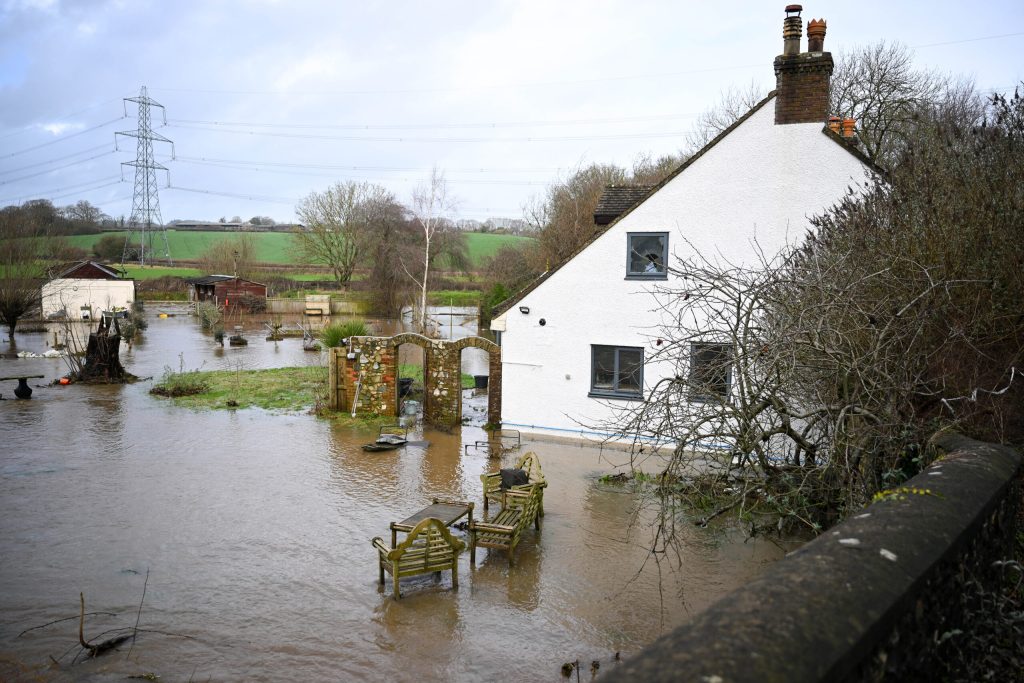
Top photograph: A house affected by flooding in the hamlet of Weycroft, England, on Jan. 27, 2026; photo credit: Finnbarr Webster/Getty Images Europe
Related:
Copyright 2026 Bloomberg.
Topics
Flood
As the threat of flood damage looms over an increasing number of homes in the UK, banks are facing mounting pressure to accurately assess the risks within their mortgage portfolios.
Nationwide Building Society, once considered an outlier for halting loans to properties at risk of flooding in 2024, has now positioned itself as a forward-thinking leader amidst rising concerns from other financial institutions. Mark Cunningham, managing director at PriceHubble, a property data firm, highlights this shift in perspective.
Cunningham warns that banks could find themselves with “mortgage prisoners” if they continue lending to properties deemed risky by others. In such scenarios, banks may struggle to recover funds as customers face difficulties in refinancing their mortgages.
“There’s still a fundamental ‘asymmetry’ between how banks and insurers are approaching the issue of flood damage. And that creates ‘a very significant risk for the banks’” — Adair Turner, former head of the UK’s banking regulator and current non-executive chairman of insurance group Chubb Ltd.’s European business.
According to the government’s Environment Agency, there are currently 6.3 million properties in England at risk of flooding from various sources, including surface water and coastal swells. Alarmingly, the number of new homes built on flood-prone land is also increasing, with Aviva estimating that around 11% of new homes constructed between 2022 and 2024 are in areas facing medium to high flood risks, up from 8% in the previous decade.
Adair Turner emphasizes the “asymmetry” in how banks and insurers are addressing flood damage, which poses significant risks for banks. The changing climate, coupled with urban development that hampers water drainage, is exacerbating the situation. This year, floods have already devastated parts of Britain, with Cornwall experiencing its wettest January on record.
This evolving landscape threatens to disrupt the real estate market in Britain, both environmentally and financially. Banks may see property values decline as homes they finance suffer damage from increasingly frequent floods. Homeowners affected by flooding often face additional costs, making it challenging to keep up with mortgage payments.
UK banks are actively assessing their loan portfolios for flood risk. Barclays Plc reports that 2.6% of its UK mortgage book is in high flood risk areas, with an additional 1.2% in very high risk zones. Barclays noted that the anticipated increase in flooding could directly impact property valuations and indirectly affect demand.
Similarly, NatWest Group Plc indicates that 3.4% of its assessed UK home loans are at high flood risk, with 1.3% in very high risk categories. The bank restricts loans for flats, new builds, and buy-to-let properties in these areas and continuously reviews its lending policies based on new flood-risk data.
Lloyds Banking Group, the UK’s largest mortgage provider, states that one in six properties in its portfolio is at risk of flooding. The bank conducts physical inspections of properties exposed to increased flood risk and will not provide mortgages for properties deemed “unsuitable collateral.”
HSBC Holdings Plc has reported similar flood-risk figures and acknowledges that flooding could significantly impact its portfolio. In general, UK banks identify London, Eastern England, Yorkshire, and Humberside as the primary risk areas.
In December, the UK’s Prudential Regulation Authority implemented stricter regulations requiring banks to incorporate flood risks into credit assessments. As a result, banks are reevaluating their lending strategies, recognizing the need for more comprehensive risk analysis.
With lenders now mandated to conduct these assessments, flood risk has become a critical factor in investment decision-making, according to Claudine Blamey, Aviva’s chief sustainability officer.
Insurers
Property and casualty insurers typically offer coverage on a one-year basis, allowing them to adjust prices or withdraw from high-risk areas. In contrast, banks often provide loans for 20 years or more, extending credit into a future where flooding may become more prevalent.
“As a property and casualty insurer, I don’t need to think about what the probability of floods are in 2035 or 2040. I can both raise my premium next year and declare that there are parts of the country where I’m unwilling to insure,” Turner explained. “The people who are in a different position are banks, particularly mortgage banks.”
Edward Burgess, strategic relationship manager at Rightmove, notes that banks are now focusing on areas that may currently seem stable but could face increased risk in the future. Identifying these “tipping points” is crucial for long-term planning.
Graeme McRitchie, director of risk and compliance at Leeds Building Society, highlights the delicate balance between serving customers and protecting against risks. “We are aware there are lots of potential tipping points, and if insurance becomes unavailable in an area, that would drive decisions anyway,” he stated.
A decade ago, the UK government established Flood Re, a reinsurance scheme designed to provide affordable insurance for homeowners in flood-prone areas. However, with an expiration date set for 2039, concerns are growing about the program’s sustainability, especially as the UK struggles to achieve full flood resilience.
Flood Re is increasingly covering more properties due to extreme weather events, including severe flooding in London in 2021. Notably, homes built after 2009 are ineligible for Flood Re, prompting banks to explore scenarios regarding the program’s potential expiration. NatWest has identified that Flood Re is essential for managing impairment rates in its residential mortgage portfolio.
Even if the government fulfills its promise to enhance flood-resistance infrastructure, there may still be a need for Flood Re, according to Aviva’s Blamey. The decision to extend the program will depend on the UK’s ability to adequately flood-proof the country.
Top photograph: A house affected by flooding in the hamlet of Weycroft, England, on Jan. 27, 2026; photo credit: Finnbarr Webster/Getty Images Europe
Related:
Copyright 2026 Bloomberg.
Topics
Flood