Hedge Fund Fermat Calls Recent Surge in Cat-Bond Sales ‘Breathtaking’

The co-founder of Fermat Capital Management, John Seo, has observed a remarkable surge in the market for catastrophe bonds, attracting new issuers at an unprecedented pace.
As the managing director and co-founder of Connecticut-based Fermat, a hedge fund specializing in cat bonds, Seo reports that 16 new issuers are expected to enter the market in 2025. This figure represents up to eight times the historical average for first-time issuers. He anticipates cat bond sales to reach approximately $24 billion this year, potentially matching last year’s record.
Seo describes the influx of first-time sellers as “pretty breathtaking,” adding that “the issuance surge we’re seeing is far from over.”
Read more: Catastrophe-Bond Risk Premia Drop to Rates Last Seen in 2022
A significant factor driving this growth is inflation, which has increased the cost of property reconstruction by about 50% over the past five years. This trend has prompted insurers and reinsurers to transfer as much risk as possible to capital markets, allowing alternative investment managers like Fermat to play a larger role in providing financial support during natural disasters.
According to Bloomberg, Fermat’s returns in 2025, net of fees, closely matched the 11% increase in the Swiss Re Cat Bond Index from the previous year.
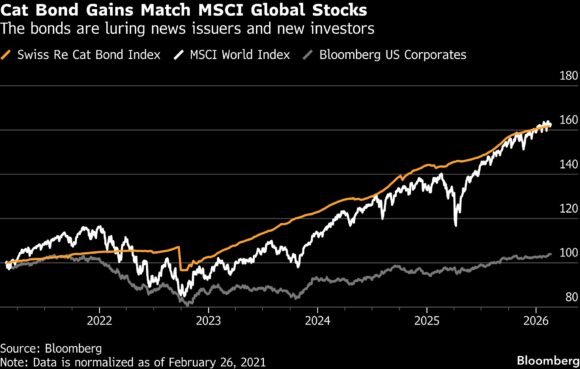
Investors profit if a predefined catastrophe does not occur, while they face losses if it does. In recent years, bondholders have generally fared well, with gains on catastrophe bonds aligning with those of the MSCI World Index of global stocks over the past five years, significantly outperforming returns on US corporate bonds.
Catastrophe bonds are increasingly penetrating mainstream financial markets, driven by inflation, urbanization, and climate change. Asset managers specializing in these products are now offering them to retail clients. Last year also marked the launch of the first-ever exchange-traded funds focused entirely on cat bonds, although Seo expresses skepticism about their efficiency due to potential frictional costs.
Moreover, endowments, family offices, and life insurance companies are now joining the ranks of investors in this space. This influx of capital has driven down cat bond yields to levels not seen since before Hurricane Ian struck Florida in 2022. Currently, investors can expect yields of approximately 6.5% above the US Treasury rate, down from about 11% in early 2023. However, Seo points out that this yield still exceeds the historical average of around 5% above the Treasury rate.
With Fermat estimating new issuance, the cat bond market is poised to reach $70 billion this year, factoring in the anticipated expiry of older bonds. Fermat currently manages about $11 billion in assets, an increase from $10.2 billion a year ago, despite losing a $3 billion portfolio management deal with GAM Holding AG in April.
“That situation has now fully played out,” Seo remarked.
Fermat’s flagship UCITS Cat Bond Fund has seen significant growth, with a net asset value of approximately $2.6 billion, having more than tripled in size over the past year. The Fermat Cat Bond Fund alone has grown about 170% during this period, reaching $2.3 billion.
Seo confirmed that Fermat is actively investing in some of the new cat bonds entering the market. Notably, last year, the UK government-backed Flood Re program issued its first cat bond for flood-related losses, addressing the increasing severity of floods across the country.
“We usually don’t comment on explicit investments, but this is such an important issue that I don’t mind saying that, yes, we absolutely did invest” in the Flood Re cat bond, Seo stated.
Photograph: John Seo, managing director and co-founder of Fermat Capital Management; photo credit: Joe Buglewicz/Bloomberg
Related:
Copyright 2026 Bloomberg.
The most important insurance news, in your inbox every business day.
Get the insurance industry’s trusted newsletter
The co-founder of Fermat Capital Management, John Seo, has observed a remarkable surge in the market for catastrophe bonds, attracting new issuers at an unprecedented pace.
As the managing director and co-founder of Connecticut-based Fermat, a hedge fund specializing in cat bonds, Seo reports that 16 new issuers are expected to enter the market in 2025. This figure represents up to eight times the historical average for first-time issuers. He anticipates cat bond sales to reach approximately $24 billion this year, potentially matching last year’s record.
Seo describes the influx of first-time sellers as “pretty breathtaking,” adding that “the issuance surge we’re seeing is far from over.”
Read more: Catastrophe-Bond Risk Premia Drop to Rates Last Seen in 2022
A significant factor driving this growth is inflation, which has increased the cost of property reconstruction by about 50% over the past five years. This trend has prompted insurers and reinsurers to transfer as much risk as possible to capital markets, allowing alternative investment managers like Fermat to play a larger role in providing financial support during natural disasters.
According to Bloomberg, Fermat’s returns in 2025, net of fees, closely matched the 11% increase in the Swiss Re Cat Bond Index from the previous year.
Investors profit if a predefined catastrophe does not occur, while they face losses if it does. In recent years, bondholders have generally fared well, with gains on catastrophe bonds aligning with those of the MSCI World Index of global stocks over the past five years, significantly outperforming returns on US corporate bonds.
Catastrophe bonds are increasingly penetrating mainstream financial markets, driven by inflation, urbanization, and climate change. Asset managers specializing in these products are now offering them to retail clients. Last year also marked the launch of the first-ever exchange-traded funds focused entirely on cat bonds, although Seo expresses skepticism about their efficiency due to potential frictional costs.
Moreover, endowments, family offices, and life insurance companies are now joining the ranks of investors in this space. This influx of capital has driven down cat bond yields to levels not seen since before Hurricane Ian struck Florida in 2022. Currently, investors can expect yields of approximately 6.5% above the US Treasury rate, down from about 11% in early 2023. However, Seo points out that this yield still exceeds the historical average of around 5% above the Treasury rate.
With Fermat estimating new issuance, the cat bond market is poised to reach $70 billion this year, factoring in the anticipated expiry of older bonds. Fermat currently manages about $11 billion in assets, an increase from $10.2 billion a year ago, despite losing a $3 billion portfolio management deal with GAM Holding AG in April.
“That situation has now fully played out,” Seo remarked.
Fermat’s flagship UCITS Cat Bond Fund has seen significant growth, with a net asset value of approximately $2.6 billion, having more than tripled in size over the past year. The Fermat Cat Bond Fund alone has grown about 170% during this period, reaching $2.3 billion.
Seo confirmed that Fermat is actively investing in some of the new cat bonds entering the market. Notably, last year, the UK government-backed Flood Re program issued its first cat bond for flood-related losses, addressing the increasing severity of floods across the country.
“We usually don’t comment on explicit investments, but this is such an important issue that I don’t mind saying that, yes, we absolutely did invest” in the Flood Re cat bond, Seo stated.
Photograph: John Seo, managing director and co-founder of Fermat Capital Management; photo credit: Joe Buglewicz/Bloomberg
Related:
Copyright 2026 Bloomberg.
The most important insurance news, in your inbox every business day.
Get the insurance industry’s trusted newsletter