Inspiring Story: Jesse Meyers’ Literary Passion
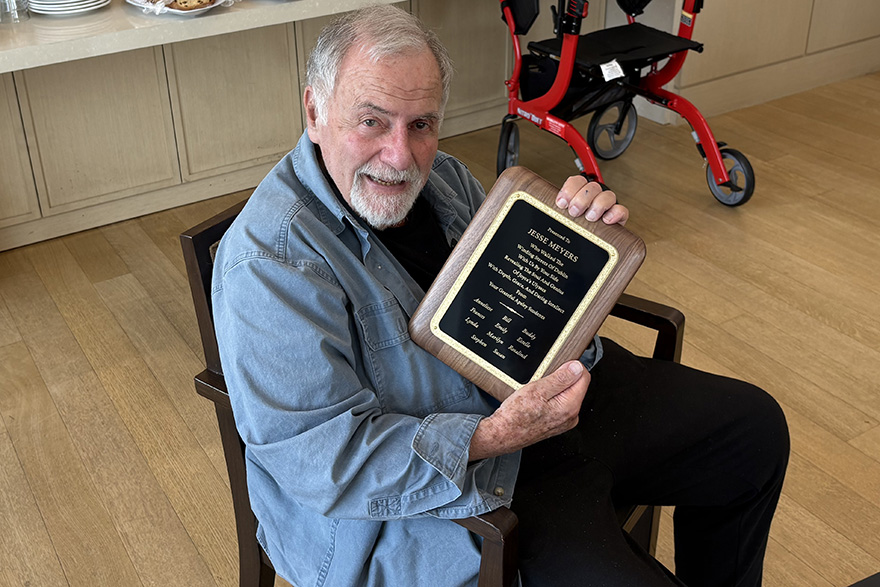
For some 20 years, Jesse Meyers (90) has taught classes on James Joyce and his novel, Ulysses. Some 1,000 students later, Jesse has raised over $300,000 for charities through his classes and donated over 700 volumes on James Joyce to Fordham University.
Jesse recently moved into The Apsley, an assisted living facility on the Upper West Side of Manhattan, but the change hasn’t slowed him down. We spoke with this military veteran and former publisher of Beverage Digest (an award-winning business newsletter which broke the story about Coca-Cola’s formula change in 1985) about leading a Ulysses reading group of his fellow assisted living residents and the benefits of literature.
Why James Joyce?
I retired at 59. My late wife took me by my ear to a Joyce lecture, insisting I needed a hobby. I was immediately smitten and overwhelmed by Joyce’s offerings. I took classes anywhere and everywhere and then began to lecture, soon developing my own teaching style: simplify and amplify strictly in street language.
Ulysses proves to be of interest to readers who enjoy word games, crossword puzzles, or clever song lyrics. The book—set in Dublin—appeals to those with Irish family backgrounds. It touches on numerous subjects, including the Catholic Church, colonialism, history, anti-Semitism, Shakespeare’s works, music, and interpersonal relationships, making it relevant to a diverse audience.
Joyce’s writing style is another draw. He is regarded as a pioneer of what is called Literary Modernism. This term can be understood in two ways: “Inner” and “Under.” The “Inner” aspect allows readers unique access to the private thoughts of characters, revealing not just their words but also their inner dialogues. The “Under” aspect explores actions beneath the waistline, encompassing everything from digestion to sexual activities.
What are the benefits of doing a close reading of a complicated text, like Ulysses?
The attentive reader gains deeper insights into life. The book consists of 18 episodes, each written in a different voice. Unlike most contemporary literature that typically employs first and third-person narratives, Joyce offers 18 distinct perspectives. You may have heard the saying: “It’s not the journey, it’s the arrival.” In this case, it’s undeniably both the journey and the arrival.
What advice do you have for starting a reading group like this?
Keep it simple. I offer two slightly unique awards. First, if a participant finishes the class—often spanning 12-14 sessions—they receive a diploma signed by James Joyce (despite his passing in early 1941).
Second, at one point in Ulysses, a character orders a simple meal in a restaurant. My classes recreate this meal during the final diploma-awarding session.
What do you think is the importance of literature in our lives?
Literature educates, amuses, startles, and often inspires us. Without these moments, what’s the point of living?
A brief note on the availability of literature today: your cell phone serves as a gateway to vast amounts of free literature. A great resource is Project Gutenberg, which offers thousands of books at no cost. There’s even a free copy of Ulysses, though it contains numerous errors. A newer, error-free edition available online is called The Gabler Ulysses, which is the version most educators use.
What does aging with attitude mean to you?
As you age, hopefully, you gain wisdom. Often, this means that the next book you choose to read is Ulysses.
To get more literature in your life, join Senior Planet’s virtual Book Club!
Photo Credit: The Apsley
For some 20 years, Jesse Meyers (90) has taught classes on James Joyce and his novel, Ulysses. Some 1,000 students later, Jesse has raised over $300,000 for charities through his classes and donated over 700 volumes on James Joyce to Fordham University.
Jesse recently moved into The Apsley, an assisted living facility on the Upper West Side of Manhattan, but the change hasn’t slowed him down. We spoke with this military veteran and former publisher of Beverage Digest (an award-winning business newsletter which broke the story about Coca-Cola’s formula change in 1985) about leading a Ulysses reading group of his fellow assisted living residents and the benefits of literature.
Why James Joyce?
I retired at 59. My late wife took me by my ear to a Joyce lecture, insisting I needed a hobby. I was immediately smitten and overwhelmed by Joyce’s offerings. I took classes anywhere and everywhere and then began to lecture, soon developing my own teaching style: simplify and amplify strictly in street language.
Ulysses proves to be of interest to readers who enjoy word games, crossword puzzles, or clever song lyrics. The book—set in Dublin—appeals to those with Irish family backgrounds. It touches on numerous subjects, including the Catholic Church, colonialism, history, anti-Semitism, Shakespeare’s works, music, and interpersonal relationships, making it relevant to a diverse audience.
Joyce’s writing style is another draw. He is regarded as a pioneer of what is called Literary Modernism. This term can be understood in two ways: “Inner” and “Under.” The “Inner” aspect allows readers unique access to the private thoughts of characters, revealing not just their words but also their inner dialogues. The “Under” aspect explores actions beneath the waistline, encompassing everything from digestion to sexual activities.
What are the benefits of doing a close reading of a complicated text, like Ulysses?
The attentive reader gains deeper insights into life. The book consists of 18 episodes, each written in a different voice. Unlike most contemporary literature that typically employs first and third-person narratives, Joyce offers 18 distinct perspectives. You may have heard the saying: “It’s not the journey, it’s the arrival.” In this case, it’s undeniably both the journey and the arrival.
What advice do you have for starting a reading group like this?
Keep it simple. I offer two slightly unique awards. First, if a participant finishes the class—often spanning 12-14 sessions—they receive a diploma signed by James Joyce (despite his passing in early 1941).
Second, at one point in Ulysses, a character orders a simple meal in a restaurant. My classes recreate this meal during the final diploma-awarding session.
What do you think is the importance of literature in our lives?
Literature educates, amuses, startles, and often inspires us. Without these moments, what’s the point of living?
A brief note on the availability of literature today: your cell phone serves as a gateway to vast amounts of free literature. A great resource is Project Gutenberg, which offers thousands of books at no cost. There’s even a free copy of Ulysses, though it contains numerous errors. A newer, error-free edition available online is called The Gabler Ulysses, which is the version most educators use.
What does aging with attitude mean to you?
As you age, hopefully, you gain wisdom. Often, this means that the next book you choose to read is Ulysses.
To get more literature in your life, join Senior Planet’s virtual Book Club!
Photo Credit: The Apsley