White House AI Czar Supports Trump’s Efforts to Limit State Regulations
White House AI czar David Sacks has come forward to defend President Donald Trump’s initiative aimed at curbing state-level regulations on artificial intelligence (AI). This move has sparked objections from Democrats, but Sacks argues that it is essential for alleviating the compliance burden faced by companies in the AI sector.
According to Sacks, the directive signed by Trump on Thursday is a step toward collaborating with Congress to establish a unified standard for overseeing AI technology. Currently, the development of AI models is subject to varying regulatory standards across different states, which complicates the process for companies.
“You have fifty different states running in fifty different directions. That type of compliance regime will be hard for small companies and startups, especially innovators,” Sacks stated in an interview on Bloomberg Tech. “What we need is a single federal or national framework for AI regulation.”
This order, championed by Sacks, is the culmination of months of lobbying by major AI companies, including OpenAI and Alphabet Inc.’s Google, along with venture capital firm Andreessen Horowitz. These stakeholders have expressed concerns that the proliferation of state laws could overwhelm the burgeoning AI industry and jeopardize U.S. competitiveness against China.
Related: Trump Signs Order Seeking to Limit State-Level AI Regulation
In his directive, Trump has instructed the U.S. Attorney General to form a task force aimed at challenging state regulations that conflict with the administration’s goal of promoting AI adoption. Additionally, the Commerce Department is authorized to evaluate whether federal broadband funding should be withheld from localities that implement AI measures deemed burdensome by the administration.
Legal challenges to the order are anticipated, particularly from states that have already enacted regulations. California State Senator Scott Wiener, who was instrumental in crafting significant legislation in the state, criticized the move, stating that safety regulations have been a fundamental aspect of state law for decades. “It’s absurd for Trump to think he can weaponize the DOJ and Commerce to undermine those state rights,” Wiener remarked.
Sacks clarified that the provision allowing the Justice Department to sue states over AI regulations is intended to target the most onerous rules. While he did not specify whether the administration would challenge California or New York, he did highlight a Colorado law aimed at prohibiting algorithmic discrimination as “probably the most excessive.”
After failing to include similar legislation in a must-pass defense bill earlier this month, Trump opted for the executive order. In response, Democratic U.S. Senator Brian Schatz announced plans to introduce legislation aimed at fully repealing the order, emphasizing that the potential risks of AI should not be overlooked.
“Embracing the amazing possibilities of AI can’t come at the cost of leaving Americans vulnerable to its profound risks,” Schatz stated. “Congress has a responsibility to get this technology right – and quickly – but states must be allowed to act in the public interest in the meantime.”
As AI becomes increasingly integrated into daily life—impacting areas such as job applications, criminal identification, and medical claims—state lawmakers are eager to establish regulatory frameworks. However, Trump’s order complicates these efforts, potentially putting states at odds with the federal government.
Tech companies have generally opposed state-level regulations, particularly in California and New York, which would hold them accountable for the harms caused by AI products. Despite the political challenges, Trump and his allies have promoted the AI boom as beneficial for the U.S. economy, even as concerns about energy costs and job displacement loom.
Sacks, a venture capitalist who joined the administration in January, countered fears about job losses, asserting that the AI sector has thus far created more jobs than it has eliminated. “We are seeing an overall AI boom that’s benefiting the economy,” he noted.
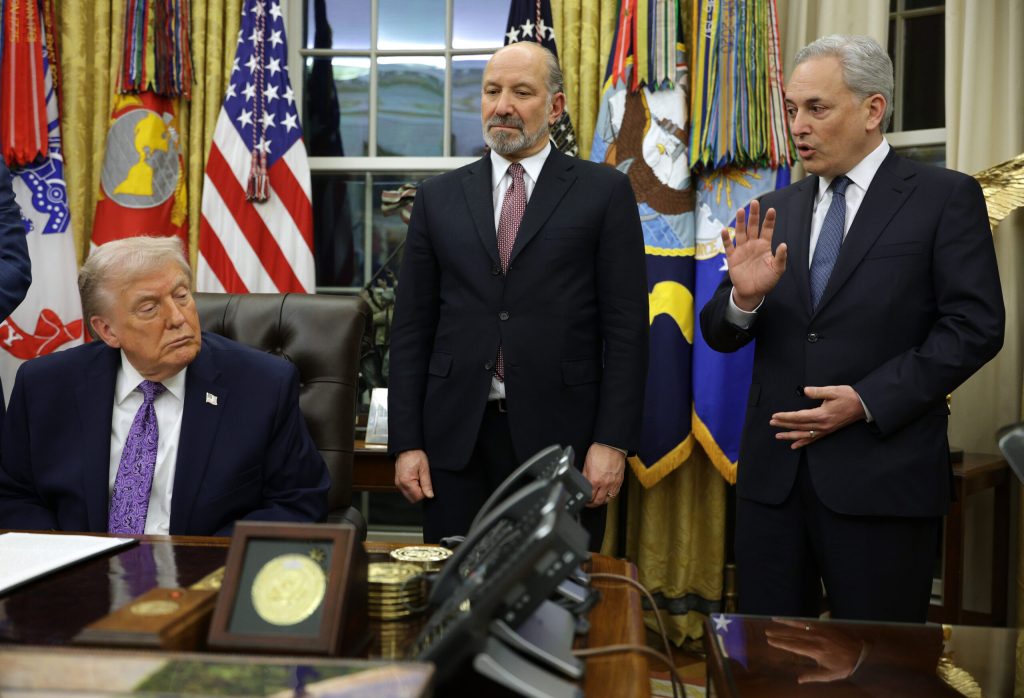
Photo: President Donald Trump, left, and Commerce Secretary Howard Lutnick look on as White House AI czar David Sacks speaks in the Oval Office of the White House on December 11. Photographer: Alex Wong/Getty Images
Copyright 2025 Bloomberg.
Interested in AI?
Get automatic alerts for this topic.
White House AI czar David Sacks has come forward to defend President Donald Trump’s initiative aimed at curbing state-level regulations on artificial intelligence (AI). This move has sparked objections from Democrats, but Sacks argues that it is essential for alleviating the compliance burden faced by companies in the AI sector.
According to Sacks, the directive signed by Trump on Thursday is a step toward collaborating with Congress to establish a unified standard for overseeing AI technology. Currently, the development of AI models is subject to varying regulatory standards across different states, which complicates the process for companies.
“You have fifty different states running in fifty different directions. That type of compliance regime will be hard for small companies and startups, especially innovators,” Sacks stated in an interview on Bloomberg Tech. “What we need is a single federal or national framework for AI regulation.”
This order, championed by Sacks, is the culmination of months of lobbying by major AI companies, including OpenAI and Alphabet Inc.’s Google, along with venture capital firm Andreessen Horowitz. These stakeholders have expressed concerns that the proliferation of state laws could overwhelm the burgeoning AI industry and jeopardize U.S. competitiveness against China.
Related: Trump Signs Order Seeking to Limit State-Level AI Regulation
In his directive, Trump has instructed the U.S. Attorney General to form a task force aimed at challenging state regulations that conflict with the administration’s goal of promoting AI adoption. Additionally, the Commerce Department is authorized to evaluate whether federal broadband funding should be withheld from localities that implement AI measures deemed burdensome by the administration.
Legal challenges to the order are anticipated, particularly from states that have already enacted regulations. California State Senator Scott Wiener, who was instrumental in crafting significant legislation in the state, criticized the move, stating that safety regulations have been a fundamental aspect of state law for decades. “It’s absurd for Trump to think he can weaponize the DOJ and Commerce to undermine those state rights,” Wiener remarked.
Sacks clarified that the provision allowing the Justice Department to sue states over AI regulations is intended to target the most onerous rules. While he did not specify whether the administration would challenge California or New York, he did highlight a Colorado law aimed at prohibiting algorithmic discrimination as “probably the most excessive.”
After failing to include similar legislation in a must-pass defense bill earlier this month, Trump opted for the executive order. In response, Democratic U.S. Senator Brian Schatz announced plans to introduce legislation aimed at fully repealing the order, emphasizing that the potential risks of AI should not be overlooked.
“Embracing the amazing possibilities of AI can’t come at the cost of leaving Americans vulnerable to its profound risks,” Schatz stated. “Congress has a responsibility to get this technology right – and quickly – but states must be allowed to act in the public interest in the meantime.”
As AI becomes increasingly integrated into daily life—impacting areas such as job applications, criminal identification, and medical claims—state lawmakers are eager to establish regulatory frameworks. However, Trump’s order complicates these efforts, potentially putting states at odds with the federal government.
Tech companies have generally opposed state-level regulations, particularly in California and New York, which would hold them accountable for the harms caused by AI products. Despite the political challenges, Trump and his allies have promoted the AI boom as beneficial for the U.S. economy, even as concerns about energy costs and job displacement loom.
Sacks, a venture capitalist who joined the administration in January, countered fears about job losses, asserting that the AI sector has thus far created more jobs than it has eliminated. “We are seeing an overall AI boom that’s benefiting the economy,” he noted.
Photo: President Donald Trump, left, and Commerce Secretary Howard Lutnick look on as White House AI czar David Sacks speaks in the Oval Office of the White House on December 11. Photographer: Alex Wong/Getty Images
Copyright 2025 Bloomberg.
Interested in AI?
Get automatic alerts for this topic.