Wildfire-Linked Catastrophe Bonds Diminish in Status
Alternative investment managers are increasingly focusing on catastrophe bonds associated with wildfires, venturing into a risk category that was once deemed too complex to model effectively.
In 2025, insurers issued over $5 billion in cat bonds linked to wildfire risk, according to Artemis, a specialist in insurance-linked securities. This figure is more than double the amount from 2024, which saw only a handful of individual bond sales totaling in the tens of millions.
While still a small segment, wildfire bonds significantly contributed to a record $23 billion surge in overall cat bond issuance for 2025, putting the total market on track to reach approximately $60 billion by year-end. Acrisure Re, a reinsurance broker, notes that improved modeling techniques have shifted investor sentiment, encouraging fund managers to explore this previously “untouchable” risk category.
Read more: Catastrophe Bonds’ Huge Market Gains Put Reinsurers on Backfoot
Dirk Schmelzer, senior fund manager at Plenum Investments AG, suggests that this trend may lead to a fundamental restructuring of catastrophe bonds in the future, as the increasing severity of wildfires pushes the insurance industry to rely more on capital markets.
“Historically, wildfire exposure was grouped with earthquake and hurricane risks,” Schmelzer explained. “Now, it has become such a significant peril that it warrants standalone risk placement.”
Interest in wildfire cat bonds has been particularly driven by developments in California, where consecutive severe fire seasons have made reinsurance prohibitively expensive. The January fires in Los Angeles destroyed over 16,000 buildings, leading to record insured losses of $40 billion.
The LA fires were a key factor in global insured losses from natural disasters surpassing $100 billion in 2025, marking the sixth consecutive year this threshold has been exceeded.
However, cat bond investors were largely insulated from these losses, with Fitch Ratings estimating that the total setback they faced was under $250 million.
As climate-driven urban fires become more frequent, insurers and utilities are increasingly seeking ways to transfer their risks to capital markets. A notable example is the California FAIR Plan Association’s debut wildfire cat bond, which raised $750 million—tripling its initial target—making it the largest pure wildfire cat bond ever issued.
Other wildfire-prone regions, such as Colorado, are also considering cat bonds to manage escalating wildfire risks. Recent legislation has been proposed to facilitate this financial approach.
In Europe, where the fire season is expanding, the European Central Bank and the region’s insurance authority are advocating for cat bonds to complement insurance facilities and provide prompt liquidity for post-disaster reconstruction.
Advancements in modeling techniques from firms like Moody’s Corp., Verisk Analytics Inc., and Karen Clark & Co. are enhancing the ability to structure financial products around wildfire risk. Artificial intelligence is also playing a role in generating more reliable loss estimates.
“For cat bonds, this translates to more informed pricing and broader investor participation, evident in the surge of wildfire-exposed deals in 2024-2025,” Acrisure Re noted.
Currently, however, risk premiums on wildfire cat bonds remain significantly higher than those on traditional bonds linked to better-understood risks like hurricanes. In 2025, wildfire cat bonds were priced at six to eight times the estimated loss probability, compared to two to four times for bonds targeting more familiar risks.
According to Dirk Lohmann, vice chairman of ILS at Schroders, the models used for wildfire risk are still less mature and empirically calibrated than those for major wind or earthquake events.
The Broader Market
Looking ahead, cat bonds are expected to experience tighter spreads in 2026, partly due to the absence of major investor losses. Hurricane Melissa, which impacted Jamaica and triggered a $150 million cat bond, spared the main market.
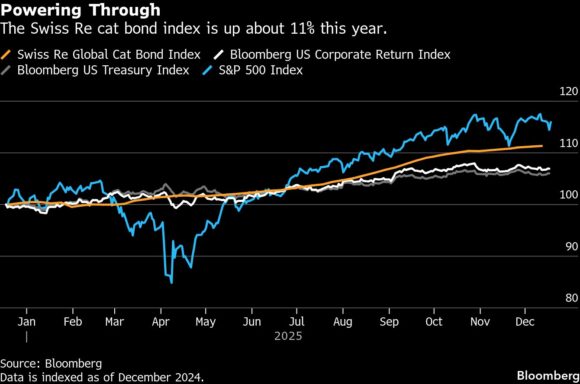
The Swiss Re Global Cat Bond Performance Index has risen approximately 11% in 2025, outperforming a Bloomberg index tracking US corporate bonds and US Treasuries. The S&P 500 Index has also seen a 15% increase this year. The continued demand for cat bonds is attributed to their role as portfolio diversifiers, as evidenced by their resilience during market downturns.
Primary issuance in 2026 is anticipated to be robust, as lower spreads reduce issuance costs, according to Twelve Securis, an asset manager focused on insurance-linked securities and cat bonds.
Additionally, the reinsurance market is expected to push more risks and secondary perils into capital markets, as noted by Etienne Schwartz, chief investment officer of liquid strategies at Twelve Securis.
This year also marked the launch of the world’s first cat bond exchange-traded fund. The Brookmont Catastrophic Bond ETF (ticker ILS), which initially struggled to find a lead market maker, has since attracted client investments, with assets rising to about $30 million.
“By the end of the first quarter, we should comfortably reach $50 million,” said Ethan Powell, chief investment officer of Brookmont.
King Ridge Capital Advisors is also planning to launch a cat bond ETF in Europe, with co-founder Rick Pagnani stating that it’s an “opportune time” for such an initiative.
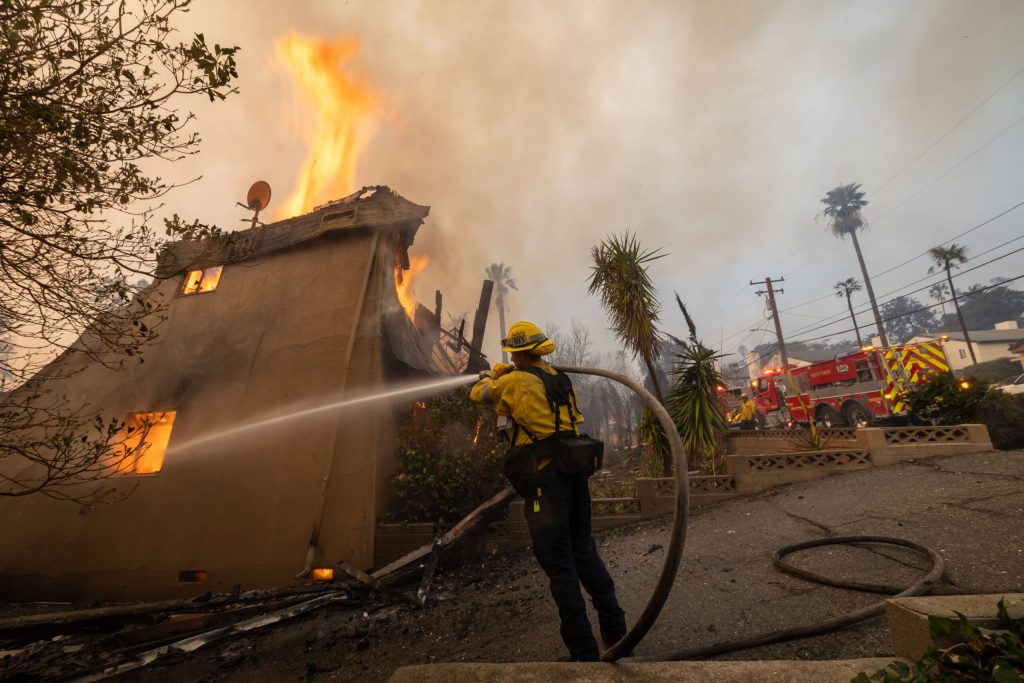
Photograph: A firefighter hoses down a burning house during the Eaton Fire in Altadena, California on Jan. 8, 2025. Photo credit: Michael Nigro/Bloomberg
Related:
Copyright 2025 Bloomberg.
Topics
Catastrophe
Natural Disasters
Wildfire
Alternative investment managers are increasingly focusing on catastrophe bonds associated with wildfires, venturing into a risk category that was once deemed too complex to model effectively.
In 2025, insurers issued over $5 billion in cat bonds linked to wildfire risk, according to Artemis, a specialist in insurance-linked securities. This figure is more than double the amount from 2024, which saw only a handful of individual bond sales totaling in the tens of millions.
While still a small segment, wildfire bonds significantly contributed to a record $23 billion surge in overall cat bond issuance for 2025, putting the total market on track to reach approximately $60 billion by year-end. Acrisure Re, a reinsurance broker, notes that improved modeling techniques have shifted investor sentiment, encouraging fund managers to explore this previously “untouchable” risk category.
Read more: Catastrophe Bonds’ Huge Market Gains Put Reinsurers on Backfoot
Dirk Schmelzer, senior fund manager at Plenum Investments AG, suggests that this trend may lead to a fundamental restructuring of catastrophe bonds in the future, as the increasing severity of wildfires pushes the insurance industry to rely more on capital markets.
“Historically, wildfire exposure was grouped with earthquake and hurricane risks,” Schmelzer explained. “Now, it has become such a significant peril that it warrants standalone risk placement.”
Interest in wildfire cat bonds has been particularly driven by developments in California, where consecutive severe fire seasons have made reinsurance prohibitively expensive. The January fires in Los Angeles destroyed over 16,000 buildings, leading to record insured losses of $40 billion.
The LA fires were a key factor in global insured losses from natural disasters surpassing $100 billion in 2025, marking the sixth consecutive year this threshold has been exceeded.
However, cat bond investors were largely insulated from these losses, with Fitch Ratings estimating that the total setback they faced was under $250 million.
As climate-driven urban fires become more frequent, insurers and utilities are increasingly seeking ways to transfer their risks to capital markets. A notable example is the California FAIR Plan Association’s debut wildfire cat bond, which raised $750 million—tripling its initial target—making it the largest pure wildfire cat bond ever issued.
Other wildfire-prone regions, such as Colorado, are also considering cat bonds to manage escalating wildfire risks. Recent legislation has been proposed to facilitate this financial approach.
In Europe, where the fire season is expanding, the European Central Bank and the region’s insurance authority are advocating for cat bonds to complement insurance facilities and provide prompt liquidity for post-disaster reconstruction.
Advancements in modeling techniques from firms like Moody’s Corp., Verisk Analytics Inc., and Karen Clark & Co. are enhancing the ability to structure financial products around wildfire risk. Artificial intelligence is also playing a role in generating more reliable loss estimates.
“For cat bonds, this translates to more informed pricing and broader investor participation, evident in the surge of wildfire-exposed deals in 2024-2025,” Acrisure Re noted.
Currently, however, risk premiums on wildfire cat bonds remain significantly higher than those on traditional bonds linked to better-understood risks like hurricanes. In 2025, wildfire cat bonds were priced at six to eight times the estimated loss probability, compared to two to four times for bonds targeting more familiar risks.
According to Dirk Lohmann, vice chairman of ILS at Schroders, the models used for wildfire risk are still less mature and empirically calibrated than those for major wind or earthquake events.
The Broader Market
Looking ahead, cat bonds are expected to experience tighter spreads in 2026, partly due to the absence of major investor losses. Hurricane Melissa, which impacted Jamaica and triggered a $150 million cat bond, spared the main market.
The Swiss Re Global Cat Bond Performance Index has risen approximately 11% in 2025, outperforming a Bloomberg index tracking US corporate bonds and US Treasuries. The S&P 500 Index has also seen a 15% increase this year. The continued demand for cat bonds is attributed to their role as portfolio diversifiers, as evidenced by their resilience during market downturns.
Primary issuance in 2026 is anticipated to be robust, as lower spreads reduce issuance costs, according to Twelve Securis, an asset manager focused on insurance-linked securities and cat bonds.
Additionally, the reinsurance market is expected to push more risks and secondary perils into capital markets, as noted by Etienne Schwartz, chief investment officer of liquid strategies at Twelve Securis.
This year also marked the launch of the world’s first cat bond exchange-traded fund. The Brookmont Catastrophic Bond ETF (ticker ILS), which initially struggled to find a lead market maker, has since attracted client investments, with assets rising to about $30 million.
“By the end of the first quarter, we should comfortably reach $50 million,” said Ethan Powell, chief investment officer of Brookmont.
King Ridge Capital Advisors is also planning to launch a cat bond ETF in Europe, with co-founder Rick Pagnani stating that it’s an “opportune time” for such an initiative.
Photograph: A firefighter hoses down a burning house during the Eaton Fire in Altadena, California on Jan. 8, 2025. Photo credit: Michael Nigro/Bloomberg
Related:
Copyright 2025 Bloomberg.
Topics
Catastrophe
Natural Disasters
Wildfire