India’s Bold Financial Reforms Aim to Attract Foreign Investment

India’s long-awaited package of financial services reforms is setting the stage for a surge of foreign capital into the world’s fastest-growing major economy.
In a significant move, lawmakers passed a bill this week allowing up to 100% foreign ownership of insurance firms. This reform bolsters an industry that has long been viewed as under-penetrated and in need of capital. Additionally, regulators have revamped rules for banks, pension funds, and capital markets, aiming to redirect savings from idle assets like gold and property towards equities, bonds, and long-term investments essential for financing factories and infrastructure.
These reforms align with Prime Minister Narendra Modi’s vision of transforming India into a developed economy by 2047. Achieving this ambitious goal necessitates an economic growth rate of approximately 8% per year. Policymakers are banking on rapid industrialization and deeper capital markets to realize this vision.
The urgency to attract foreign capital has intensified following US President Donald Trump’s imposition of a 50% tariff on Indian goods in August, one of the highest rates globally. This move has adversely affected exports to India’s largest market, potentially jeopardizing its manufacturing ambitions.
“The latest spate of reforms will help revive global investor sentiment amid tariff worries,” stated Pramod Kumar, CEO of Barclays Plc’s India operations. He anticipates that foreign investment flows will increase, creating more opportunities for banks like Barclays.
A series of recent deals underscores the growing appetite for Indian assets. Mitsubishi UFJ Financial Group Inc. announced its acquisition of a minority stake in Shriram Finance Ltd. for $4.4 billion, marking the largest foreign investment in India’s financial services sector. This follows Mizuho Financial Group Inc.’s agreement to purchase a controlling stake in KKR & Co.-backed investment bank Avendus Capital. Earlier this year, Sumitomo Mitsui Financial Group Inc. became the largest shareholder of Yes Bank Ltd. in a landmark transaction.
From April to September, India recorded a net foreign direct investment of $7.6 billion, more than double the rate from the previous year, according to data from the Reserve Bank of India.
The opening of the insurance and pensions sectors, alongside new bank licenses and substantial investments from Japan, exemplifies “deregulation in action,” according to Vivek Ramji Iyer, a partner at Grant Thornton Bharat.
The insurance reform caps years of debate within government and industry, signaling a readiness to allow global players to manage insurers independently, provided they commit capital and expertise. Companies like Allianz SE, AXA SA, and Nippon Life Insurance Co. have operated in India for years, but full ownership is expected to grant them greater flexibility to scale investments and pursue growth opportunities.
This shift also extends to the $177 billion pension fund sector, paving the way for 100% foreign ownership of companies in that domain, as confirmed by the top pension regulator in a recent interview. Previously, overseas investment in both sectors was capped at 74%.
The broad reforms may prompt foreign portfolio investors, who have been hesitant to allocate to India over the past year, to recognize that “now is as good a time as any to ensure they don’t miss out on the next leg of growth in an economy that – arguably to a greater degree than ever before – is firing on all cylinders,” remarked Andrei Stetsenko, partner at New York-based Farley Capital.
Bold Moves
For many market participants, these reforms represent the most significant changes since the early 2000s, when India liberalized its telecommunications and electricity sectors and introduced fiscal and foreign investment guidelines.
Pension and insurance funds, whether domestic or foreign, are typically patient capital—precisely the type needed for infrastructure projects like highways and power plants. In a separate initiative, India’s parliament recently passed a bill to open its nuclear industry to private firms, unlocking investment opportunities worth $214 billion. Modi has also implemented tax cuts and labor-law reforms to stimulate consumer and business spending.
Encouraging consolidation is also a key component of India’s strategy. The total volume of transactions targeting Indian firms has surged by 15% this year, reaching nearly $90 billion, with significant involvement from Japanese buyers in major banking deals.
Easier rules for mergers and acquisitions, coupled with a more supportive regulatory environment, aim to assist Indian companies in scaling up. State-run banks, which remain dominant lenders, are now permitted to play a more active role in funding takeovers, enhancing their competitiveness against foreign counterparts.
Meanwhile, capital markets are thriving. Indian firms have raised a record $22 billion through initial public offerings in 2025, while the Nifty 500 Index—the broadest gauge for local stocks—has delivered total shareholder returns of 122% over the past five years, outperforming the S&P 500.
To further enhance trading, India’s securities market regulator recently reduced fees paid by domestic mutual funds to brokerages and slashed the basic management charge, marking one of the most significant changes to the industry’s fee structure.
“I do see a positive impact from the reforms, but it will be gradual,” noted Abhishek Thepade, a portfolio manager at DNB Asset Management AS in Oslo. “The challenge has been the absence of a trade deal, which dampens sentiment,” he added.
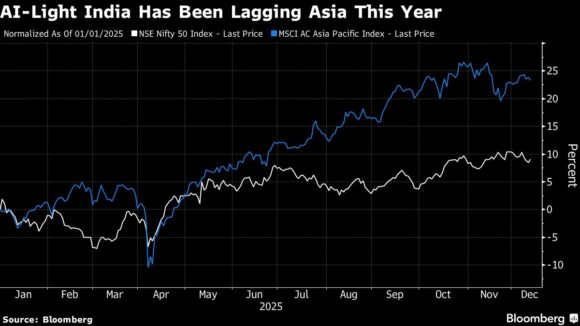
Despite these reforms, local stocks have underperformed compared to global counterparts this year, with the Nifty 50 Index rising only 10% as valuations appear stretched. Foreign investors have withdrawn approximately $18 billion from equity markets this year, marking the largest annual withdrawal on record. The rupee’s 5% decline this year, making it Asia’s worst-performing currency, poses a near-term threat to a recovering stock market.
Nevertheless, the current wave of reforms, along with rate cuts and relative underperformance, render the market more appealing, according to Joshua Crabb, head of Asia-Pacific equities at asset manager Robeco. “Reform is always beneficial, but it takes time, and impacts occur with a lag,” he stated.
Photograph: Buildings in Mumbai, India; photo credit: Abeer Khan/Bloomberg
Related:
Copyright 2025 Bloomberg.
Topics
India
India’s long-awaited package of financial services reforms is setting the stage for a surge of foreign capital into the world’s fastest-growing major economy.
In a significant move, lawmakers passed a bill this week allowing up to 100% foreign ownership of insurance firms. This reform bolsters an industry that has long been viewed as under-penetrated and in need of capital. Additionally, regulators have revamped rules for banks, pension funds, and capital markets, aiming to redirect savings from idle assets like gold and property towards equities, bonds, and long-term investments essential for financing factories and infrastructure.
These reforms align with Prime Minister Narendra Modi’s vision of transforming India into a developed economy by 2047. Achieving this ambitious goal necessitates an economic growth rate of approximately 8% per year. Policymakers are banking on rapid industrialization and deeper capital markets to realize this vision.
The urgency to attract foreign capital has intensified following US President Donald Trump’s imposition of a 50% tariff on Indian goods in August, one of the highest rates globally. This move has adversely affected exports to India’s largest market, potentially jeopardizing its manufacturing ambitions.
“The latest spate of reforms will help revive global investor sentiment amid tariff worries,” stated Pramod Kumar, CEO of Barclays Plc’s India operations. He anticipates that foreign investment flows will increase, creating more opportunities for banks like Barclays.
A series of recent deals underscores the growing appetite for Indian assets. Mitsubishi UFJ Financial Group Inc. announced its acquisition of a minority stake in Shriram Finance Ltd. for $4.4 billion, marking the largest foreign investment in India’s financial services sector. This follows Mizuho Financial Group Inc.’s agreement to purchase a controlling stake in KKR & Co.-backed investment bank Avendus Capital. Earlier this year, Sumitomo Mitsui Financial Group Inc. became the largest shareholder of Yes Bank Ltd. in a landmark transaction.
From April to September, India recorded a net foreign direct investment of $7.6 billion, more than double the rate from the previous year, according to data from the Reserve Bank of India.
The opening of the insurance and pensions sectors, alongside new bank licenses and substantial investments from Japan, exemplifies “deregulation in action,” according to Vivek Ramji Iyer, a partner at Grant Thornton Bharat.
The insurance reform caps years of debate within government and industry, signaling a readiness to allow global players to manage insurers independently, provided they commit capital and expertise. Companies like Allianz SE, AXA SA, and Nippon Life Insurance Co. have operated in India for years, but full ownership is expected to grant them greater flexibility to scale investments and pursue growth opportunities.
This shift also extends to the $177 billion pension fund sector, paving the way for 100% foreign ownership of companies in that domain, as confirmed by the top pension regulator in a recent interview. Previously, overseas investment in both sectors was capped at 74%.
The broad reforms may prompt foreign portfolio investors, who have been hesitant to allocate to India over the past year, to recognize that “now is as good a time as any to ensure they don’t miss out on the next leg of growth in an economy that – arguably to a greater degree than ever before – is firing on all cylinders,” remarked Andrei Stetsenko, partner at New York-based Farley Capital.
Bold Moves
For many market participants, these reforms represent the most significant changes since the early 2000s, when India liberalized its telecommunications and electricity sectors and introduced fiscal and foreign investment guidelines.
Pension and insurance funds, whether domestic or foreign, are typically patient capital—precisely the type needed for infrastructure projects like highways and power plants. In a separate initiative, India’s parliament recently passed a bill to open its nuclear industry to private firms, unlocking investment opportunities worth $214 billion. Modi has also implemented tax cuts and labor-law reforms to stimulate consumer and business spending.
Encouraging consolidation is also a key component of India’s strategy. The total volume of transactions targeting Indian firms has surged by 15% this year, reaching nearly $90 billion, with significant involvement from Japanese buyers in major banking deals.
Easier rules for mergers and acquisitions, coupled with a more supportive regulatory environment, aim to assist Indian companies in scaling up. State-run banks, which remain dominant lenders, are now permitted to play a more active role in funding takeovers, enhancing their competitiveness against foreign counterparts.
Meanwhile, capital markets are thriving. Indian firms have raised a record $22 billion through initial public offerings in 2025, while the Nifty 500 Index—the broadest gauge for local stocks—has delivered total shareholder returns of 122% over the past five years, outperforming the S&P 500.
To further enhance trading, India’s securities market regulator recently reduced fees paid by domestic mutual funds to brokerages and slashed the basic management charge, marking one of the most significant changes to the industry’s fee structure.
“I do see a positive impact from the reforms, but it will be gradual,” noted Abhishek Thepade, a portfolio manager at DNB Asset Management AS in Oslo. “The challenge has been the absence of a trade deal, which dampens sentiment,” he added.
Despite these reforms, local stocks have underperformed compared to global counterparts this year, with the Nifty 50 Index rising only 10% as valuations appear stretched. Foreign investors have withdrawn approximately $18 billion from equity markets this year, marking the largest annual withdrawal on record. The rupee’s 5% decline this year, making it Asia’s worst-performing currency, poses a near-term threat to a recovering stock market.
Nevertheless, the current wave of reforms, along with rate cuts and relative underperformance, render the market more appealing, according to Joshua Crabb, head of Asia-Pacific equities at asset manager Robeco. “Reform is always beneficial, but it takes time, and impacts occur with a lag,” he stated.
Photograph: Buildings in Mumbai, India; photo credit: Abeer Khan/Bloomberg
Related:
Copyright 2025 Bloomberg.
Topics
India