Addressing Safety Challenges in New Venezuelan Oil Exports: Insights from Industry Sources

In the wake of President Nicolas Maduro’s ouster, oil companies are racing to secure tankers and establish operations for exporting Venezuelan crude to the U.S. According to four sources familiar with the situation, discussions are intensifying to ensure the safe transfer of oil from aging vessels and deteriorating Venezuelan ports.
Major trading houses and oil companies, including Chevron, Vitol, and Trafigura, are vying for U.S. government contracts to facilitate these exports. This surge in interest follows President Donald Trump’s announcement that Venezuela could potentially deliver up to 50 million barrels of sanctioned oil to the United States.
Trafigura indicated during a recent meeting with the White House that it anticipates its first vessel will be ready to load within the next week. However, the situation is complicated by Venezuela’s ongoing U.S. blockade, which has led to the country storing oil in tankers that are now nearly full. Many of these vessels are old, poorly maintained, and under sanctions, creating significant logistical challenges.
Due to liability and insurance requirements, other vessels are unable to make direct contact with sanctioned ships, even if the U.S. grants licenses. Furthermore, the onshore storage tanks, which have not been maintained for years, pose additional risks for those attempting to load the oil.
Shipping companies like Maersk Tankers and American Eagle Tankers are exploring ways to expand their ship-to-ship transfer operations in Venezuela. One source noted that Maersk could replicate its successful ship-to-shore-to-ship logistics previously used in Amuay Bay. Maersk already operates in nearby Aruba and Curacao, which are often utilized for transferring Venezuelan oil. However, these transfers can be more costly when conducted in Aruba or U.S. ports.
Complicating matters further is the shortage of smaller ships needed to transport oil from storage vessels to piers, where it can then be transferred to larger ships. Additionally, inadequate maintenance of machinery and equipment poses further challenges, according to another shipping source.
AET, which currently assists Chevron in transferring Venezuelan crude to the U.S., is reportedly being approached by potential clients looking to expand its operational capacity in this area. Maersk Tankers, AET, and Chevron have not yet responded to requests for comment.
While there is potential for supply to reach the 500,000 barrels per day that Venezuela previously exported to the U.S. before sanctions, achieving this goal will be difficult. The logistics of extracting oil from both tankers and onshore storage complicate the process, according to sources.
Companies are also fiercely competing for loading slots at Venezuela’s main Jose oil terminal, which has limitations in both capacity and speed. Chevron, a key joint venture partner in the region, is actively working to maintain its advantageous position at Venezuela’s terminals while coordinating its vessel fleet.
In addition, oil companies, including Chevron, Vitol, and Trafigura, are sourcing essential supplies of naphtha. This substance is typically blended with heavy Venezuelan crude to reduce its density, making it easier to transport and process at refineries.
(Reporting by Marianna Parrage and Arathy Somasekhar in Houston; editing by Liz Hampton and Rosalba O’Brien)
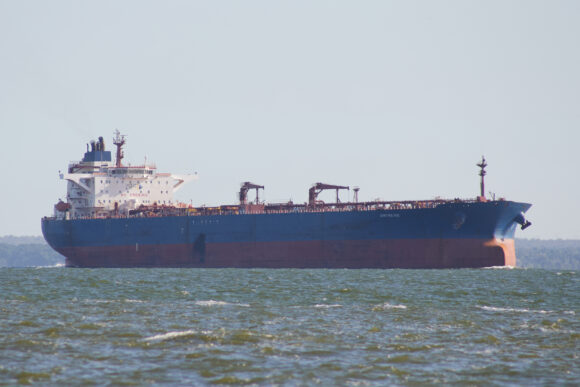
Photograph: The oil tanker named Xanthos Eos steams on Lake Maracaibo, Venezuela, Wednesday, Jan. 7, 2026. (AP Photo/Edgar Frias)
In the wake of President Nicolas Maduro’s ouster, oil companies are racing to secure tankers and establish operations for exporting Venezuelan crude to the U.S. According to four sources familiar with the situation, discussions are intensifying to ensure the safe transfer of oil from aging vessels and deteriorating Venezuelan ports.
Major trading houses and oil companies, including Chevron, Vitol, and Trafigura, are vying for U.S. government contracts to facilitate these exports. This surge in interest follows President Donald Trump’s announcement that Venezuela could potentially deliver up to 50 million barrels of sanctioned oil to the United States.
Trafigura indicated during a recent meeting with the White House that it anticipates its first vessel will be ready to load within the next week. However, the situation is complicated by Venezuela’s ongoing U.S. blockade, which has led to the country storing oil in tankers that are now nearly full. Many of these vessels are old, poorly maintained, and under sanctions, creating significant logistical challenges.
Due to liability and insurance requirements, other vessels are unable to make direct contact with sanctioned ships, even if the U.S. grants licenses. Furthermore, the onshore storage tanks, which have not been maintained for years, pose additional risks for those attempting to load the oil.
Shipping companies like Maersk Tankers and American Eagle Tankers are exploring ways to expand their ship-to-ship transfer operations in Venezuela. One source noted that Maersk could replicate its successful ship-to-shore-to-ship logistics previously used in Amuay Bay. Maersk already operates in nearby Aruba and Curacao, which are often utilized for transferring Venezuelan oil. However, these transfers can be more costly when conducted in Aruba or U.S. ports.
Complicating matters further is the shortage of smaller ships needed to transport oil from storage vessels to piers, where it can then be transferred to larger ships. Additionally, inadequate maintenance of machinery and equipment poses further challenges, according to another shipping source.
AET, which currently assists Chevron in transferring Venezuelan crude to the U.S., is reportedly being approached by potential clients looking to expand its operational capacity in this area. Maersk Tankers, AET, and Chevron have not yet responded to requests for comment.
While there is potential for supply to reach the 500,000 barrels per day that Venezuela previously exported to the U.S. before sanctions, achieving this goal will be difficult. The logistics of extracting oil from both tankers and onshore storage complicate the process, according to sources.
Companies are also fiercely competing for loading slots at Venezuela’s main Jose oil terminal, which has limitations in both capacity and speed. Chevron, a key joint venture partner in the region, is actively working to maintain its advantageous position at Venezuela’s terminals while coordinating its vessel fleet.
In addition, oil companies, including Chevron, Vitol, and Trafigura, are sourcing essential supplies of naphtha. This substance is typically blended with heavy Venezuelan crude to reduce its density, making it easier to transport and process at refineries.
(Reporting by Marianna Parrage and Arathy Somasekhar in Houston; editing by Liz Hampton and Rosalba O’Brien)
Photograph: The oil tanker named Xanthos Eos steams on Lake Maracaibo, Venezuela, Wednesday, Jan. 7, 2026. (AP Photo/Edgar Frias)