Analyzing the Potential US-China Conflict Over Taiwan

At the heart of the artificial intelligence boom and the global economy lies Taiwan, a pivotal player in semiconductor production. This island nation faces mounting pressure from mainland China and increasing uncertainty regarding U.S. support. While war seems unlikely at present, any conflict would have a seismic impact on the global economy.
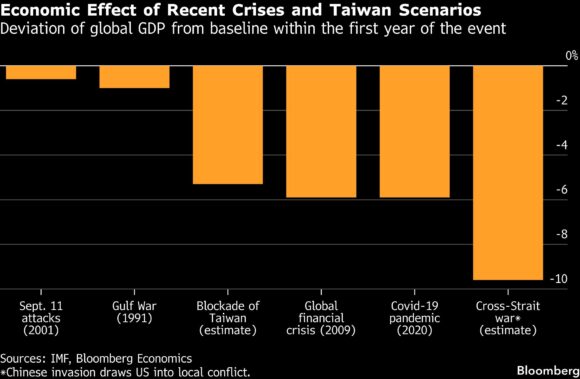
Bloomberg Economics outlines five potential scenarios for escalating tensions in the Taiwan Strait, ranging from war to diplomatic rapprochement, and assesses their economic repercussions. In the most extreme scenario, a U.S.-China conflict over Taiwan could cost the global economy approximately $10.6 trillion—around 9.6% of global GDP—within the first year, surpassing the impacts of both the COVID-19 pandemic and the 2007-09 financial crisis.
• A U.S.-China war would drastically limit access to logic semiconductors, essential for various industries including automotive, aviation, AI data centers, and smartphones.
• Trade between these superpowers and their allies would likely collapse, halting shipping through one of the world’s busiest sea lanes. Global markets, increasingly buoyed by AI optimism, could face a significant downturn. Industries reliant on Taiwanese chips, such as smartphones, PCs, and automobiles, would be severely impacted.
• The fallout would be felt worldwide. Taiwan’s economy would be devastated, with estimates suggesting an 11% decline in China’s GDP and a 6.6% drop in the U.S. GDP in the first year. The European Union could see a 10.9% decline, while India and the UK might experience drops of 8% and 6.1%, respectively. South Korea could face a staggering 23% reduction in GDP, and Japan 14.7%.
• Other scenarios include a Chinese blockade of Taiwan or, in a more optimistic but unlikely outcome, a move toward détente between the two sides.
High Stakes in the Taiwan Strait
The semiconductor shortages experienced during the post-COVID recovery highlighted the critical role of chips in the global economy. A crisis in the Taiwan Strait would deliver an even greater shock. Taiwan produces 62% of the world’s advanced logic semiconductors and is also a key player in legacy chip manufacturing. Globally, sectors utilizing chips contribute nearly $6 trillion to value-added production.
Taiwan Semiconductor Manufacturing Co. (TSMC) dominates the global foundry market, accounting for 70% of revenue and supplying major companies like AMD, Apple, and Nvidia. Other firms, such as UMC and PSMC, also play significant roles in the island’s chip production landscape.
This dominance extends to financial markets, where the largest U.S. tech companies represent over 30% of the S&P 500, driving substantial market gains. The combined market capitalization of TSMC’s top ten customers reaches $14 trillion.
The Taiwan Strait is a vital artery for global commerce, with nearly half of the global container fleet and over one-fifth of maritime trade ($2.45 trillion) passing through in 2022.
Strategically, Taiwan tests U.S. power and credibility in Asia. Its position in the First Island Chain, which stretches from Japan to the Philippines, serves as a counterbalance to China’s military ambitions. Politically, Taiwan’s 23 million citizens uphold a vibrant democracy, symbolizing the stakes in the broader struggle between open and authoritarian systems.
Breaking the Status Quo
Since the U.S. severed official ties with Taipei in 1979 to recognize China, an uneasy status quo has emerged, supported by U.S. military superiority, Beijing’s strategic patience, and deepening economic ties across the strait. However, these pillars are eroding. The U.S. no longer holds a decisive military edge, while Beijing grows increasingly impatient for unification.
In 1996, during the Third Taiwan Strait Crisis, the U.S. sent an aircraft carrier through the strait as a show of force. Today, such a gesture would carry less weight, given China’s military advancements, including a growing navy and missile capabilities.
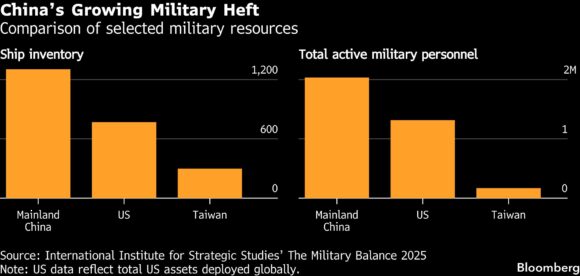
China’s military modernization has transformed it into a near-peer force, surpassing the U.S. in naval strength and rapidly expanding its capabilities in undersea warfare. Geography also favors China; any conflict would occur in its backyard, complicating U.S. operations that would require traversing thousands of miles.
China’s advanced military capabilities include stealth aircraft and hypersonic missiles, with significant investments in counter-space and cyber operations aimed at exploiting U.S. vulnerabilities.
The View From Three Capitals
Over the past 75 years, the ambitions of China, Taiwan, and the U.S. have shifted dramatically. China sees itself as stronger than ever and is increasingly impatient for unification. Taiwan is committed to its distinct democratic identity, while the U.S. grapples with the implications of its global commitments.
Since taking office, President Xi Jinping has intensified pressure on Taiwan, framing unification as central to his legacy and the Communist Party’s legitimacy. Despite being China’s most powerful leader in decades, Xi faces constraints, including a slowing economy and an untested military.
Public sentiment in Taiwan has hardened against China, particularly following the crackdown in Hong Kong. The ruling Democratic Progressive Party (DPP) remains wary of Beijing, committed to preserving Taiwan’s status quo while facing political constraints on defense spending.
Complicating matters is an unconventional U.S. president who has questioned the logic of defending Taiwan. With Trump’s return to the White House, the traditional U.S. stance of “strategic ambiguity” may be at risk, further destabilizing the status quo.
As tensions rise, the Taiwan Security Index, which measures geopolitical friction, has increased significantly since Lai’s inauguration, reflecting the growing military activity and rhetoric from China.
While the risk of war is rising, it is not imminent. China’s military is progressing toward the capability to take Taiwan by force, but the government likely still views an all-out attack as too risky. A failed invasion would be a catastrophic blow to the Communist Party’s legitimacy.
Scenarios for the Taiwan Strait
Bloomberg outlines five potential pathways for cross-strait relations over the next five years, from a Chinese invasion to diplomatic rapprochement. Each scenario is modeled to estimate GDP impacts across major economies through three channels: semiconductor supply chain disruptions, trade shocks, and financial market shocks.
Supply chain disruptions are assessed using OECD trade data, estimating chip shortages and the direct impacts on sectors reliant on semiconductors. In a war scenario, losing access to Taiwan’s production could cut global supplies of advanced logic chips by 62% and less-advanced chips by 31%.
Trade shocks would arise from sanctions and military-related shipping disruptions. In a blockade scenario, tariffs would increase significantly, further straining economic ties between the U.S. and China.
Financial shocks are modeled using a structural Bayesian Global VAR model, estimating the impact of geopolitical uncertainty on global markets. Given the heavy market exposure to AI and Taiwan’s role in chip production, a crisis could trigger a substantial financial shock.
In Case of a War
One potential flashpoint for conflict could arise if Beijing perceives Taiwan as moving toward a formal declaration of independence. While the Chinese government exercises caution, the probability of conflict is increasing as tensions escalate.
In the event of a Chinese invasion, the initial assault could come with little warning, potentially involving a massive strike campaign against Taiwan and U.S. forces in the region. Such actions would likely escalate the conflict and disrupt global trade.
For the main actors and the global economy, the fallout from a conflict would be catastrophic. Taiwan’s economy could suffer a 40% hit to GDP, while China’s GDP might decline by 11%. The U.S. could see a 6.6% reduction in GDP, with global GDP down by 9.6% in the first year.
For global businesses, the semiconductor supply chain is critical, and a crisis in the Taiwan Strait could have far-reaching consequences. For instance, Apple could face a 90% loss in iPhone sales due to reliance on Taiwanese chips, while the global PC market could see revenue declines of 30% to 40%.
Air and Sea Blockade
China could also opt for an air and sea blockade to coerce Taiwan into submission, which would disrupt trade and provoke a strong response from the U.S. and its allies. The economic consequences of such a blockade would be severe, with Taiwan’s GDP potentially down by 12.5% in the first year.
Tensions Could Increase
Low-intensity clashes or gray zone tactics could further escalate tensions without triggering a major crisis. This scenario could result in a small GDP impact for China and the U.S., but it reflects the growing geopolitical risk in the region.
What If Things Stay the Same?
The current status quo is under pressure but remains intact for now. Most in Taiwan prefer this situation over the risks of independence or forced unification. However, rising tensions and strategic rivalry between the U.S. and China make it increasingly unlikely that the equilibrium will hold.
Rapprochement Is Elusive
Finally, a scenario of peace and increased trade between Taiwan and China remains highly improbable. Historical precedents suggest that any significant shift in policy would be challenging for both sides, given entrenched positions and public sentiment.
The outlook for the Taiwan Strait is uncertain, but the stakes are clear. Taiwan’s central role in the semiconductor supply chain and its geopolitical significance underscore the potential costs of a crisis for China, the U.S., and the world.
Top photograph: Anti-landing barriers on the Taiwanese islands of Kinmen, across from Xiamen in mainland China. Photo credit: An Rong Xu/Bloomberg
At the heart of the artificial intelligence boom and the global economy lies Taiwan, a pivotal player in semiconductor production. This island nation faces mounting pressure from mainland China and increasing uncertainty regarding U.S. support. While war seems unlikely at present, any conflict would have a seismic impact on the global economy.
Bloomberg Economics outlines five potential scenarios for escalating tensions in the Taiwan Strait, ranging from war to diplomatic rapprochement, and assesses their economic repercussions. In the most extreme scenario, a U.S.-China conflict over Taiwan could cost the global economy approximately $10.6 trillion—around 9.6% of global GDP—within the first year, surpassing the impacts of both the COVID-19 pandemic and the 2007-09 financial crisis.
• A U.S.-China war would drastically limit access to logic semiconductors, essential for various industries including automotive, aviation, AI data centers, and smartphones.
• Trade between these superpowers and their allies would likely collapse, halting shipping through one of the world’s busiest sea lanes. Global markets, increasingly buoyed by AI optimism, could face a significant downturn. Industries reliant on Taiwanese chips, such as smartphones, PCs, and automobiles, would be severely impacted.
• The fallout would be felt worldwide. Taiwan’s economy would be devastated, with estimates suggesting an 11% decline in China’s GDP and a 6.6% drop in the U.S. GDP in the first year. The European Union could see a 10.9% decline, while India and the UK might experience drops of 8% and 6.1%, respectively. South Korea could face a staggering 23% reduction in GDP, and Japan 14.7%.
• Other scenarios include a Chinese blockade of Taiwan or, in a more optimistic but unlikely outcome, a move toward détente between the two sides.
High Stakes in the Taiwan Strait
The semiconductor shortages experienced during the post-COVID recovery highlighted the critical role of chips in the global economy. A crisis in the Taiwan Strait would deliver an even greater shock. Taiwan produces 62% of the world’s advanced logic semiconductors and is also a key player in legacy chip manufacturing. Globally, sectors utilizing chips contribute nearly $6 trillion to value-added production.
Taiwan Semiconductor Manufacturing Co. (TSMC) dominates the global foundry market, accounting for 70% of revenue and supplying major companies like AMD, Apple, and Nvidia. Other firms, such as UMC and PSMC, also play significant roles in the island’s chip production landscape.
This dominance extends to financial markets, where the largest U.S. tech companies represent over 30% of the S&P 500, driving substantial market gains. The combined market capitalization of TSMC’s top ten customers reaches $14 trillion.
The Taiwan Strait is a vital artery for global commerce, with nearly half of the global container fleet and over one-fifth of maritime trade ($2.45 trillion) passing through in 2022.
Strategically, Taiwan tests U.S. power and credibility in Asia. Its position in the First Island Chain, which stretches from Japan to the Philippines, serves as a counterbalance to China’s military ambitions. Politically, Taiwan’s 23 million citizens uphold a vibrant democracy, symbolizing the stakes in the broader struggle between open and authoritarian systems.
Breaking the Status Quo
Since the U.S. severed official ties with Taipei in 1979 to recognize China, an uneasy status quo has emerged, supported by U.S. military superiority, Beijing’s strategic patience, and deepening economic ties across the strait. However, these pillars are eroding. The U.S. no longer holds a decisive military edge, while Beijing grows increasingly impatient for unification.
In 1996, during the Third Taiwan Strait Crisis, the U.S. sent an aircraft carrier through the strait as a show of force. Today, such a gesture would carry less weight, given China’s military advancements, including a growing navy and missile capabilities.
China’s military modernization has transformed it into a near-peer force, surpassing the U.S. in naval strength and rapidly expanding its capabilities in undersea warfare. Geography also favors China; any conflict would occur in its backyard, complicating U.S. operations that would require traversing thousands of miles.
China’s advanced military capabilities include stealth aircraft and hypersonic missiles, with significant investments in counter-space and cyber operations aimed at exploiting U.S. vulnerabilities.
The View From Three Capitals
Over the past 75 years, the ambitions of China, Taiwan, and the U.S. have shifted dramatically. China sees itself as stronger than ever and is increasingly impatient for unification. Taiwan is committed to its distinct democratic identity, while the U.S. grapples with the implications of its global commitments.
Since taking office, President Xi Jinping has intensified pressure on Taiwan, framing unification as central to his legacy and the Communist Party’s legitimacy. Despite being China’s most powerful leader in decades, Xi faces constraints, including a slowing economy and an untested military.
Public sentiment in Taiwan has hardened against China, particularly following the crackdown in Hong Kong. The ruling Democratic Progressive Party (DPP) remains wary of Beijing, committed to preserving Taiwan’s status quo while facing political constraints on defense spending.
Complicating matters is an unconventional U.S. president who has questioned the logic of defending Taiwan. With Trump’s return to the White House, the traditional U.S. stance of “strategic ambiguity” may be at risk, further destabilizing the status quo.
As tensions rise, the Taiwan Security Index, which measures geopolitical friction, has increased significantly since Lai’s inauguration, reflecting the growing military activity and rhetoric from China.
While the risk of war is rising, it is not imminent. China’s military is progressing toward the capability to take Taiwan by force, but the government likely still views an all-out attack as too risky. A failed invasion would be a catastrophic blow to the Communist Party’s legitimacy.
Scenarios for the Taiwan Strait
Bloomberg outlines five potential pathways for cross-strait relations over the next five years, from a Chinese invasion to diplomatic rapprochement. Each scenario is modeled to estimate GDP impacts across major economies through three channels: semiconductor supply chain disruptions, trade shocks, and financial market shocks.
Supply chain disruptions are assessed using OECD trade data, estimating chip shortages and the direct impacts on sectors reliant on semiconductors. In a war scenario, losing access to Taiwan’s production could cut global supplies of advanced logic chips by 62% and less-advanced chips by 31%.
Trade shocks would arise from sanctions and military-related shipping disruptions. In a blockade scenario, tariffs would increase significantly, further straining economic ties between the U.S. and China.
Financial shocks are modeled using a structural Bayesian Global VAR model, estimating the impact of geopolitical uncertainty on global markets. Given the heavy market exposure to AI and Taiwan’s role in chip production, a crisis could trigger a substantial financial shock.
In Case of a War
One potential flashpoint for conflict could arise if Beijing perceives Taiwan as moving toward a formal declaration of independence. While the Chinese government exercises caution, the probability of conflict is increasing as tensions escalate.
In the event of a Chinese invasion, the initial assault could come with little warning, potentially involving a massive strike campaign against Taiwan and U.S. forces in the region. Such actions would likely escalate the conflict and disrupt global trade.
For the main actors and the global economy, the fallout from a conflict would be catastrophic. Taiwan’s economy could suffer a 40% hit to GDP, while China’s GDP might decline by 11%. The U.S. could see a 6.6% reduction in GDP, with global GDP down by 9.6% in the first year.
For global businesses, the semiconductor supply chain is critical, and a crisis in the Taiwan Strait could have far-reaching consequences. For instance, Apple could face a 90% loss in iPhone sales due to reliance on Taiwanese chips, while the global PC market could see revenue declines of 30% to 40%.
Air and Sea Blockade
China could also opt for an air and sea blockade to coerce Taiwan into submission, which would disrupt trade and provoke a strong response from the U.S. and its allies. The economic consequences of such a blockade would be severe, with Taiwan’s GDP potentially down by 12.5% in the first year.
Tensions Could Increase
Low-intensity clashes or gray zone tactics could further escalate tensions without triggering a major crisis. This scenario could result in a small GDP impact for China and the U.S., but it reflects the growing geopolitical risk in the region.
What If Things Stay the Same?
The current status quo is under pressure but remains intact for now. Most in Taiwan prefer this situation over the risks of independence or forced unification. However, rising tensions and strategic rivalry between the U.S. and China make it increasingly unlikely that the equilibrium will hold.
Rapprochement Is Elusive
Finally, a scenario of peace and increased trade between Taiwan and China remains highly improbable. Historical precedents suggest that any significant shift in policy would be challenging for both sides, given entrenched positions and public sentiment.
The outlook for the Taiwan Strait is uncertain, but the stakes are clear. Taiwan’s central role in the semiconductor supply chain and its geopolitical significance underscore the potential costs of a crisis for China, the U.S., and the world.
Top photograph: Anti-landing barriers on the Taiwanese islands of Kinmen, across from Xiamen in mainland China. Photo credit: An Rong Xu/Bloomberg