Apollo Enhances Asset-Level Risk Assessments to Address Extreme Weather Effects
Apollo Global Management Inc. is enhancing its risk review process to better account for the impact of extreme weather on asset valuations.
This initiative comes in response to the increasing damage caused by floods, storms, and wildfires. Since 2023, Apollo has been conducting top-down analyses of these risks and is now expanding its approach to include a more detailed process for identifying company-level risks prior to closing deals, according to Jaycee Pribulsky, Apollo’s chief sustainability officer.
“Both private equity and private credit teams are expanding bottom-up, asset-level evaluations of physical and transition risks,” she stated in an interview with Bloomberg.
Pribulsky emphasized that “climate-driven disruptions can directly impact operating costs, supply chains, and insurance markets,” making financial risk factors increasingly urgent.
This development reflects a growing recognition that extreme weather events can significantly alter asset values. Managers like Apollo are keen to reassure investors that valuation models in private markets remain robust.
When wildfires and floods devastate neighborhoods, asset values can plummet overnight. Swiss Re estimates that natural catastrophes in 2025 resulted in $107 billion in global insured losses, with total economic losses reaching $220 billion.
“Elevated natural catastrophe losses are no longer outliers but the new baseline,” stated Monica Ningen, Swiss Re’s chief executive of US Property and Casualty.
Recent steps taken by Apollo include a more thorough analysis of the effects of “acute and chronic climate hazards.” This involves “loan-level mapping in mortgage portfolios” to evaluate exposure to drought, flood, heat, and wildfire in hard-asset sectors, where these risks can materially influence collateral values and cash-flow durability.
Advancements in technology and data availability are enabling Apollo to refine its approach to measuring the physical and transition risks associated with adapting to a warmer planet. These assessments are now “integrated into every deal, across all asset classes,” Pribulsky noted.
Efforts to quantify such risks are gaining traction across private markets. KKR & Co. announced in July the introduction of a new credit climate risk model that provides analysts with physical risk inputs for evaluating new and existing issuers, which can also be used to assess credit valuations.
A month earlier, KKR cautioned that potential “changes in climatic conditions, along with the response or failure to respond to these changes,” may “strain or deplete infrastructure and response capabilities,” as well as “increase costs, including insurance costs.”
These assessments are particularly relevant for investments in large infrastructure projects, such as data centers that support artificial intelligence. Apollo has been active in such deals, including a majority stake acquisition in Stream Data Centers.
“When evaluating data centers, power is a critical focus area as it represents one of the largest operating expenses,” Pribulsky explained. “We assess energy efficiency and power sourcing while also evaluating water sourcing, usage, and recycling, as design can significantly influence costs, regulatory exposure, and resilience.”
Wall Street lenders are also increasingly attentive to these considerations, producing research that underscores the need to treat extreme weather shocks as financial risks akin to inflation or political risk.
Sarah Kapnick, global head of climate advisory at JPMorgan Chase & Co., asserts that investors “need to start assessing how climate will affect their holdings in the same way they would for inflation or debt coverage ratios, as it can impact cash flows and costs.”
She notes that this realization is “now starting to enter the financial markets,” prompting savvy investors to understand the evolving nature of these risks, which could erode profitability but also present opportunities.
Investors planning to hold assets for several years should pay particular attention to these risks, especially given the typical time horizon for private market investments.
A recent report by MSCI highlighted that “physical risk isn’t tomorrow’s problem; it is already impacting portfolios.” Analyzing $2 trillion of listed equities, MSCI found that 55% of companies “already face severe physical hazards today.”
Sectors currently affected include real estate, insurance, and utilities, as noted in a client note from Jefferies analysts led by Luke Sussams. The consequences are higher premiums, lower asset values, and reduced access to insurance. In the event of a catastrophe, supply chains can face immediate and devastating disruptions, compounding risks for businesses and their investors.
Rather than viewing physical risk as a distant concern, JPMorgan’s Kapnick asserts that “investors are increasingly recognizing it as a factor already priced into the market today.”
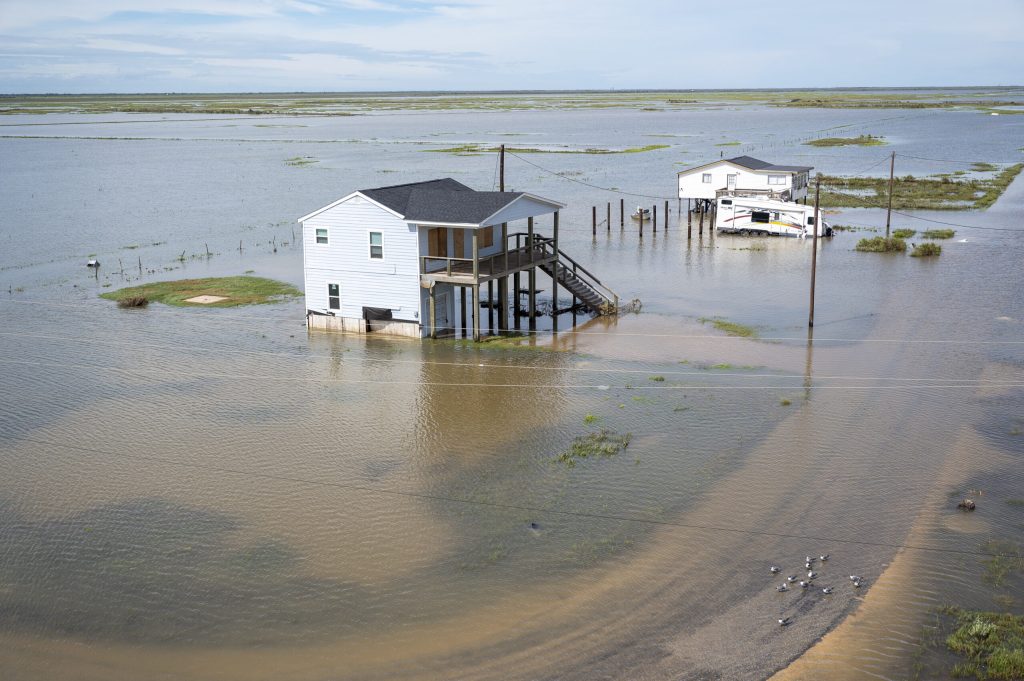
Photo: Homes surrounded by flood waters after Hurricane Beryl made landfall in Sargent, Texas. Photo credit: Eddie Seal/Bloomberg
Copyright 2025 Bloomberg.
Apollo Global Management Inc. is enhancing its risk review process to better account for the impact of extreme weather on asset valuations.
This initiative comes in response to the increasing damage caused by floods, storms, and wildfires. Since 2023, Apollo has been conducting top-down analyses of these risks and is now expanding its approach to include a more detailed process for identifying company-level risks prior to closing deals, according to Jaycee Pribulsky, Apollo’s chief sustainability officer.
“Both private equity and private credit teams are expanding bottom-up, asset-level evaluations of physical and transition risks,” she stated in an interview with Bloomberg.
Pribulsky emphasized that “climate-driven disruptions can directly impact operating costs, supply chains, and insurance markets,” making financial risk factors increasingly urgent.
This development reflects a growing recognition that extreme weather events can significantly alter asset values. Managers like Apollo are keen to reassure investors that valuation models in private markets remain robust.
When wildfires and floods devastate neighborhoods, asset values can plummet overnight. Swiss Re estimates that natural catastrophes in 2025 resulted in $107 billion in global insured losses, with total economic losses reaching $220 billion.
“Elevated natural catastrophe losses are no longer outliers but the new baseline,” stated Monica Ningen, Swiss Re’s chief executive of US Property and Casualty.
Recent steps taken by Apollo include a more thorough analysis of the effects of “acute and chronic climate hazards.” This involves “loan-level mapping in mortgage portfolios” to evaluate exposure to drought, flood, heat, and wildfire in hard-asset sectors, where these risks can materially influence collateral values and cash-flow durability.
Advancements in technology and data availability are enabling Apollo to refine its approach to measuring the physical and transition risks associated with adapting to a warmer planet. These assessments are now “integrated into every deal, across all asset classes,” Pribulsky noted.
Efforts to quantify such risks are gaining traction across private markets. KKR & Co. announced in July the introduction of a new credit climate risk model that provides analysts with physical risk inputs for evaluating new and existing issuers, which can also be used to assess credit valuations.
A month earlier, KKR cautioned that potential “changes in climatic conditions, along with the response or failure to respond to these changes,” may “strain or deplete infrastructure and response capabilities,” as well as “increase costs, including insurance costs.”
These assessments are particularly relevant for investments in large infrastructure projects, such as data centers that support artificial intelligence. Apollo has been active in such deals, including a majority stake acquisition in Stream Data Centers.
“When evaluating data centers, power is a critical focus area as it represents one of the largest operating expenses,” Pribulsky explained. “We assess energy efficiency and power sourcing while also evaluating water sourcing, usage, and recycling, as design can significantly influence costs, regulatory exposure, and resilience.”
Wall Street lenders are also increasingly attentive to these considerations, producing research that underscores the need to treat extreme weather shocks as financial risks akin to inflation or political risk.
Sarah Kapnick, global head of climate advisory at JPMorgan Chase & Co., asserts that investors “need to start assessing how climate will affect their holdings in the same way they would for inflation or debt coverage ratios, as it can impact cash flows and costs.”
She notes that this realization is “now starting to enter the financial markets,” prompting savvy investors to understand the evolving nature of these risks, which could erode profitability but also present opportunities.
Investors planning to hold assets for several years should pay particular attention to these risks, especially given the typical time horizon for private market investments.
A recent report by MSCI highlighted that “physical risk isn’t tomorrow’s problem; it is already impacting portfolios.” Analyzing $2 trillion of listed equities, MSCI found that 55% of companies “already face severe physical hazards today.”
Sectors currently affected include real estate, insurance, and utilities, as noted in a client note from Jefferies analysts led by Luke Sussams. The consequences are higher premiums, lower asset values, and reduced access to insurance. In the event of a catastrophe, supply chains can face immediate and devastating disruptions, compounding risks for businesses and their investors.
Rather than viewing physical risk as a distant concern, JPMorgan’s Kapnick asserts that “investors are increasingly recognizing it as a factor already priced into the market today.”
Photo: Homes surrounded by flood waters after Hurricane Beryl made landfall in Sargent, Texas. Photo credit: Eddie Seal/Bloomberg
Copyright 2025 Bloomberg.