Australia Faces Wildfire Threats Similar to Los Angeles: Millions at Risk
Millions of people living on the expanding outskirts of Australia’s major cities face an increasing risk of urban wildfires similar to the deadly blazes in Los Angeles last year.
Suburbs on the fringes of centers including Sydney, Melbourne, and Perth now house at least 6.9 million inhabitants. Like regions impacted in LA, these areas feature residential neighborhoods adjacent to highly flammable grasslands, according to a report published Tuesday by the Climate Council think tank and a group of former Australian fire chiefs.
“Nearly every Australian capital city has a dangerous mix of preconditions for a catastrophic fire like LA — the possibility of extreme dry periods, severe winds, steep slopes, bushland near homes, and a history of destructive fires,” stated Greg Mullins, a former New South Wales Fire Commissioner who has also worked with authorities in the US.
In January 2025, blazes in Los Angeles County killed 31 people and are considered the world’s costliest wildfires, with estimated insured losses of $40 billion, according to Swiss Re. The report highlights that factors contributing to this devastation—such as erratic weather driven by climate change and the expansion of new homes near urban fringes—are also present across Australia.
To mitigate these risks, Australian authorities must act swiftly to phase out polluting fossil fuels and increase investment in disaster preparation and resilience, the report emphasizes. Australia has a long history of deadly wildfires, with the 2019-2020 Black Summer blazes resulting in 33 fatalities and burning through 24 million hectares (59 million acres).
Read more: Natural Catastrophe Losses in 2019 Down 18% from Annual Average: Willis Re Report
“It’s critical that we address the root causes of more extreme weather by drastically cutting climate pollution while adequately resourcing fire and land management agencies, and preparing suburban communities for rising risks,” Mullins added. He is also the founder of the Emergency Leaders for Climate Action group.
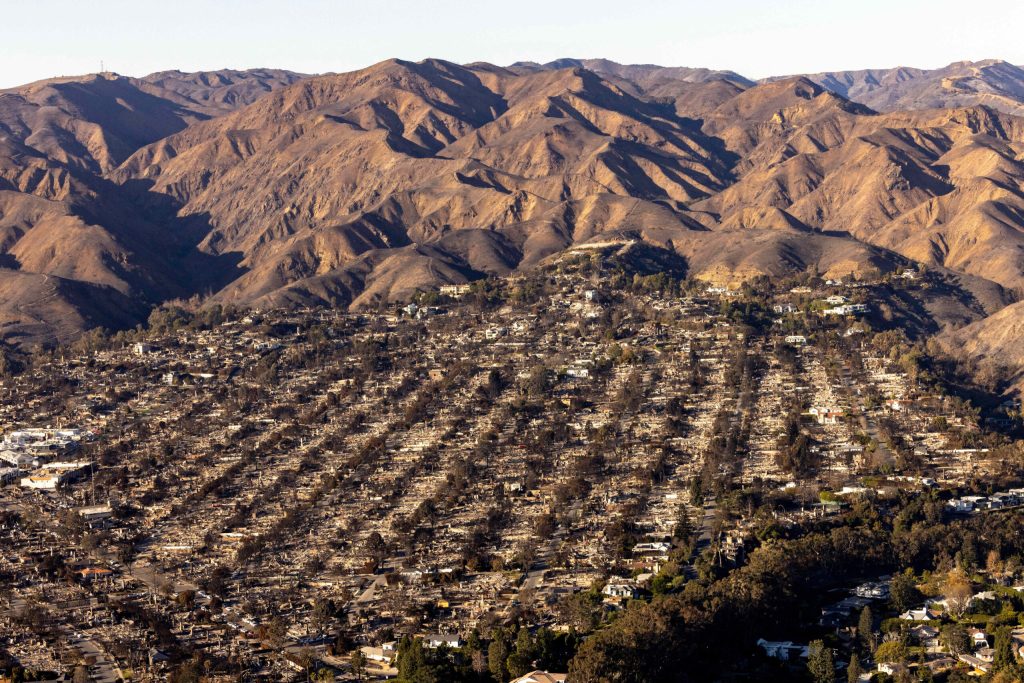
Photograph: Homes destroyed by the Palisades Fire in Los Angeles, on Jan. 15, 2025. Photo credit: Jill Connelly/Bloomberg
Related:
Copyright 2026 Bloomberg.
Was this article valuable?
Here are more articles you may enjoy.
Interested in Catastrophe?
Get automatic alerts for this topic.
Millions of people living on the expanding outskirts of Australia’s major cities face an increasing risk of urban wildfires similar to the deadly blazes in Los Angeles last year.
Suburbs on the fringes of centers including Sydney, Melbourne, and Perth now house at least 6.9 million inhabitants. Like regions impacted in LA, these areas feature residential neighborhoods adjacent to highly flammable grasslands, according to a report published Tuesday by the Climate Council think tank and a group of former Australian fire chiefs.
“Nearly every Australian capital city has a dangerous mix of preconditions for a catastrophic fire like LA — the possibility of extreme dry periods, severe winds, steep slopes, bushland near homes, and a history of destructive fires,” stated Greg Mullins, a former New South Wales Fire Commissioner who has also worked with authorities in the US.
In January 2025, blazes in Los Angeles County killed 31 people and are considered the world’s costliest wildfires, with estimated insured losses of $40 billion, according to Swiss Re. The report highlights that factors contributing to this devastation—such as erratic weather driven by climate change and the expansion of new homes near urban fringes—are also present across Australia.
To mitigate these risks, Australian authorities must act swiftly to phase out polluting fossil fuels and increase investment in disaster preparation and resilience, the report emphasizes. Australia has a long history of deadly wildfires, with the 2019-2020 Black Summer blazes resulting in 33 fatalities and burning through 24 million hectares (59 million acres).
Read more: Natural Catastrophe Losses in 2019 Down 18% from Annual Average: Willis Re Report
“It’s critical that we address the root causes of more extreme weather by drastically cutting climate pollution while adequately resourcing fire and land management agencies, and preparing suburban communities for rising risks,” Mullins added. He is also the founder of the Emergency Leaders for Climate Action group.
Photograph: Homes destroyed by the Palisades Fire in Los Angeles, on Jan. 15, 2025. Photo credit: Jill Connelly/Bloomberg
Related:
Copyright 2026 Bloomberg.
Was this article valuable?
Here are more articles you may enjoy.
Interested in Catastrophe?
Get automatic alerts for this topic.