Britain Faces Sharpest Job Cuts Amid AI Shift, According to Morgan Stanley

The UK is experiencing a significant job loss due to artificial intelligence (AI), outpacing its international counterparts. This alarming trend is highlighted by research from Morgan Stanley, which indicates that the benefits of AI adoption for businesses come at a steep cost for workers in Britain, further straining an already cooling labor market.
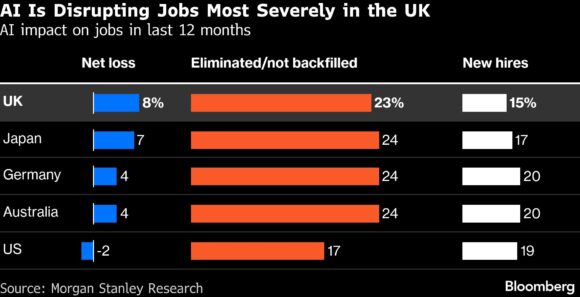
According to the study shared with Bloomberg, British companies reported an 8% net job loss over the past year, the highest among a group that included firms from Germany, the US, Japan, and Australia. This figure is double the international average, underscoring the unique challenges faced by the UK workforce.
The report surveyed companies across five industries—consumer staples and retail, real estate, transport, healthcare equipment, and automobiles—that have been utilizing AI for at least a year. Many of these firms are already reaping the rewards of their tech investments.
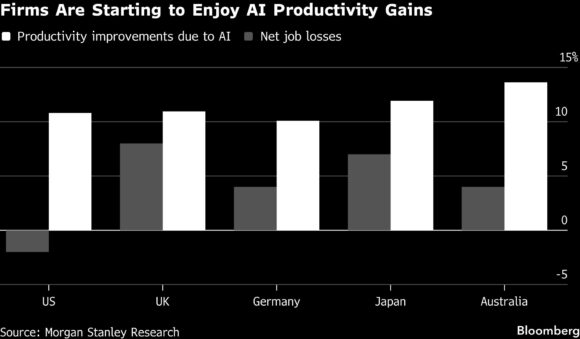
UK firms reported an average productivity increase of 11.5% due to AI, with nearly half experiencing even greater gains. In contrast, their US counterparts, who reported similar productivity improvements, managed to create more jobs than they eliminated through AI.
The AI revolution in the UK coincides with employers grappling with rising payroll costs, sluggish growth, and heightened political instability. Job cuts are occurring at the fastest rate since 2020, with unemployment nearing a five-year high. This situation is exacerbated by substantial minimum wage increases and rising national insurance contributions, which are affecting staffing strategies.
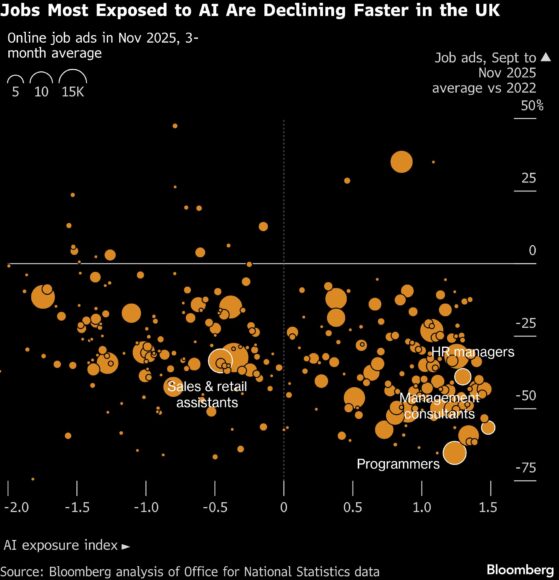
While job postings are declining across various sectors, UK firms are particularly reducing positions likely to be impacted by AI, such as software developers and consultants. A Bloomberg analysis of online vacancy data from the Office for National Statistics reveals that vacancies for these roles have plummeted by 37% since the launch of OpenAI’s ChatGPT, compared to a 26% decline in other sectors.
Justin Moy, managing director at EHF Mortgages in Chelmsford, northeast of London, noted, “The rising costs of employing staff are driving a growing number of smaller businesses to use AI and outsourcing solutions to fulfill roles traditionally filled by local people who are now missing out on these opportunities.”
The Morgan Stanley report indicates that AI has led UK employers to cut or refrain from backfilling about a quarter of their roles, similar to trends in other countries. However, UK firms are significantly less likely to increase hiring as a result of this technology.
Despite the challenges, AI holds the potential to revitalize Britain’s economy, as highlighted by the Bank of England and the Office for Budget Responsibility. The fiscal watchdog estimates that AI could enhance productivity growth by as much as 0.8 percentage points over the next decade, a boost that would benefit living standards and public finances.
Currently, however, the focus remains on how AI exacerbates the UK’s job crisis, particularly affecting young people and white-collar workers. Official figures released last week indicate that vacancies across the economy have fallen by over a third since 2022, equating to half a million roles. A significant portion of this decline is attributed to sectors most susceptible to AI, including professional, scientific, technical activities, administrative services, and IT.
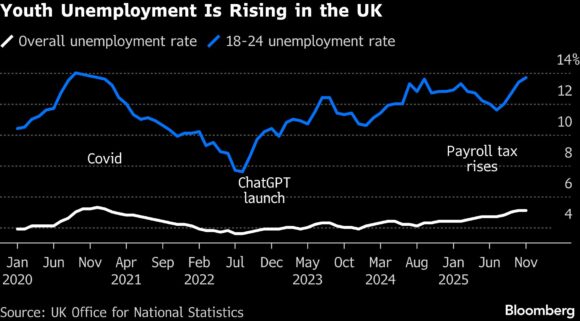
The UK’s youngest workers face challenges on multiple fronts, as AI disrupts entry-level white-collar roles while Labour’s tax policies hinder hiring in retail and hospitality. Youth unemployment has surged faster than the overall rate, reaching 13.7% in the three months ending in November, the highest level since 2020.
Bank of England Governor Andrew Bailey has remarked that AI is emerging as the next “general purpose technology,” akin to transformative innovations like computers and the internet. However, he cautioned that the UK must prepare for potential job displacements driven by AI, which could also affect the talent pipeline for advancing into senior roles.
Employers surveyed by Morgan Stanley indicated that they are most likely to cut early-career jobs requiring two to five years of experience in the UK. Rachel Fletcher, Head of EMEA Sustainability Research, emphasized that the findings serve as an “early warning sign” of how AI is disrupting the labor market, noting that the technology’s impact on employment has been a frequent topic in recent investor discussions.
Photograph: Commuters in London. Photo credit: Jose Sarmento Matos/Bloomberg
Copyright 2026 Bloomberg.
Interested in AI?
Get automatic alerts for this topic.
The UK is experiencing a significant job loss due to artificial intelligence (AI), outpacing its international counterparts. This alarming trend is highlighted by research from Morgan Stanley, which indicates that the benefits of AI adoption for businesses come at a steep cost for workers in Britain, further straining an already cooling labor market.
According to the study shared with Bloomberg, British companies reported an 8% net job loss over the past year, the highest among a group that included firms from Germany, the US, Japan, and Australia. This figure is double the international average, underscoring the unique challenges faced by the UK workforce.
The report surveyed companies across five industries—consumer staples and retail, real estate, transport, healthcare equipment, and automobiles—that have been utilizing AI for at least a year. Many of these firms are already reaping the rewards of their tech investments.
UK firms reported an average productivity increase of 11.5% due to AI, with nearly half experiencing even greater gains. In contrast, their US counterparts, who reported similar productivity improvements, managed to create more jobs than they eliminated through AI.
The AI revolution in the UK coincides with employers grappling with rising payroll costs, sluggish growth, and heightened political instability. Job cuts are occurring at the fastest rate since 2020, with unemployment nearing a five-year high. This situation is exacerbated by substantial minimum wage increases and rising national insurance contributions, which are affecting staffing strategies.
While job postings are declining across various sectors, UK firms are particularly reducing positions likely to be impacted by AI, such as software developers and consultants. A Bloomberg analysis of online vacancy data from the Office for National Statistics reveals that vacancies for these roles have plummeted by 37% since the launch of OpenAI’s ChatGPT, compared to a 26% decline in other sectors.
Justin Moy, managing director at EHF Mortgages in Chelmsford, northeast of London, noted, “The rising costs of employing staff are driving a growing number of smaller businesses to use AI and outsourcing solutions to fulfill roles traditionally filled by local people who are now missing out on these opportunities.”
The Morgan Stanley report indicates that AI has led UK employers to cut or refrain from backfilling about a quarter of their roles, similar to trends in other countries. However, UK firms are significantly less likely to increase hiring as a result of this technology.
Despite the challenges, AI holds the potential to revitalize Britain’s economy, as highlighted by the Bank of England and the Office for Budget Responsibility. The fiscal watchdog estimates that AI could enhance productivity growth by as much as 0.8 percentage points over the next decade, a boost that would benefit living standards and public finances.
Currently, however, the focus remains on how AI exacerbates the UK’s job crisis, particularly affecting young people and white-collar workers. Official figures released last week indicate that vacancies across the economy have fallen by over a third since 2022, equating to half a million roles. A significant portion of this decline is attributed to sectors most susceptible to AI, including professional, scientific, technical activities, administrative services, and IT.
The UK’s youngest workers face challenges on multiple fronts, as AI disrupts entry-level white-collar roles while Labour’s tax policies hinder hiring in retail and hospitality. Youth unemployment has surged faster than the overall rate, reaching 13.7% in the three months ending in November, the highest level since 2020.
Bank of England Governor Andrew Bailey has remarked that AI is emerging as the next “general purpose technology,” akin to transformative innovations like computers and the internet. However, he cautioned that the UK must prepare for potential job displacements driven by AI, which could also affect the talent pipeline for advancing into senior roles.
Employers surveyed by Morgan Stanley indicated that they are most likely to cut early-career jobs requiring two to five years of experience in the UK. Rachel Fletcher, Head of EMEA Sustainability Research, emphasized that the findings serve as an “early warning sign” of how AI is disrupting the labor market, noting that the technology’s impact on employment has been a frequent topic in recent investor discussions.
Photograph: Commuters in London. Photo credit: Jose Sarmento Matos/Bloomberg
Copyright 2026 Bloomberg.
Interested in AI?
Get automatic alerts for this topic.