Cartoonist Stan Mack Keeps the Adventure Going
Stan Mack is best known for his nonfiction comic strip Stan Mack’s Real Life Funnies, a witty chronicle of New York life in the 70s, 80s, and 90s, which ran in The Village Voice for over 20 years. A collection was published in 2024 and nominated for an Eisner Award.
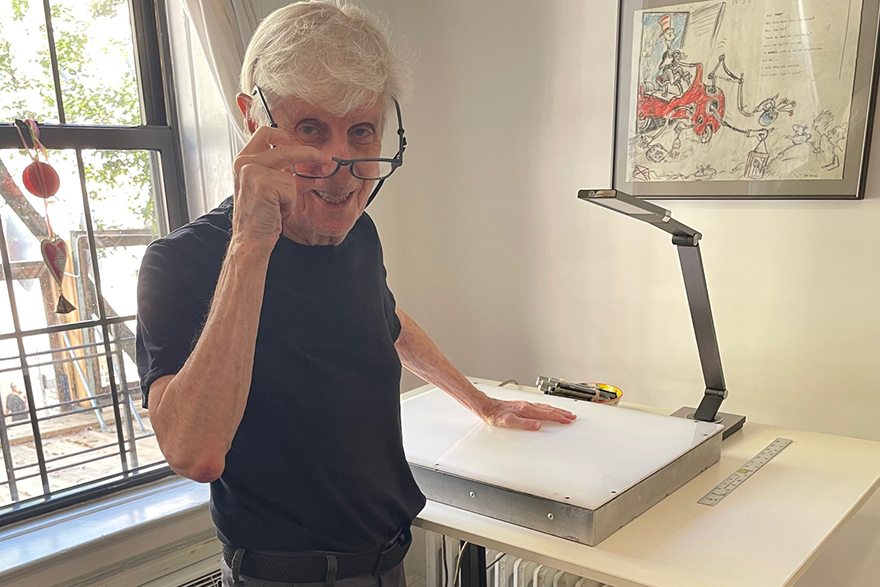
A graduate of the Rhode Island School of Design, Mack is also the author of several graphic nonfiction books on serious subjects. Now in his 80s, he’s enjoyed a varied career, including roles as an art director and illustrator. Senior Planet spoke to the legendary cartoonist in his home studio in Manhattan, where he lives with his wife, Susan Champlin, whom he met when she edited a comic strip he created for Modern Maturity magazine.
SP: How did you get started in the art world?
SM: After finishing art school in 1963, I moved to New York and fell into an art director job at the New York Herald Tribune, the birthplace of New Journalism. Think Tom Wolfe and Gloria Steinem. When that paper folded, I transitioned to The New York Times as art director of their Sunday magazine, where I began to experiment with illustration as a reporting tool. After a few years, I decided to go freelance.
SP: Let’s talk about Real Life Funnies at The Village Voice. How did that comic strip get started?

SM: I knew Milton Glaser was redesigning The Village Voice, so I proposed a one-shot piece that combined art and reporting on New York. He encouraged me to turn it into a weekly comic strip to help build circulation. The Voice was the go-to paper for the downtown scene, and the strip quickly gained popularity. While the concept of overhearing public conversations was a gimmick, I took accuracy very seriously.
SP: Can you explain more about your approach to Real Life Funnies?
SM: I would overhear people and sometimes engage them in conversation, sketching them as I went. In my mind, I was a reporter, and I felt that if I altered any phrase I heard, I would ruin it. I ventured into places where I didn’t belong, like Plato’s Retreat or a UFO believers’ conference. At that time, comics were primarily fiction, so my approach was innovative and a fresh use of the comic strip format.
SP: Your cartooning often pokes fun at various subjects, and humor is subjective. How did you navigate this without facing backlash?
SM: I offered anonymity by not using people’s names, which helped avoid offense. The Voice had lawyers reviewing each issue before publication. However, I did face challenges; I was once mistaken for an IRS agent and thrown out of a high-end antique fair.
SP: You were also a cartoonist for Modern Maturity magazine for many years. What were some of your topics? What’s it like to create humor for seniors?
SM: In the 90s, Milton Glaser was redesigning Modern Maturity, and he asked me to create a version of Real Life Funnies aimed at those over 50. The strips were based on real conversations, and people appreciated the honesty. I illustrated scenarios like an aging biker trying to enter a retirement home with a girlfriend who wasn’t yet 65, and an older woman who loved to dance but had a boyfriend with two left feet. I aimed for humor that was charming and relatable for the over-50 crowd.
SP: You also created a graphic memoir about caretaking for your partner during her battle with breast cancer. What inspired you to write Janet and Me: An Illustrated Story of Love and Loss?
SM: I was her caretaker throughout her illness. After she passed away, I began the book as a way to process my grief and share what I learned with other caregivers. It serves as a tribute to her and is a hybrid of narrative and comic strip.
SP: What is a typical workday like for you?
SM: It varies based on the assignment. When I was working on Real Life Funnies, I had weekly deadlines, so there was no time for distractions. Nowadays, I focus on book projects, and my last book took three years to complete—one-third research, one-third writing, and one-third illustration.
SP: What advice would you give to other creative people?
SM: You should enjoy what you do and embrace challenges. While money can be a motivator, the real joy comes from the work itself.
SP: What was the most enjoyable period of your career?
SM: Leaving The New York Times in 1973 was liberating. Since then, it has been a fun journey.
SP: What does aging with attitude mean to you?
SM: I’m living it right now. Aging presents a spectrum of challenges, but it’s essential to cope with limitations, push yourself, and maintain enjoyment in life. Next week, my wife and I are heading to LA to celebrate her mother’s 100th birthday, with a stop in Montana to visit my cousin, a forest ranger.

Kate Walter is the author of two memoirs: Behind the Mask: Living Alone in the Epicenter; and Looking for a Kiss: A Chronicle of Downtown Heartbreak and Healing. Her essays and opinion pieces have appeared in The New York Times, Newsday, New York Daily News, AM-NY, Next Avenue, The Advocate, The Village Sun, and other outlets. She taught writing at CUNY and NYU for three decades and now works as a writing coach.
Photo of Kate Walter by Su Zen
Photo of Stan Mack: Kate Walter
Stan Mack is best known for his nonfiction comic strip Stan Mack’s Real Life Funnies, a witty chronicle of New York life in the 70s, 80s, and 90s, which ran in The Village Voice for over 20 years. A collection was published in 2024 and nominated for an Eisner Award.
A graduate of the Rhode Island School of Design, Mack is also the author of several graphic nonfiction books on serious subjects. Now in his 80s, he’s enjoyed a varied career, including roles as an art director and illustrator. Senior Planet spoke to the legendary cartoonist in his home studio in Manhattan, where he lives with his wife, Susan Champlin, whom he met when she edited a comic strip he created for Modern Maturity magazine.
SP: How did you get started in the art world?
SM: After finishing art school in 1963, I moved to New York and fell into an art director job at the New York Herald Tribune, the birthplace of New Journalism. Think Tom Wolfe and Gloria Steinem. When that paper folded, I transitioned to The New York Times as art director of their Sunday magazine, where I began to experiment with illustration as a reporting tool. After a few years, I decided to go freelance.
SP: Let’s talk about Real Life Funnies at The Village Voice. How did that comic strip get started?
SM: I knew Milton Glaser was redesigning The Village Voice, so I proposed a one-shot piece that combined art and reporting on New York. He encouraged me to turn it into a weekly comic strip to help build circulation. The Voice was the go-to paper for the downtown scene, and the strip quickly gained popularity. While the concept of overhearing public conversations was a gimmick, I took accuracy very seriously.
SP: Can you explain more about your approach to Real Life Funnies?
SM: I would overhear people and sometimes engage them in conversation, sketching them as I went. In my mind, I was a reporter, and I felt that if I altered any phrase I heard, I would ruin it. I ventured into places where I didn’t belong, like Plato’s Retreat or a UFO believers’ conference. At that time, comics were primarily fiction, so my approach was innovative and a fresh use of the comic strip format.
SP: Your cartooning often pokes fun at various subjects, and humor is subjective. How did you navigate this without facing backlash?
SM: I offered anonymity by not using people’s names, which helped avoid offense. The Voice had lawyers reviewing each issue before publication. However, I did face challenges; I was once mistaken for an IRS agent and thrown out of a high-end antique fair.
SP: You were also a cartoonist for Modern Maturity magazine for many years. What were some of your topics? What’s it like to create humor for seniors?
SM: In the 90s, Milton Glaser was redesigning Modern Maturity, and he asked me to create a version of Real Life Funnies aimed at those over 50. The strips were based on real conversations, and people appreciated the honesty. I illustrated scenarios like an aging biker trying to enter a retirement home with a girlfriend who wasn’t yet 65, and an older woman who loved to dance but had a boyfriend with two left feet. I aimed for humor that was charming and relatable for the over-50 crowd.
SP: You also created a graphic memoir about caretaking for your partner during her battle with breast cancer. What inspired you to write Janet and Me: An Illustrated Story of Love and Loss?
SM: I was her caretaker throughout her illness. After she passed away, I began the book as a way to process my grief and share what I learned with other caregivers. It serves as a tribute to her and is a hybrid of narrative and comic strip.
SP: What is a typical workday like for you?
SM: It varies based on the assignment. When I was working on Real Life Funnies, I had weekly deadlines, so there was no time for distractions. Nowadays, I focus on book projects, and my last book took three years to complete—one-third research, one-third writing, and one-third illustration.
SP: What advice would you give to other creative people?
SM: You should enjoy what you do and embrace challenges. While money can be a motivator, the real joy comes from the work itself.
SP: What was the most enjoyable period of your career?
SM: Leaving The New York Times in 1973 was liberating. Since then, it has been a fun journey.
SP: What does aging with attitude mean to you?
SM: I’m living it right now. Aging presents a spectrum of challenges, but it’s essential to cope with limitations, push yourself, and maintain enjoyment in life. Next week, my wife and I are heading to LA to celebrate her mother’s 100th birthday, with a stop in Montana to visit my cousin, a forest ranger.
Kate Walter is the author of two memoirs: Behind the Mask: Living Alone in the Epicenter; and Looking for a Kiss: A Chronicle of Downtown Heartbreak and Healing. Her essays and opinion pieces have appeared in The New York Times, Newsday, New York Daily News, AM-NY, Next Avenue, The Advocate, The Village Sun, and other outlets. She taught writing at CUNY and NYU for three decades and now works as a writing coach.
Photo of Kate Walter by Su Zen
Photo of Stan Mack: Kate Walter