Ensuring Affordable Flood Insurance in the UK: Strategies Through 2039
The Flood Re scheme serves as a temporary solution to the pressing issue of flood insurance in the UK, set to conclude in 2039. This initiative operates under the assumption that flood risks will diminish over time, allowing the insurance market to transition back to more risk-reflective pricing. However, financial experts express concerns that the UK may struggle to adapt its infrastructure and systems to the realities of climate change swiftly enough.
The effectiveness of the Flood Re scheme relies on a collaborative agreement among the government, homeowners, and insurers. The government must invest in risk reduction and effective delivery, while homeowners are encouraged to minimize damage by rebuilding more resiliently and avoiding unnecessary exposure. Insurers, on the other hand, need to adjust premium prices to accurately reflect climate risks, but they must do so gradually to prevent insurance from becoming unaffordable.
If premiums increase too rapidly, many households may opt out of insurance, undermining the ability to distribute risks across a broad pool of policyholders.
The magnitude of the challenge is already evident. Flood Re was conceived when a global temperature rise of 1.5°C seemed attainable, with a 2°C increase viewed as a critical limit. However, climate change has progressed more rapidly than anticipated. By 2050, approximately 8 million properties in England, or one in four, could be at risk of flooding.
The House of Commons public accounts committee has highlighted that the deterioration of existing flood defenses has left around 203,000 properties without reliable protection. Meanwhile, the government aims to safeguard an additional 200,000 properties by 2027. Labour’s ambitious target of delivering 1.5 million new homes in England by 2029 could exacerbate the situation by pushing development onto less expensive land that is more susceptible to flooding.
While many countries provide support for disaster insurance, few set a definitive end date for such assistance. For instance, the US National Flood Insurance Program (NFIP) was established to offer affordable flood insurance and mitigate future damage by discouraging development in high-risk floodplains. However, repeated extreme weather events have left the NFIP in debt, and subsidized premiums have weakened incentives to avoid construction in flood-prone areas. Although the program is regularly renewed by Congress, its long-term viability remains uncertain.
In France, the catastrophes naturelles scheme (CAT-NAT) addresses natural disaster losses that private insurers find challenging to price, funded by a national surcharge. As losses from increasingly frequent and severe disasters rise, the surcharge is set to increase from 12% to 20% in January 2025, prompting a critical question: how can the system remain equitable as disaster costs continue to escalate?
Preparing for Post-2039
Our ongoing research indicates that flood-related volatility can heighten financial stress and uncertainty. The choice is not merely between perpetuating Flood Re or discontinuing it; the real question is whether the UK can leverage the time that Flood Re provides to effectively mitigate risks and facilitate a fair transition by 2039.
To achieve this, progress must be visible and measurable in five key areas:
First, flood maps and modeling must accurately reflect current conditions and future climate risks, with updates that keep pace with evolving flood risk drivers, including heavy rainfall and rising sea levels.
Second, governance must be cohesive, with clearly defined responsibilities and minimum coordination standards across agencies responsible for rivers, surface water, drainage, and sewers. Enhanced collaboration would help resolve misalignments in major capital programs across risk management authorities.
Third, drainage and surface water management should be fortified, with established rules and long-term maintenance plans to ensure that new developments do not exacerbate flood and sewer risks.
Moreover, all available tools should be utilized to boost investment in flood risk reduction and improve maintenance. The advantages of flood protection must be made transparent to insurers and integrated into catastrophe models.
Finally, a clear vision for the future of Flood Re must be collaboratively shaped by planners, insurers, and flood authorities. This will help establish a shared standard for effective flood risk management.
Don’t have time to read about climate change as much as you’d like?
Get a weekly roundup in your inbox instead. Every Wednesday, The Conversation’s environment editor writes Imagine, a short email that delves deeper into a single climate issue. Join the 47,000+ readers who’ve subscribed so far.
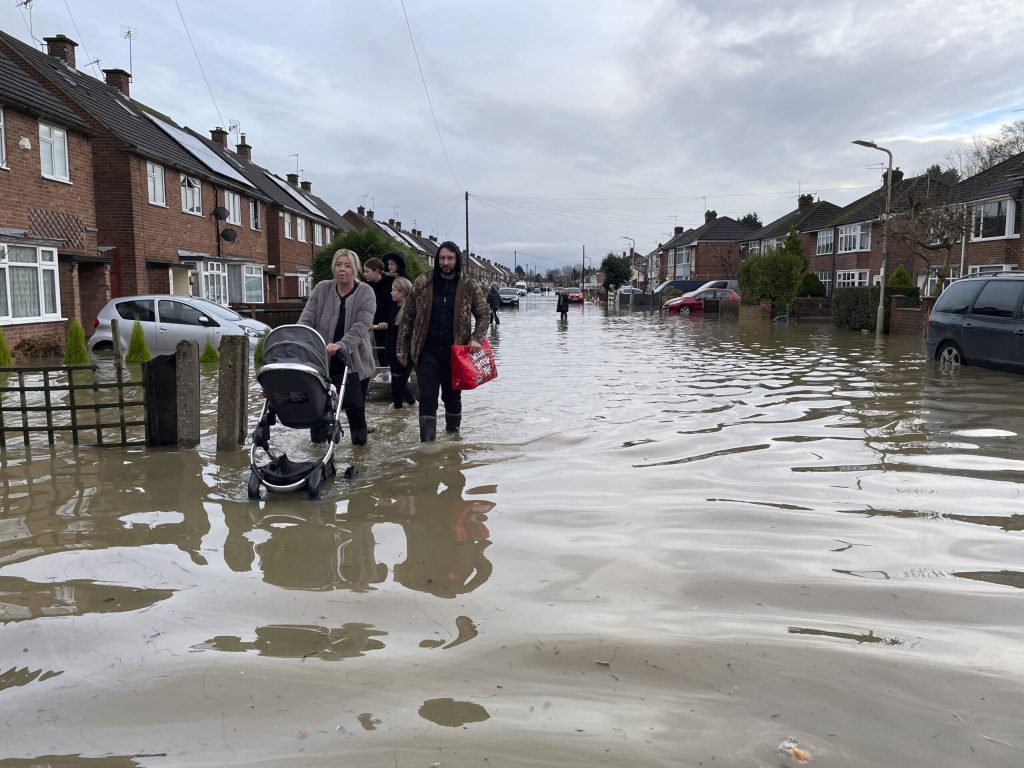
Top photograph: Residents wade through flood water in Loughborough, Leicestershire after rain and strong winds from Storm Henk lashed large parts of the UK, Wednesday Jan. 3, 2024. (Callum Parke/PA via AP)
This article is republished from The Conversation under a Creative Commons license. The Conversation is an independent and nonprofit source of news, analysis, and commentary from academic experts. The original article can be accessed here.
Related:
The Flood Re scheme serves as a temporary solution to the pressing issue of flood insurance in the UK, set to conclude in 2039. This initiative operates under the assumption that flood risks will diminish over time, allowing the insurance market to transition back to more risk-reflective pricing. However, financial experts express concerns that the UK may struggle to adapt its infrastructure and systems to the realities of climate change swiftly enough.
The effectiveness of the Flood Re scheme relies on a collaborative agreement among the government, homeowners, and insurers. The government must invest in risk reduction and effective delivery, while homeowners are encouraged to minimize damage by rebuilding more resiliently and avoiding unnecessary exposure. Insurers, on the other hand, need to adjust premium prices to accurately reflect climate risks, but they must do so gradually to prevent insurance from becoming unaffordable.
If premiums increase too rapidly, many households may opt out of insurance, undermining the ability to distribute risks across a broad pool of policyholders.
The magnitude of the challenge is already evident. Flood Re was conceived when a global temperature rise of 1.5°C seemed attainable, with a 2°C increase viewed as a critical limit. However, climate change has progressed more rapidly than anticipated. By 2050, approximately 8 million properties in England, or one in four, could be at risk of flooding.
The House of Commons public accounts committee has highlighted that the deterioration of existing flood defenses has left around 203,000 properties without reliable protection. Meanwhile, the government aims to safeguard an additional 200,000 properties by 2027. Labour’s ambitious target of delivering 1.5 million new homes in England by 2029 could exacerbate the situation by pushing development onto less expensive land that is more susceptible to flooding.
While many countries provide support for disaster insurance, few set a definitive end date for such assistance. For instance, the US National Flood Insurance Program (NFIP) was established to offer affordable flood insurance and mitigate future damage by discouraging development in high-risk floodplains. However, repeated extreme weather events have left the NFIP in debt, and subsidized premiums have weakened incentives to avoid construction in flood-prone areas. Although the program is regularly renewed by Congress, its long-term viability remains uncertain.
In France, the catastrophes naturelles scheme (CAT-NAT) addresses natural disaster losses that private insurers find challenging to price, funded by a national surcharge. As losses from increasingly frequent and severe disasters rise, the surcharge is set to increase from 12% to 20% in January 2025, prompting a critical question: how can the system remain equitable as disaster costs continue to escalate?
Preparing for Post-2039
Our ongoing research indicates that flood-related volatility can heighten financial stress and uncertainty. The choice is not merely between perpetuating Flood Re or discontinuing it; the real question is whether the UK can leverage the time that Flood Re provides to effectively mitigate risks and facilitate a fair transition by 2039.
To achieve this, progress must be visible and measurable in five key areas:
First, flood maps and modeling must accurately reflect current conditions and future climate risks, with updates that keep pace with evolving flood risk drivers, including heavy rainfall and rising sea levels.
Second, governance must be cohesive, with clearly defined responsibilities and minimum coordination standards across agencies responsible for rivers, surface water, drainage, and sewers. Enhanced collaboration would help resolve misalignments in major capital programs across risk management authorities.
Third, drainage and surface water management should be fortified, with established rules and long-term maintenance plans to ensure that new developments do not exacerbate flood and sewer risks.
Moreover, all available tools should be utilized to boost investment in flood risk reduction and improve maintenance. The advantages of flood protection must be made transparent to insurers and integrated into catastrophe models.
Finally, a clear vision for the future of Flood Re must be collaboratively shaped by planners, insurers, and flood authorities. This will help establish a shared standard for effective flood risk management.
Don’t have time to read about climate change as much as you’d like?
Get a weekly roundup in your inbox instead. Every Wednesday, The Conversation’s environment editor writes Imagine, a short email that delves deeper into a single climate issue. Join the 47,000+ readers who’ve subscribed so far.
Top photograph: Residents wade through flood water in Loughborough, Leicestershire after rain and strong winds from Storm Henk lashed large parts of the UK, Wednesday Jan. 3, 2024. (Callum Parke/PA via AP)
This article is republished from The Conversation under a Creative Commons license. The Conversation is an independent and nonprofit source of news, analysis, and commentary from academic experts. The original article can be accessed here.
Related: