February Consumer Confidence Rises Amid Positive Labor Market Outlook

Piper Sandler Chief Global Economist Nancy Lazar analyzes surging consumer confidence, the job market and more on ‘Making Money.’
Consumer confidence experienced a notable increase in February, reflecting improved expectations among American households regarding the labor market.
The Conference Board reported that its consumer confidence index rose by 2.2 points, reaching 91.2 in February, up from an upwardly revised 89 in January. Initially, January’s figure was reported as 84.5, marking the lowest level since May 2014.
Economists surveyed by LSEG had predicted a February reading of 87 for the index.
FED’S FAVORED INFLATION GAUGE SHOWED CONSUMER PRICE GROWTH REMAINED ELEVATED IN DECEMBER
“Confidence ticked up in February after falling in January, as consumers’ pessimistic expectations for the future eased somewhat,” stated Dana M. Peterson, chief economist at The Conference Board. “Four of five components of the Index firmed. Nonetheless, the measure remained well below the four-year peak achieved in November 2024,” she added.

The Conference Board found that consumer confidence rose in February from the prior month, though it remains well below a 2024 peak. (Gabby Jones/Getty Images)
The Conference Board’s present situation index saw an overall decline, with perceptions of current business conditions dipping by 0.7%. However, views on employment conditions improved slightly. The labor market differential, which measures the share of consumers who believe jobs are “plentiful” versus those who think they are “hard to get,” increased by 0.6 percentage points to 7.4%.
All three components of the Conference Board’s expectations index saw slight increases. Expectations for business and labor market conditions six months ahead were less negative than before, while income expectations turned more positive.
US ECONOMY GREW SLOWER THAN EXPECTED IN FOURTH QUARTER

Consumer confidence rose among Republicans and Independents, while it continued to decline for Democrats. (J. David Ake/Getty Images)
Younger consumers displayed the highest levels of optimism among age groups, with their confidence increasing on a six-month moving average basis in February for those under 35. In contrast, confidence dipped among individuals aged 35 and older.
While consumer confidence rose among Generation Z respondents, older generations reported a decline in their confidence levels.
Consumer confidence based on political affiliation showed an uptick among Republican and Independent voters in February, following a decline in January. Conversely, Democrats exhibited a decrease in optimism compared to the previous month.
US ECONOMY ADDED 130K JOBS IN JANUARY, DELAYED REPORT SHOWS
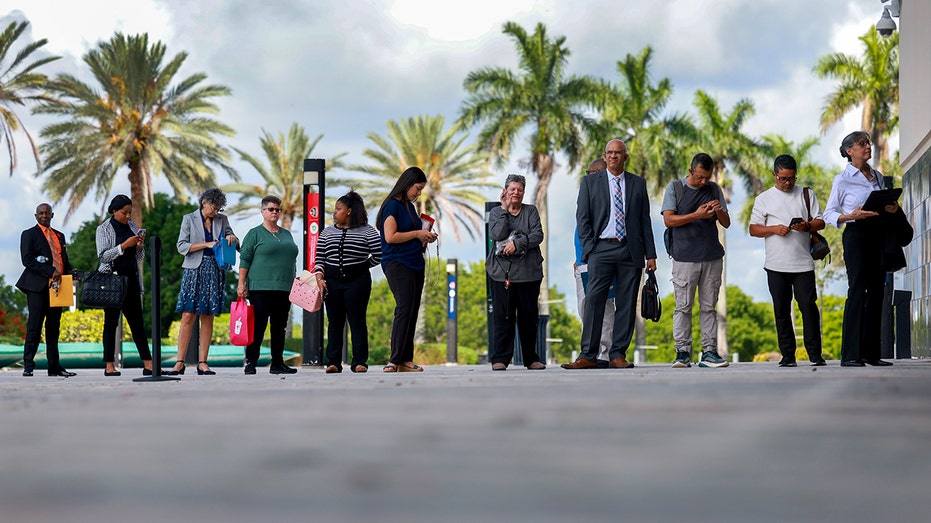
The report showed consumers were more confident about the labor market in February’s preliminary data. (Joe Raedle/Getty Images)
“Consumers’ write-in responses on factors affecting the economy continued to skew toward pessimism,” Peterson noted. “Comments about prices, inflation, and the cost of goods remained at the forefront of consumers’ concerns.
“Mentions of trade and politics also saw an uptick in February. While labor market mentions eased a bit, observations about immigration showed a slight decline as well.”
Despite a decline in consumers’ views of their family’s current financial situation after an unexpected surge in January, expectations regarding their family’s future financial situation remained less optimistic.
GET FOX BUSINESS ON THE GO BY CLICKING HERE
Plans to purchase big-ticket items in the next six months increased in February. The share of respondents indicating “yes” or “maybe” rose, while those saying “no” declined. Popular items for future purchases included used cars, furniture, TVs, and smartphones.
Piper Sandler Chief Global Economist Nancy Lazar analyzes surging consumer confidence, the job market and more on ‘Making Money.’
Consumer confidence experienced a notable increase in February, reflecting improved expectations among American households regarding the labor market.
The Conference Board reported that its consumer confidence index rose by 2.2 points, reaching 91.2 in February, up from an upwardly revised 89 in January. Initially, January’s figure was reported as 84.5, marking the lowest level since May 2014.
Economists surveyed by LSEG had predicted a February reading of 87 for the index.
FED’S FAVORED INFLATION GAUGE SHOWED CONSUMER PRICE GROWTH REMAINED ELEVATED IN DECEMBER
“Confidence ticked up in February after falling in January, as consumers’ pessimistic expectations for the future eased somewhat,” stated Dana M. Peterson, chief economist at The Conference Board. “Four of five components of the Index firmed. Nonetheless, the measure remained well below the four-year peak achieved in November 2024,” she added.
The Conference Board found that consumer confidence rose in February from the prior month, though it remains well below a 2024 peak. (Gabby Jones/Getty Images)
The Conference Board’s present situation index saw an overall decline, with perceptions of current business conditions dipping by 0.7%. However, views on employment conditions improved slightly. The labor market differential, which measures the share of consumers who believe jobs are “plentiful” versus those who think they are “hard to get,” increased by 0.6 percentage points to 7.4%.
All three components of the Conference Board’s expectations index saw slight increases. Expectations for business and labor market conditions six months ahead were less negative than before, while income expectations turned more positive.
US ECONOMY GREW SLOWER THAN EXPECTED IN FOURTH QUARTER
Consumer confidence rose among Republicans and Independents, while it continued to decline for Democrats. (J. David Ake/Getty Images)
Younger consumers displayed the highest levels of optimism among age groups, with their confidence increasing on a six-month moving average basis in February for those under 35. In contrast, confidence dipped among individuals aged 35 and older.
While consumer confidence rose among Generation Z respondents, older generations reported a decline in their confidence levels.
Consumer confidence based on political affiliation showed an uptick among Republican and Independent voters in February, following a decline in January. Conversely, Democrats exhibited a decrease in optimism compared to the previous month.
US ECONOMY ADDED 130K JOBS IN JANUARY, DELAYED REPORT SHOWS
The report showed consumers were more confident about the labor market in February’s preliminary data. (Joe Raedle/Getty Images)
“Consumers’ write-in responses on factors affecting the economy continued to skew toward pessimism,” Peterson noted. “Comments about prices, inflation, and the cost of goods remained at the forefront of consumers’ concerns.
“Mentions of trade and politics also saw an uptick in February. While labor market mentions eased a bit, observations about immigration showed a slight decline as well.”
Despite a decline in consumers’ views of their family’s current financial situation after an unexpected surge in January, expectations regarding their family’s future financial situation remained less optimistic.
GET FOX BUSINESS ON THE GO BY CLICKING HERE
Plans to purchase big-ticket items in the next six months increased in February. The share of respondents indicating “yes” or “maybe” rose, while those saying “no” declined. Popular items for future purchases included used cars, furniture, TVs, and smartphones.