Impact of Climate Change and Budget Cuts on South American Wildfires
Recent wildfires in Argentina and Chile have been exacerbated by human-induced climate change, land-use changes, and budget cuts, threatening some of the world’s oldest trees. An analysis reveals that these regions are experiencing a significant decrease in rainfall, estimated at 20% to 25%, largely due to climate change driven by fossil fuel consumption. This information comes from a report by World Weather Attribution (WWA), a scientific group that assesses extreme weather events shortly after they occur.
According to Clair Barnes, a researcher at the Centre for Environmental Policy at Imperial College London, “We estimate that similarly extreme fire weather conditions are now nearly three times as likely due to the 1.3C of human-caused warming.” The drying trend is well-supported by climate models, indicating a clear link between climate change and increased wildfire risks.
The wildfires, which ignited in early January, have devastated large areas of south-central Chile, destroying approximately 2,300 homes and resulting in 21 fatalities, as reported by the United Nations. In Argentina’s Patagonia, the fires continue to rage, affecting parts of Los Alerces National Park, which is home to the Alerce tree, the second-longest living tree species in the world, with some individuals reaching over 3,600 years of age.
Co-author Juan Antonio Rivera, a researcher at the Argentine Institute of Nivology, Glaciology and Environmental Sciences, stated, “Climate change is leading to extreme and persistent temperatures well above average.” He noted that weather stations near Patagonia, some of which have been operational for 70 years, have recorded unprecedented warm spells.
The WWA analysis also highlighted that the increase in pine tree plantations has heightened wildfire risks in both countries. These plantations are particularly flammable due to their uniform fuel structure and density. In 2024, wildfires in Chile’s Viña del Mar resulted in 138 deaths, with fires spreading to neighborhoods through these tree plantations.
In Argentine Patagonia, wildfire hotspots remain active within Los Alerces National Park. Environmental groups and the WWA have pointed to significant budget cuts under President Javier Milei, who has denied the existence of human-induced climate change. The National Fire Management Service’s budget was slashed by 69% this year compared to 2023, and by 54% compared to 2025, according to an analysis by the nonprofit Environment and Natural Resources Foundation (Farn).
Argentina’s National Parks Administration reported that wildfires have affected around 16,000 hectares (39,500 acres) of Los Alerces National Park, an area slightly larger than San Francisco. Over 200 federal personnel are currently involved in firefighting efforts, working alongside 278 public servants from Chubut province.
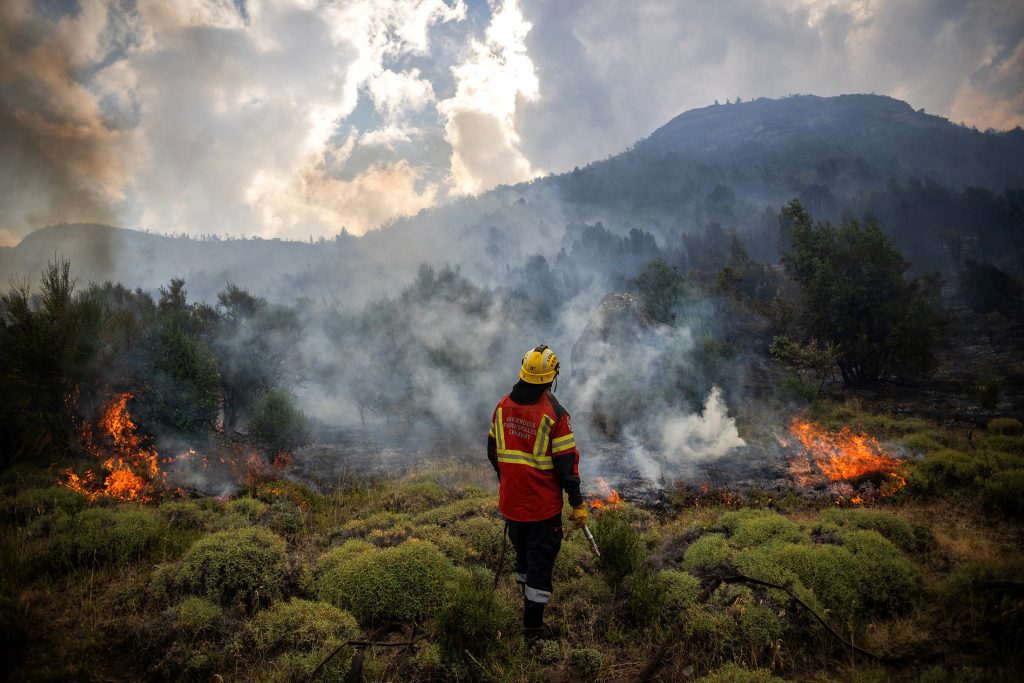
Photograph: A firefighter works to extinguish a forest fire burning in the mountains of the rural area of Epuyen, in the Patagonian region of Chubut province, Argentina, on Feb. 2, 2025. Photo credit: Tomas Cuesta/AFP/Getty Images
Copyright 2026 Bloomberg.
Topics
Climate Change
Interested in Climate Change?
Get automatic alerts for this topic.
Recent wildfires in Argentina and Chile have been exacerbated by human-induced climate change, land-use changes, and budget cuts, threatening some of the world’s oldest trees. An analysis reveals that these regions are experiencing a significant decrease in rainfall, estimated at 20% to 25%, largely due to climate change driven by fossil fuel consumption. This information comes from a report by World Weather Attribution (WWA), a scientific group that assesses extreme weather events shortly after they occur.
According to Clair Barnes, a researcher at the Centre for Environmental Policy at Imperial College London, “We estimate that similarly extreme fire weather conditions are now nearly three times as likely due to the 1.3C of human-caused warming.” The drying trend is well-supported by climate models, indicating a clear link between climate change and increased wildfire risks.
The wildfires, which ignited in early January, have devastated large areas of south-central Chile, destroying approximately 2,300 homes and resulting in 21 fatalities, as reported by the United Nations. In Argentina’s Patagonia, the fires continue to rage, affecting parts of Los Alerces National Park, which is home to the Alerce tree, the second-longest living tree species in the world, with some individuals reaching over 3,600 years of age.
Co-author Juan Antonio Rivera, a researcher at the Argentine Institute of Nivology, Glaciology and Environmental Sciences, stated, “Climate change is leading to extreme and persistent temperatures well above average.” He noted that weather stations near Patagonia, some of which have been operational for 70 years, have recorded unprecedented warm spells.
The WWA analysis also highlighted that the increase in pine tree plantations has heightened wildfire risks in both countries. These plantations are particularly flammable due to their uniform fuel structure and density. In 2024, wildfires in Chile’s Viña del Mar resulted in 138 deaths, with fires spreading to neighborhoods through these tree plantations.
In Argentine Patagonia, wildfire hotspots remain active within Los Alerces National Park. Environmental groups and the WWA have pointed to significant budget cuts under President Javier Milei, who has denied the existence of human-induced climate change. The National Fire Management Service’s budget was slashed by 69% this year compared to 2023, and by 54% compared to 2025, according to an analysis by the nonprofit Environment and Natural Resources Foundation (Farn).
Argentina’s National Parks Administration reported that wildfires have affected around 16,000 hectares (39,500 acres) of Los Alerces National Park, an area slightly larger than San Francisco. Over 200 federal personnel are currently involved in firefighting efforts, working alongside 278 public servants from Chubut province.
Photograph: A firefighter works to extinguish a forest fire burning in the mountains of the rural area of Epuyen, in the Patagonian region of Chubut province, Argentina, on Feb. 2, 2025. Photo credit: Tomas Cuesta/AFP/Getty Images
Copyright 2026 Bloomberg.
Topics
Climate Change
Interested in Climate Change?
Get automatic alerts for this topic.