Mississippi’s Deep South Faces Icy Challenges Amidst Long Recovery Ahead
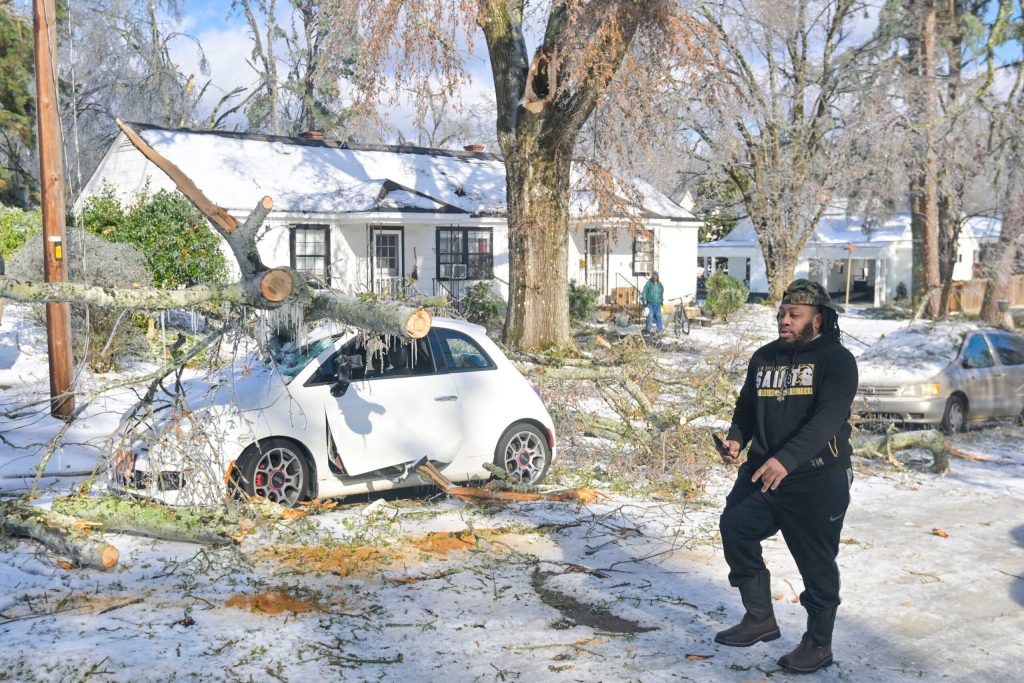
Residents in a frozen expanse of Mississippi faced a harsh reality on Monday as they huddled in increasingly cold and dark homes. Recovery from the state’s most severe ice storm in over three decades is expected to take a week or longer.
While the weekend’s winter storm affected millions across the country, its most significant impacts are felt in a corridor stretching from far eastern Texas through north Louisiana, Mississippi, and into Nashville, Tennessee. More snow and ice are anticipated in the coming days as another storm front approaches.
Parents are particularly concerned for the 20,000-plus college students at the University of Mississippi, which has canceled classes and closed its campus for the remainder of the week. Officials are not only focused on restoring electricity and opening warming stations but also on ensuring fuel supplies for backup generators that power water pumps and medical facilities, as well as reopening darkened gas stations and grocery stores.
“It looks like a war zone out here,” remarked Adrian Ronca-Hohn, who estimated that the storm knocked down around 40 trees surrounding his property in Iuka, located in the hilly northeast corner of the state. He and his family plan to use chainsaws to clear their way out on Tuesday.
Like many others, Ronca-Hohn was unaware of the extent of the destruction when the ice began to bring down trees before dawn on Sunday. However, the sounds of destruction were unmistakable.
“We couldn’t go 10 seconds without hearing what sounded like a gunshot,” he described. “You’d hear a pop, a hard pop, and then the whistle of a tree falling, followed by a crash that felt like an explosion. It was a sleepless night.”
Marshall Ramsey, an editorial cartoonist and journalism instructor at Ole Miss, described the cacophony of breaking trees, exploding transformers, and thunder as a “demonic symphony” in Oxford.
By Monday afternoon, power outages had dropped below 150,000, but Mississippi still had the highest number of outages in the nation. In Alcorn County, all 19,000 customers were without power by midday. Tennessee Valley Authority high-voltage lines were down, and General Manager Sean McGrath noted that a full damage assessment couldn’t be conducted until TVA restored power to substations.
TVA spokesperson Scott Brooks reported that while connections to local utilities in parts of Tennessee were restored, work continued on restoring all connections in Mississippi. Many residents faced tough choices in one of the nation’s poorest states. In Vicksburg, Jamita Washington described wrapping herself in blankets while seeing her breath in the home she shares with her 20-year-old son and small dog. After two days of warming up in her car, she began searching for a hotel room.
“I wanted to wait it out, but I think I have to,” Washington said. “I can’t take another chance on it. It was extremely cold last night.”
Jackson Mills, 25, shared that he was staying with his wife, son, and in-laws at his grandfather’s house in Corinth, where they have a gas fireplace. He made a trip into nearby Tennessee on Sunday to buy gas for their generator.
“We’d like for all this to mostly go away, just melt away, but it’s just so dadgum cold that it’s not melting,” Mills lamented.
Conditions were even worse in neighboring Tippah County, where not only was power out, but most residents also lacked running water and natural gas service. State Rep. Jody Steverson of Ripley warned that low temperatures could make conditions “life-threatening.” He communicated via text as cellphone service faltered.
Republican Gov. Tate Reeves announced on Monday that he would deploy 500 National Guard soldiers by Wednesday to assist with debris removal and traffic control. He mentioned that 61 shelters and warming centers were operational across 30 counties, and the state had doubled its request for generators from the Federal Emergency Management Agency from 30 to 60 to provide power to shelters, nursing homes, hospitals, and water systems. Additionally, the state is distributing cots, blankets, prepackaged meals, and bottled water.
“We will get through this,” Reeves stated. “We’re not going to get through it today and we’re not going to get through it tomorrow.”
Ramsey noted that his family in Oxford has been relying on a generator to power a space heater and a light while charging their phones. He described the indoor temperature as about 50 degrees on Monday morning, calling it “a little chilly, but doable.”
“Apparently, the new status symbol in this town is having electricity,” Ramsey quipped. “It’s a mess.”
Copyright 2026 Associated Press. All rights reserved. This material may not be published, broadcast, rewritten, or redistributed.
Topics
Mississippi
The most important insurance news, in your inbox every business day.
Get the insurance industry’s trusted newsletter
Residents in a frozen expanse of Mississippi faced a harsh reality on Monday as they huddled in increasingly cold and dark homes. Recovery from the state’s most severe ice storm in over three decades is expected to take a week or longer.
While the weekend’s winter storm affected millions across the country, its most significant impacts are felt in a corridor stretching from far eastern Texas through north Louisiana, Mississippi, and into Nashville, Tennessee. More snow and ice are anticipated in the coming days as another storm front approaches.
Parents are particularly concerned for the 20,000-plus college students at the University of Mississippi, which has canceled classes and closed its campus for the remainder of the week. Officials are not only focused on restoring electricity and opening warming stations but also on ensuring fuel supplies for backup generators that power water pumps and medical facilities, as well as reopening darkened gas stations and grocery stores.
“It looks like a war zone out here,” remarked Adrian Ronca-Hohn, who estimated that the storm knocked down around 40 trees surrounding his property in Iuka, located in the hilly northeast corner of the state. He and his family plan to use chainsaws to clear their way out on Tuesday.
Like many others, Ronca-Hohn was unaware of the extent of the destruction when the ice began to bring down trees before dawn on Sunday. However, the sounds of destruction were unmistakable.
“We couldn’t go 10 seconds without hearing what sounded like a gunshot,” he described. “You’d hear a pop, a hard pop, and then the whistle of a tree falling, followed by a crash that felt like an explosion. It was a sleepless night.”
Marshall Ramsey, an editorial cartoonist and journalism instructor at Ole Miss, described the cacophony of breaking trees, exploding transformers, and thunder as a “demonic symphony” in Oxford.
By Monday afternoon, power outages had dropped below 150,000, but Mississippi still had the highest number of outages in the nation. In Alcorn County, all 19,000 customers were without power by midday. Tennessee Valley Authority high-voltage lines were down, and General Manager Sean McGrath noted that a full damage assessment couldn’t be conducted until TVA restored power to substations.
TVA spokesperson Scott Brooks reported that while connections to local utilities in parts of Tennessee were restored, work continued on restoring all connections in Mississippi. Many residents faced tough choices in one of the nation’s poorest states. In Vicksburg, Jamita Washington described wrapping herself in blankets while seeing her breath in the home she shares with her 20-year-old son and small dog. After two days of warming up in her car, she began searching for a hotel room.
“I wanted to wait it out, but I think I have to,” Washington said. “I can’t take another chance on it. It was extremely cold last night.”
Jackson Mills, 25, shared that he was staying with his wife, son, and in-laws at his grandfather’s house in Corinth, where they have a gas fireplace. He made a trip into nearby Tennessee on Sunday to buy gas for their generator.
“We’d like for all this to mostly go away, just melt away, but it’s just so dadgum cold that it’s not melting,” Mills lamented.
Conditions were even worse in neighboring Tippah County, where not only was power out, but most residents also lacked running water and natural gas service. State Rep. Jody Steverson of Ripley warned that low temperatures could make conditions “life-threatening.” He communicated via text as cellphone service faltered.
Republican Gov. Tate Reeves announced on Monday that he would deploy 500 National Guard soldiers by Wednesday to assist with debris removal and traffic control. He mentioned that 61 shelters and warming centers were operational across 30 counties, and the state had doubled its request for generators from the Federal Emergency Management Agency from 30 to 60 to provide power to shelters, nursing homes, hospitals, and water systems. Additionally, the state is distributing cots, blankets, prepackaged meals, and bottled water.
“We will get through this,” Reeves stated. “We’re not going to get through it today and we’re not going to get through it tomorrow.”
Ramsey noted that his family in Oxford has been relying on a generator to power a space heater and a light while charging their phones. He described the indoor temperature as about 50 degrees on Monday morning, calling it “a little chilly, but doable.”
“Apparently, the new status symbol in this town is having electricity,” Ramsey quipped. “It’s a mess.”
Copyright 2026 Associated Press. All rights reserved. This material may not be published, broadcast, rewritten, or redistributed.
Topics
Mississippi
The most important insurance news, in your inbox every business day.
Get the insurance industry’s trusted newsletter