Research Reveals Rising Temperatures Lead to More Fire-Prone Days
The number of days characterized by hot, dry, and windy weather—conditions that can ignite extreme wildfires—has nearly tripled globally over the past 45 years. This alarming trend is particularly pronounced in the Americas, according to a recent study.
Researchers attribute more than half of this increase to human-induced climate change. As the planet warms, the likelihood of multiple regions experiencing simultaneous fire weather rises, creating a scenario where countries may lack the resources to combat all the fires erupting at once. Assistance from neighboring regions may also be limited, as they grapple with their own wildfire crises, as highlighted in a study published in Science Advances.
From 1979 to 1994, the world averaged about 22 synchronous fire weather days annually, where large global regions experienced similar conditions. Fast forward to 2023 and 2024, and that number has surged to over 60 days each year.
“These changes significantly increase the likelihood of fires that are very challenging to suppress,” stated John Abatzoglou, a fire scientist at the University of California, Merced, and co-author of the study.
While the researchers focused on weather conditions—warm temperatures, strong winds, and dry air and ground—they emphasized that these factors alone do not cause fires. “The weather is just one dimension,” explained Cong Yin, the study’s lead author and a fire researcher at UC Merced. Other critical elements include oxygen, fuel sources like trees and brush, and ignition sources such as lightning, arson, or human error.
This study is crucial because extreme fire weather is a primary, though not the only, factor contributing to the increasing impact of wildfires globally. Mike Flannigan, a fire scientist at Thompson Rivers University in Canada, noted that regions that once had distinct fire seasons and could share firefighting resources are now facing overlapping fire seasons.
Abatzoglou remarked, “And that’s where things begin to break.”
More than 60% of the global increase in synchronous fire weather days is linked to climate change driven by the combustion of coal, oil, and natural gas. Yin and his colleagues reached this conclusion by using computer simulations to compare the last 45 years with a hypothetical world devoid of the greenhouse gases emitted by fossil fuel burning.
In the continental United States, the average number of synchronous fire weather days rose from 7.7 days per year between 1979 and 1988 to 38 days per year over the last decade. However, this increase pales in comparison to the southern half of South America, where the average jumped from 5.5 days in 1979-1988 to an astonishing 70.6 days in the last decade, including a staggering 118 days in 2023.
Among 14 global regions studied, only Southeast Asia experienced a decrease in synchronous fire weather, likely due to increasing humidity in that area, according to Yin.
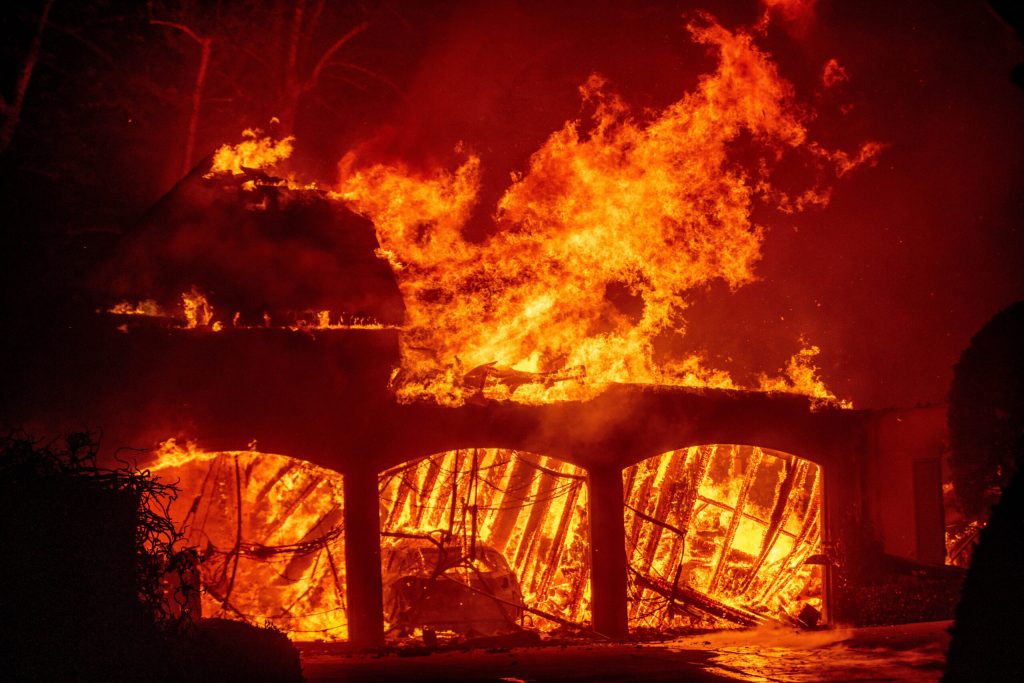
Photo: The Eaton Fire burns a residence on Jan. 8, 2025, in Altadena, Calif. (AP Photo/Ethan Swope, File)
The most important insurance news, in your inbox every business day.
Get the insurance industry’s trusted newsletter
The number of days characterized by hot, dry, and windy weather—conditions that can ignite extreme wildfires—has nearly tripled globally over the past 45 years. This alarming trend is particularly pronounced in the Americas, according to a recent study.
Researchers attribute more than half of this increase to human-induced climate change. As the planet warms, the likelihood of multiple regions experiencing simultaneous fire weather rises, creating a scenario where countries may lack the resources to combat all the fires erupting at once. Assistance from neighboring regions may also be limited, as they grapple with their own wildfire crises, as highlighted in a study published in Science Advances.
From 1979 to 1994, the world averaged about 22 synchronous fire weather days annually, where large global regions experienced similar conditions. Fast forward to 2023 and 2024, and that number has surged to over 60 days each year.
“These changes significantly increase the likelihood of fires that are very challenging to suppress,” stated John Abatzoglou, a fire scientist at the University of California, Merced, and co-author of the study.
While the researchers focused on weather conditions—warm temperatures, strong winds, and dry air and ground—they emphasized that these factors alone do not cause fires. “The weather is just one dimension,” explained Cong Yin, the study’s lead author and a fire researcher at UC Merced. Other critical elements include oxygen, fuel sources like trees and brush, and ignition sources such as lightning, arson, or human error.
This study is crucial because extreme fire weather is a primary, though not the only, factor contributing to the increasing impact of wildfires globally. Mike Flannigan, a fire scientist at Thompson Rivers University in Canada, noted that regions that once had distinct fire seasons and could share firefighting resources are now facing overlapping fire seasons.
Abatzoglou remarked, “And that’s where things begin to break.”
More than 60% of the global increase in synchronous fire weather days is linked to climate change driven by the combustion of coal, oil, and natural gas. Yin and his colleagues reached this conclusion by using computer simulations to compare the last 45 years with a hypothetical world devoid of the greenhouse gases emitted by fossil fuel burning.
In the continental United States, the average number of synchronous fire weather days rose from 7.7 days per year between 1979 and 1988 to 38 days per year over the last decade. However, this increase pales in comparison to the southern half of South America, where the average jumped from 5.5 days in 1979-1988 to an astonishing 70.6 days in the last decade, including a staggering 118 days in 2023.
Among 14 global regions studied, only Southeast Asia experienced a decrease in synchronous fire weather, likely due to increasing humidity in that area, according to Yin.
Photo: The Eaton Fire burns a residence on Jan. 8, 2025, in Altadena, Calif. (AP Photo/Ethan Swope, File)
The most important insurance news, in your inbox every business day.
Get the insurance industry’s trusted newsletter