Texas Fire Threat Escalates Amid Oklahoma Panhandle Blaze
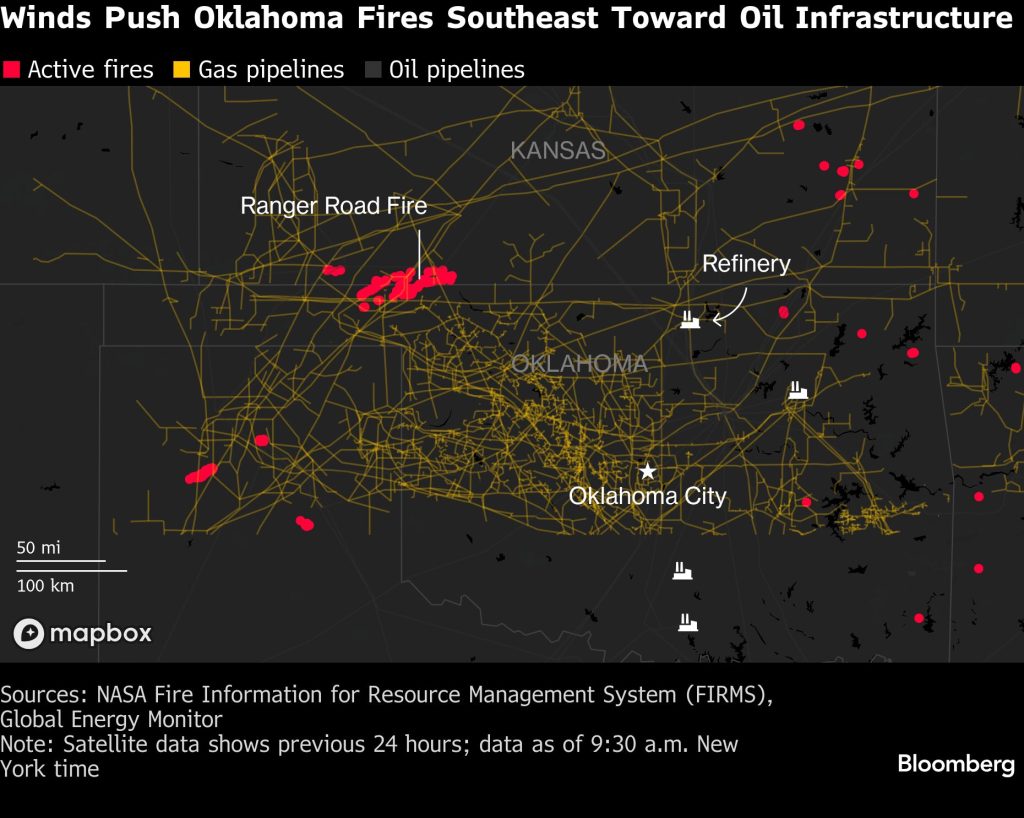
A fast-moving wildfire in the Oklahoma panhandle has dramatically expanded, doubling in size as it encroaches into Kansas. Winds are raising fire risks across West Texas and New Mexico, complicating firefighting efforts.
The Ranger Road Fire has consumed over 283,000 acres across Oklahoma and Kansas as of Thursday, an area nearly 20 times larger than Manhattan. In total, more than 300,000 acres have burned in Oklahoma this week, driven by soaring temperatures that are approximately 15°F (8°C) above average, coupled with extremely low humidity that has dried out grasses and brush.
Oklahoma officials reported 33 incidents of fires and hotspots across nearly two dozen counties, including a rapidly spreading fire that briefly necessitated evacuations south of the Ranger Road blaze. While some relief is anticipated on Friday with cooler temperatures and increased humidity, winds are expected to intensify in far West Texas. Two fires near Amarillo have already consumed over 31,000 acres.
Drought conditions have severely impacted much of Texas and the Great Plains this winter, despite recent snowfall and rainfall. The US Climate Prediction Center forecasts that the region will continue to experience drier and warmer-than-normal conditions over the next week, according to their latest reports.
As of Thursday, the wildfires have not significantly affected oil or natural gas production in Oklahoma, a crucial area for drilling and a hub for a dense network of pipelines. Approximately 24 million barrels of crude oil are stored in Cushing, which is the nation’s largest onshore storage facility and serves as the delivery point for benchmark US crude futures.
Oklahoma is also home to several refineries operated by Valero Energy Corp., Phillips 66, HF Sinclair, and CVR Energy. Fortunately, none of these fuel-making plants, which collectively refine 550,000 barrels of oil daily, are situated in the panhandle where wildfire activity has been most intense.
The region, primarily rural, is characterized by expansive ranches and farms. In response to the devastation, the Oklahoma Cattlemen’s Foundation has established a relief fund aimed at assisting cattle ranchers affected by the fires.
Copyright 2026 Bloomberg.
Was this article valuable?
Here are more articles you may enjoy.
The most important insurance news, in your inbox every business day.
Get the insurance industry’s trusted newsletter
A fast-moving wildfire in the Oklahoma panhandle has dramatically expanded, doubling in size as it encroaches into Kansas. Winds are raising fire risks across West Texas and New Mexico, complicating firefighting efforts.
The Ranger Road Fire has consumed over 283,000 acres across Oklahoma and Kansas as of Thursday, an area nearly 20 times larger than Manhattan. In total, more than 300,000 acres have burned in Oklahoma this week, driven by soaring temperatures that are approximately 15°F (8°C) above average, coupled with extremely low humidity that has dried out grasses and brush.
Oklahoma officials reported 33 incidents of fires and hotspots across nearly two dozen counties, including a rapidly spreading fire that briefly necessitated evacuations south of the Ranger Road blaze. While some relief is anticipated on Friday with cooler temperatures and increased humidity, winds are expected to intensify in far West Texas. Two fires near Amarillo have already consumed over 31,000 acres.
Drought conditions have severely impacted much of Texas and the Great Plains this winter, despite recent snowfall and rainfall. The US Climate Prediction Center forecasts that the region will continue to experience drier and warmer-than-normal conditions over the next week, according to their latest reports.
As of Thursday, the wildfires have not significantly affected oil or natural gas production in Oklahoma, a crucial area for drilling and a hub for a dense network of pipelines. Approximately 24 million barrels of crude oil are stored in Cushing, which is the nation’s largest onshore storage facility and serves as the delivery point for benchmark US crude futures.
Oklahoma is also home to several refineries operated by Valero Energy Corp., Phillips 66, HF Sinclair, and CVR Energy. Fortunately, none of these fuel-making plants, which collectively refine 550,000 barrels of oil daily, are situated in the panhandle where wildfire activity has been most intense.
The region, primarily rural, is characterized by expansive ranches and farms. In response to the devastation, the Oklahoma Cattlemen’s Foundation has established a relief fund aimed at assisting cattle ranchers affected by the fires.
Copyright 2026 Bloomberg.
Was this article valuable?
Here are more articles you may enjoy.
The most important insurance news, in your inbox every business day.
Get the insurance industry’s trusted newsletter