Texas House GOP Focuses on Key Tort Battle in Upcoming Races
In 2024, the Texas House Republican primaries were nothing short of a bloodbath. This intense cycle witnessed unprecedented levels of campaign ad spending, driven by the usual financial backing from West Texas oil billionaires Tim Dunn and Farris Wilks, who supported far-right primary challengers. Governor Greg Abbott poured millions into efforts to unseat GOP incumbents who opposed private school vouchers—his signature issue—while Attorney General Ken Paxton targeted lawmakers who voted to impeach him in 2023.
Fast forward two years, and the primary landscape has undergone a significant transformation. Following a legislative season where Republicans successfully pushed through key priorities such as vouchers, congressional redistricting, and various socially conservative bills, the dynamics within the Texas GOP have shifted. After a decade of efforts to oust establishment Republicans, Dunn and Wilks’ political machine appears to be taking a step back. In the last six months of 2025, groups backed by these megadonors contributed only to a select few House Republican incumbents and candidates vying for open seats, marking a stark contrast to previous cycles where they funneled vast sums into firebrand challengers.
This cycle, the primary battle lines are drawn over tort reform. Texans for Lawsuit Reform (TLR), the state’s leading advocate for limiting business liability, is targeting three GOP incumbents who thwarted its priorities during the last legislative session. Meanwhile, trial lawyer groups are investing heavily to defend those lawmakers.
The most expensive race is unfolding in San Antonio’s House District 121, where TLR has spent nearly $900,000 supporting Republican challenger David McArthur against GOP Rep. Marc LaHood. LaHood’s reelection campaign is bolstered by significant donations from personal injury law firms and affiliated groups, including the Texas Trial Lawyers Association and Texans for Truth and Liberty, a PAC funded entirely by the prominent Houston firm Arnold & Itkin. Together, these groups contributed $268,000 to LaHood’s campaign last year, adding to a total exceeding $1 million from various medical groups and personal injury lawyers.
LaHood played a crucial role in the defeat of Senate Bill 30, which aimed to limit payouts from personal injury lawsuits—one of TLR’s top priorities. As a personal injury and criminal defense attorney, LaHood sought substantial amendments to SB 30 and helped kill two other priority bills as a member of the influential House Judiciary and Civil Jurisprudence Committee. Following the session, he exchanged heated words with TLR’s president, accusing the group of negotiating in bad faith and denouncing SB 30 as a “poorly drafted, frankly indefensible, scheme to deny aid to those who have suffered life-altering harm.”
The legislative setbacks represented a low point for TLR, which historically played a pivotal role in turning Texas red and consistently pushed bills through the Legislature to make it more challenging to sue large businesses and medical providers. SB 30 initially proposed strict limits on damages for accident victims but was significantly diluted in the House before ultimately failing to meet a critical deadline.
TLR’s influence appears to be waning as it increasingly finds itself at odds with the GOP’s far-right faction, especially after endorsing a GOP candidate who challenged Paxton in 2022. Paxton’s allies have accused TLR of orchestrating his impeachment the following year, a claim the group’s leaders vehemently deny.
Among TLR’s targets in the lower chamber are a growing number of right-wing trial lawyers, including LaHood and Rep. Mitch Little of Lewisville, who served as one of Paxton’s impeachment attorneys. Historically, trial lawyers were closely associated with the Democratic Party, but now, with top trial lawyer groups actively participating in Republican primaries, TLR Chairman Dick Weekley recently criticized “Democratic trial lawyers” for “posing as allies of the right.”
In North Texas’ House District 98, the tort reform factions are also heavily investing in the race to succeed outgoing Rep. Giovanni Capriglione, R-Southlake. In the latter half of last year, the Texas Trial Lawyers Association and Texans for Truth and Liberty contributed $127,500 to Armin Mizani, the Republican mayor of Keller who operates his own personal injury law firm. In contrast, campaign finance records show that TLR backed his opponent, Fred Tate, a businessman and former Texas Republican Party treasurer, with six figures.
Tate’s campaign website emphasizes that rising everyday costs are driven by the “tort tax” stemming from “frivolous lawsuits from greedy personal injury lawyers.” He pledges to advocate for common-sense lawsuit reforms to curb abusive litigation and hold personal injury lawyers accountable.
Elsewhere, TLR has supported primary challengers to Reps. Mark Dorazio, R-San Antonio, and Andy Hopper, R-Decatur, both of whom backed an amendment that weakened SB 30. The group spent over $60,000 last month supporting Dorazio’s GOP opponent, Willie Ng, and contributed $50,000 to Hopper’s challenger, Lisa McEntire.
The apparent pullback by Dunn and Wilks in this year’s primaries reflects the significant transformation of the Texas House, which saw many establishment Republicans ousted in the last contests. This incumbent wipeout has pushed the chamber further to the right and led to a leadership change that elevated Rep. Dustin Burrows, who aligns closely with the Senate’s conservative agenda.
“I wouldn’t say it’s a permanent condition, but I guess he’s pretty happy with the body as is,” remarked Bill Miller, a longtime Texas lobbyist, referring to Dunn. “They’re complacent, which suggests they’re satisfied with their accomplishments.”
Another factor influencing the primary landscape is Abbott’s absence from the fray, following his successful push for the school voucher program last year, which received support from every House Republican running for reelection. This earned them a blanket endorsement from President Donald Trump, complicating efforts by tort reform groups to target incumbent lawmakers, given Trump’s significant influence in Republican primaries.
Despite its substantial spending in late 2025, TLR has indicated to some candidates in competitive primaries that it may not continue funding its endorsed challengers, as reported by the Texas Bullpen. However, others within the TLR network are still contributing to these challengers, helping to fill the gap left by the group’s potential funding halt.
“We’re thankful for what TLR has done so far to get us to this point,” stated a spokesperson for McArthur’s campaign. “We’re fortunate that others have stepped up to continue the work they started.”
In a statement, TLR CEO Ryan Patrick refrained from confirming whether the group would continue its financial support for its endorsed primary challengers. However, he emphasized that TLR would persist in backing conservative Republicans and spreading its message about the “hidden tort tax that is crushing families and businesses.”
“That message will continue to resonate in districts where candidates are heavily invested with Democrat megadonors and the trial attorney lobby,” Patrick added.
Shortly after TLR reportedly indicated it would reduce its spending, McArthur launched a $100,000 television ad campaign, featuring a Newsmax anchor portraying LaHood as “on the ropes for his staunch support for the trial lawyer lobby.” In response, LaHood released an ad claiming he “stopped Big Insurance’s attempt to pick the bones of the American people.”
Earlier in 2025, Texans for Truth and Liberty also made significant contributions to hard-right incumbent lawmakers who helped undermine tort reform measures during the legislative session, strengthening their financial positions ahead of the primary season and potentially shielding them from Republican challengers. Their donations included $100,000 to Little and $50,000 each to Reps. Katrina Pierson, R-Rockwall, and Wes Virdell, R-Brady.
Renzo Downey contributed reporting.
Disclosure: Texans for Lawsuit Reform and Texas Trial Lawyers Association have been financial supporters of The Texas Tribune, a nonprofit, nonpartisan news organization funded in part by donations from members, foundations, and corporate sponsors. Financial supporters play no role in the Tribune’s journalism. Find a complete list of them here.
This article first appeared on The Texas Tribune.
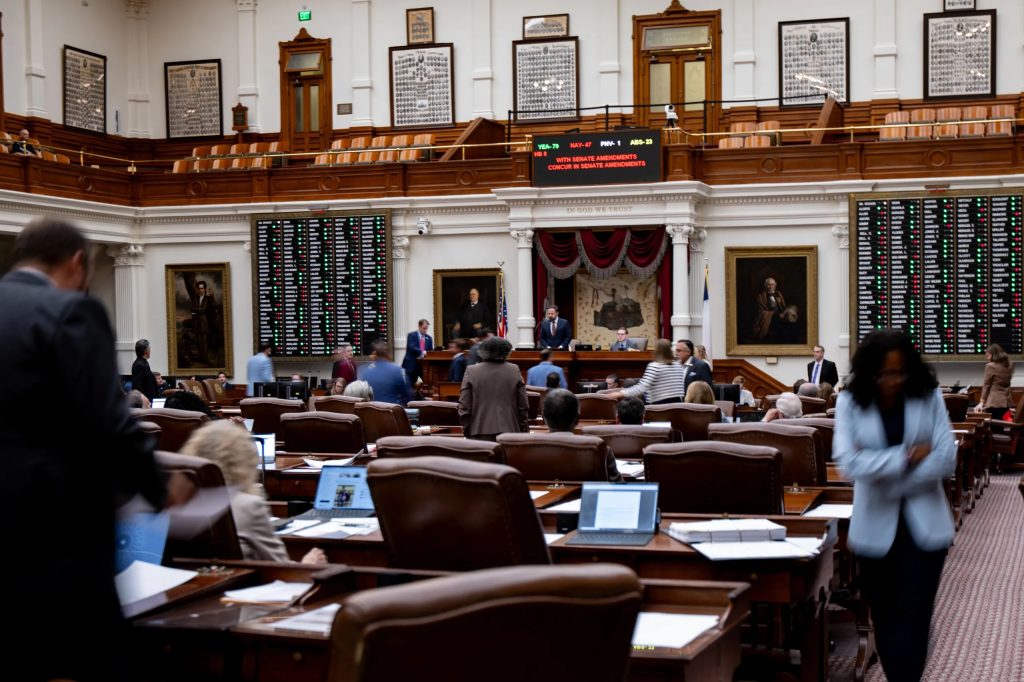
Photo: Lawmakers are shown on the Texas House floor at the Texas Capitol in Austin on Sept. 3, 2025. Kaylee Greenlee for The Texas Tribune
In 2024, the Texas House Republican primaries were nothing short of a bloodbath. This intense cycle witnessed unprecedented levels of campaign ad spending, driven by the usual financial backing from West Texas oil billionaires Tim Dunn and Farris Wilks, who supported far-right primary challengers. Governor Greg Abbott poured millions into efforts to unseat GOP incumbents who opposed private school vouchers—his signature issue—while Attorney General Ken Paxton targeted lawmakers who voted to impeach him in 2023.
Fast forward two years, and the primary landscape has undergone a significant transformation. Following a legislative season where Republicans successfully pushed through key priorities such as vouchers, congressional redistricting, and various socially conservative bills, the dynamics within the Texas GOP have shifted. After a decade of efforts to oust establishment Republicans, Dunn and Wilks’ political machine appears to be taking a step back. In the last six months of 2025, groups backed by these megadonors contributed only to a select few House Republican incumbents and candidates vying for open seats, marking a stark contrast to previous cycles where they funneled vast sums into firebrand challengers.
This cycle, the primary battle lines are drawn over tort reform. Texans for Lawsuit Reform (TLR), the state’s leading advocate for limiting business liability, is targeting three GOP incumbents who thwarted its priorities during the last legislative session. Meanwhile, trial lawyer groups are investing heavily to defend those lawmakers.
The most expensive race is unfolding in San Antonio’s House District 121, where TLR has spent nearly $900,000 supporting Republican challenger David McArthur against GOP Rep. Marc LaHood. LaHood’s reelection campaign is bolstered by significant donations from personal injury law firms and affiliated groups, including the Texas Trial Lawyers Association and Texans for Truth and Liberty, a PAC funded entirely by the prominent Houston firm Arnold & Itkin. Together, these groups contributed $268,000 to LaHood’s campaign last year, adding to a total exceeding $1 million from various medical groups and personal injury lawyers.
LaHood played a crucial role in the defeat of Senate Bill 30, which aimed to limit payouts from personal injury lawsuits—one of TLR’s top priorities. As a personal injury and criminal defense attorney, LaHood sought substantial amendments to SB 30 and helped kill two other priority bills as a member of the influential House Judiciary and Civil Jurisprudence Committee. Following the session, he exchanged heated words with TLR’s president, accusing the group of negotiating in bad faith and denouncing SB 30 as a “poorly drafted, frankly indefensible, scheme to deny aid to those who have suffered life-altering harm.”
The legislative setbacks represented a low point for TLR, which historically played a pivotal role in turning Texas red and consistently pushed bills through the Legislature to make it more challenging to sue large businesses and medical providers. SB 30 initially proposed strict limits on damages for accident victims but was significantly diluted in the House before ultimately failing to meet a critical deadline.
TLR’s influence appears to be waning as it increasingly finds itself at odds with the GOP’s far-right faction, especially after endorsing a GOP candidate who challenged Paxton in 2022. Paxton’s allies have accused TLR of orchestrating his impeachment the following year, a claim the group’s leaders vehemently deny.
Among TLR’s targets in the lower chamber are a growing number of right-wing trial lawyers, including LaHood and Rep. Mitch Little of Lewisville, who served as one of Paxton’s impeachment attorneys. Historically, trial lawyers were closely associated with the Democratic Party, but now, with top trial lawyer groups actively participating in Republican primaries, TLR Chairman Dick Weekley recently criticized “Democratic trial lawyers” for “posing as allies of the right.”
In North Texas’ House District 98, the tort reform factions are also heavily investing in the race to succeed outgoing Rep. Giovanni Capriglione, R-Southlake. In the latter half of last year, the Texas Trial Lawyers Association and Texans for Truth and Liberty contributed $127,500 to Armin Mizani, the Republican mayor of Keller who operates his own personal injury law firm. In contrast, campaign finance records show that TLR backed his opponent, Fred Tate, a businessman and former Texas Republican Party treasurer, with six figures.
Tate’s campaign website emphasizes that rising everyday costs are driven by the “tort tax” stemming from “frivolous lawsuits from greedy personal injury lawyers.” He pledges to advocate for common-sense lawsuit reforms to curb abusive litigation and hold personal injury lawyers accountable.
Elsewhere, TLR has supported primary challengers to Reps. Mark Dorazio, R-San Antonio, and Andy Hopper, R-Decatur, both of whom backed an amendment that weakened SB 30. The group spent over $60,000 last month supporting Dorazio’s GOP opponent, Willie Ng, and contributed $50,000 to Hopper’s challenger, Lisa McEntire.
The apparent pullback by Dunn and Wilks in this year’s primaries reflects the significant transformation of the Texas House, which saw many establishment Republicans ousted in the last contests. This incumbent wipeout has pushed the chamber further to the right and led to a leadership change that elevated Rep. Dustin Burrows, who aligns closely with the Senate’s conservative agenda.
“I wouldn’t say it’s a permanent condition, but I guess he’s pretty happy with the body as is,” remarked Bill Miller, a longtime Texas lobbyist, referring to Dunn. “They’re complacent, which suggests they’re satisfied with their accomplishments.”
Another factor influencing the primary landscape is Abbott’s absence from the fray, following his successful push for the school voucher program last year, which received support from every House Republican running for reelection. This earned them a blanket endorsement from President Donald Trump, complicating efforts by tort reform groups to target incumbent lawmakers, given Trump’s significant influence in Republican primaries.
Despite its substantial spending in late 2025, TLR has indicated to some candidates in competitive primaries that it may not continue funding its endorsed challengers, as reported by the Texas Bullpen. However, others within the TLR network are still contributing to these challengers, helping to fill the gap left by the group’s potential funding halt.
“We’re thankful for what TLR has done so far to get us to this point,” stated a spokesperson for McArthur’s campaign. “We’re fortunate that others have stepped up to continue the work they started.”
In a statement, TLR CEO Ryan Patrick refrained from confirming whether the group would continue its financial support for its endorsed primary challengers. However, he emphasized that TLR would persist in backing conservative Republicans and spreading its message about the “hidden tort tax that is crushing families and businesses.”
“That message will continue to resonate in districts where candidates are heavily invested with Democrat megadonors and the trial attorney lobby,” Patrick added.
Shortly after TLR reportedly indicated it would reduce its spending, McArthur launched a $100,000 television ad campaign, featuring a Newsmax anchor portraying LaHood as “on the ropes for his staunch support for the trial lawyer lobby.” In response, LaHood released an ad claiming he “stopped Big Insurance’s attempt to pick the bones of the American people.”
Earlier in 2025, Texans for Truth and Liberty also made significant contributions to hard-right incumbent lawmakers who helped undermine tort reform measures during the legislative session, strengthening their financial positions ahead of the primary season and potentially shielding them from Republican challengers. Their donations included $100,000 to Little and $50,000 each to Reps. Katrina Pierson, R-Rockwall, and Wes Virdell, R-Brady.
Renzo Downey contributed reporting.
Disclosure: Texans for Lawsuit Reform and Texas Trial Lawyers Association have been financial supporters of The Texas Tribune, a nonprofit, nonpartisan news organization funded in part by donations from members, foundations, and corporate sponsors. Financial supporters play no role in the Tribune’s journalism. Find a complete list of them here.
This article first appeared on The Texas Tribune.
Photo: Lawmakers are shown on the Texas House floor at the Texas Capitol in Austin on Sept. 3, 2025. Kaylee Greenlee for The Texas Tribune