Uncommon Weather Alert: Intense Winds Heighten Wildfire Risks in Colorado
The National Weather Service issued a rare warning for parts of Colorado’s Front Range on Friday, highlighting the threat of wildfire due to hurricane-force winds and extremely dry conditions. Concurrently, flood warnings were activated in Oregon as rivers swelled from heavy rainfall.
Severe weather swept across various regions of the United States, prompting forecasters to issue alerts ranging from wintry weather in North Dakota to red flag warnings in Nebraska and Texas, as well as flood warnings stretching from Washington down to California.
Among the most alarming was the “particularly dangerous situation” fire weather warning in Colorado, marking a first for the state. These warnings are reserved for the most critical scenarios, driven by concerns that a combination of strong winds, low humidity, and dry fuels could lead to life-threatening fire conditions.
“We don’t want people to panic, as that doesn’t help, but we do want them to be prepared,” stated Jennifer Stark, the meteorologist in charge of the Boulder weather service office. She emphasized that this period marks the peak windy season for the area.
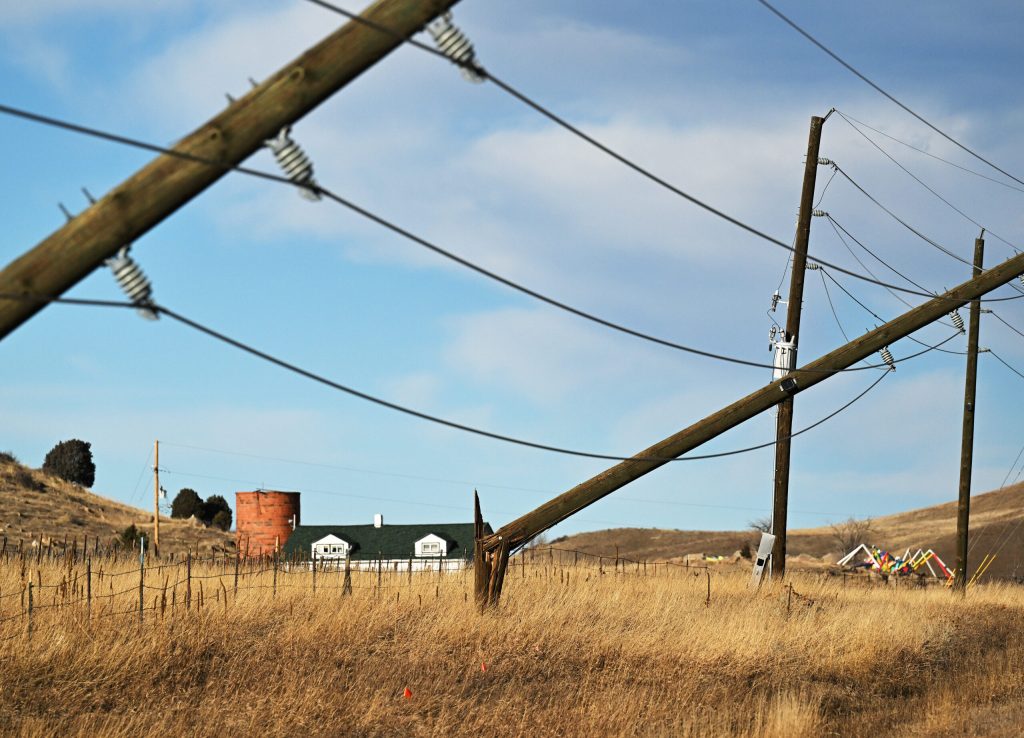
By late afternoon, a high wind warning remained in effect for the foothills and adjacent plains, with winds expected to gradually weaken after sunset. A gust of 105 mph (169 kph) was recorded at the National Center for Atmospheric Research in Boulder, resulting in toppled trees and downed power lines. Authorities shared images of dust storms, urging residents to avoid road travel.
Tens of thousands of customers experienced power outages as Xcel Energy implemented public safety power shut-offs to mitigate fire risks. The utility warned that unplanned outages from wind damage would likely exceed those caused by the preventive measures.
In Nederland, a town nestled in the Rocky Mountain foothills, Matt Arlen assisted in stocking shelves at a grocery store that was without power. This came a day after a surge of “panic shopping” in response to the extreme weather.
“We’re accustomed to high winds,” he remarked. “The power outage is more concerning for those without fireplaces for heat.” Despite this, the combination of winds and dry conditions weighed heavily on Arlen’s mind, especially given the region’s history with wildfires, such as the devastating 2021 Marshall Fire that destroyed over 1,000 homes in nearby Boulder suburbs.
Related: Denver, Rockies Face Power Shutoffs as Winds Boost Fire Risk
In Wellington, a town of 11,000 residents located on a notoriously windy stretch of the Colorado plains, public library technician Elaine Ringland noted that the wind was a common topic of conversation. During a blackout earlier in the week, she relied on a generator to keep her refrigerator and freezer running.
“I can tell you right now, our flag is standing straight out,” she said. “We’re prepared if we have to close down the library. Our town is monitoring the situation and is in contact with the power company.”
In Ringland’s neighborhood, winds bent trees and scattered shingles and tumbleweeds.
Meanwhile, in northwestern Oregon, the National Weather Service anticipated continued widespread river flooding due to heavy rains. Tragically, a 52-year-old man died in Sheridan, located about 50 miles southwest of Portland, after driving past road-closure signs onto a flooded road. His body was later recovered by a rescue team.
Clackamas County, which includes parts of Portland and the Cascade Range, issued “go now” evacuation notices to 300 residences. Significant flooding occurred on the Sandy, Clackamas, and Molalla rivers, prompting numerous rescues throughout the night. Some evacuation notices were lifted by Friday evening.
Among those rescued was a family of six trapped in their car after attempting to navigate a flooded roadway. Elsewhere, authorities used an inflatable raft to rescue a man from his home.
In northern California, forecasters predicted the arrival of a Pineapple Express—a stronger atmospheric river originating near Hawaii—around Christmas Eve. This forecast brought hope to ski resort operators for much-needed precipitation in the Sierra Nevada, where snowfall has been scarce this season.
Photo: Power poles along U.S. Highway 93 near Golden, Colo., snapped in half during a strong wind storm on Wednesday, Dec. 17, 2025. (RJ Sangosti/The Denver Post via AP)
Topics
Catastrophe
Natural Disasters
Wildfire
The National Weather Service issued a rare warning for parts of Colorado’s Front Range on Friday, highlighting the threat of wildfire due to hurricane-force winds and extremely dry conditions. Concurrently, flood warnings were activated in Oregon as rivers swelled from heavy rainfall.
Severe weather swept across various regions of the United States, prompting forecasters to issue alerts ranging from wintry weather in North Dakota to red flag warnings in Nebraska and Texas, as well as flood warnings stretching from Washington down to California.
Among the most alarming was the “particularly dangerous situation” fire weather warning in Colorado, marking a first for the state. These warnings are reserved for the most critical scenarios, driven by concerns that a combination of strong winds, low humidity, and dry fuels could lead to life-threatening fire conditions.
“We don’t want people to panic, as that doesn’t help, but we do want them to be prepared,” stated Jennifer Stark, the meteorologist in charge of the Boulder weather service office. She emphasized that this period marks the peak windy season for the area.
By late afternoon, a high wind warning remained in effect for the foothills and adjacent plains, with winds expected to gradually weaken after sunset. A gust of 105 mph (169 kph) was recorded at the National Center for Atmospheric Research in Boulder, resulting in toppled trees and downed power lines. Authorities shared images of dust storms, urging residents to avoid road travel.
Tens of thousands of customers experienced power outages as Xcel Energy implemented public safety power shut-offs to mitigate fire risks. The utility warned that unplanned outages from wind damage would likely exceed those caused by the preventive measures.
In Nederland, a town nestled in the Rocky Mountain foothills, Matt Arlen assisted in stocking shelves at a grocery store that was without power. This came a day after a surge of “panic shopping” in response to the extreme weather.
“We’re accustomed to high winds,” he remarked. “The power outage is more concerning for those without fireplaces for heat.” Despite this, the combination of winds and dry conditions weighed heavily on Arlen’s mind, especially given the region’s history with wildfires, such as the devastating 2021 Marshall Fire that destroyed over 1,000 homes in nearby Boulder suburbs.
Related: Denver, Rockies Face Power Shutoffs as Winds Boost Fire Risk
In Wellington, a town of 11,000 residents located on a notoriously windy stretch of the Colorado plains, public library technician Elaine Ringland noted that the wind was a common topic of conversation. During a blackout earlier in the week, she relied on a generator to keep her refrigerator and freezer running.
“I can tell you right now, our flag is standing straight out,” she said. “We’re prepared if we have to close down the library. Our town is monitoring the situation and is in contact with the power company.”
In Ringland’s neighborhood, winds bent trees and scattered shingles and tumbleweeds.
Meanwhile, in northwestern Oregon, the National Weather Service anticipated continued widespread river flooding due to heavy rains. Tragically, a 52-year-old man died in Sheridan, located about 50 miles southwest of Portland, after driving past road-closure signs onto a flooded road. His body was later recovered by a rescue team.
Clackamas County, which includes parts of Portland and the Cascade Range, issued “go now” evacuation notices to 300 residences. Significant flooding occurred on the Sandy, Clackamas, and Molalla rivers, prompting numerous rescues throughout the night. Some evacuation notices were lifted by Friday evening.
Among those rescued was a family of six trapped in their car after attempting to navigate a flooded roadway. Elsewhere, authorities used an inflatable raft to rescue a man from his home.
In northern California, forecasters predicted the arrival of a Pineapple Express—a stronger atmospheric river originating near Hawaii—around Christmas Eve. This forecast brought hope to ski resort operators for much-needed precipitation in the Sierra Nevada, where snowfall has been scarce this season.
Photo: Power poles along U.S. Highway 93 near Golden, Colo., snapped in half during a strong wind storm on Wednesday, Dec. 17, 2025. (RJ Sangosti/The Denver Post via AP)
Topics
Catastrophe
Natural Disasters
Wildfire