US P/C Insurers Face Uncertain Future as Auto Challenges Loom

In their latest report on the U.S. auto insurance market, analysts from S&P Global Market Intelligence predict the strongest overall U.S. property/casualty insurance underwriting results in 18 years for 2025, driven by favorable private passenger auto outcomes.
Despite this optimistic outlook, the projected combined ratio across all lines for 2025 is now 96.2, which is three points better than the midyear projection of 99.2 estimated in August. However, S&P GMI cautions that “success is anticipated to be temporary due to various market dynamics and challenges,” as stated in a December media release.
The media statement highlighted the publication of the firm’s 2025 U.S. Auto Insurance Market Report, emphasizing the significant role that auto insurance plays in the overall P/C insurance industry results.
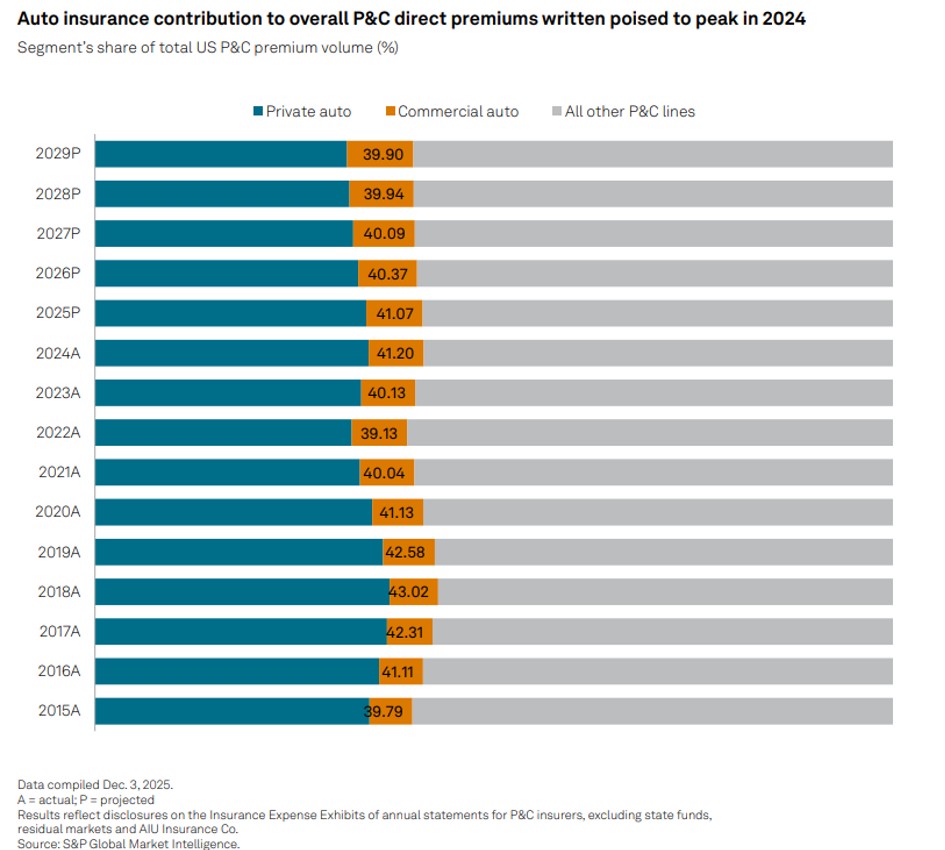
S&P GMI estimates that private and commercial auto insurance will account for 41.1% of total U.S. P/C direct premiums written in 2025, slightly down from a five-year high of 41.2% achieved in 2024. This decline reflects the competitive pressures emerging in the private auto market.
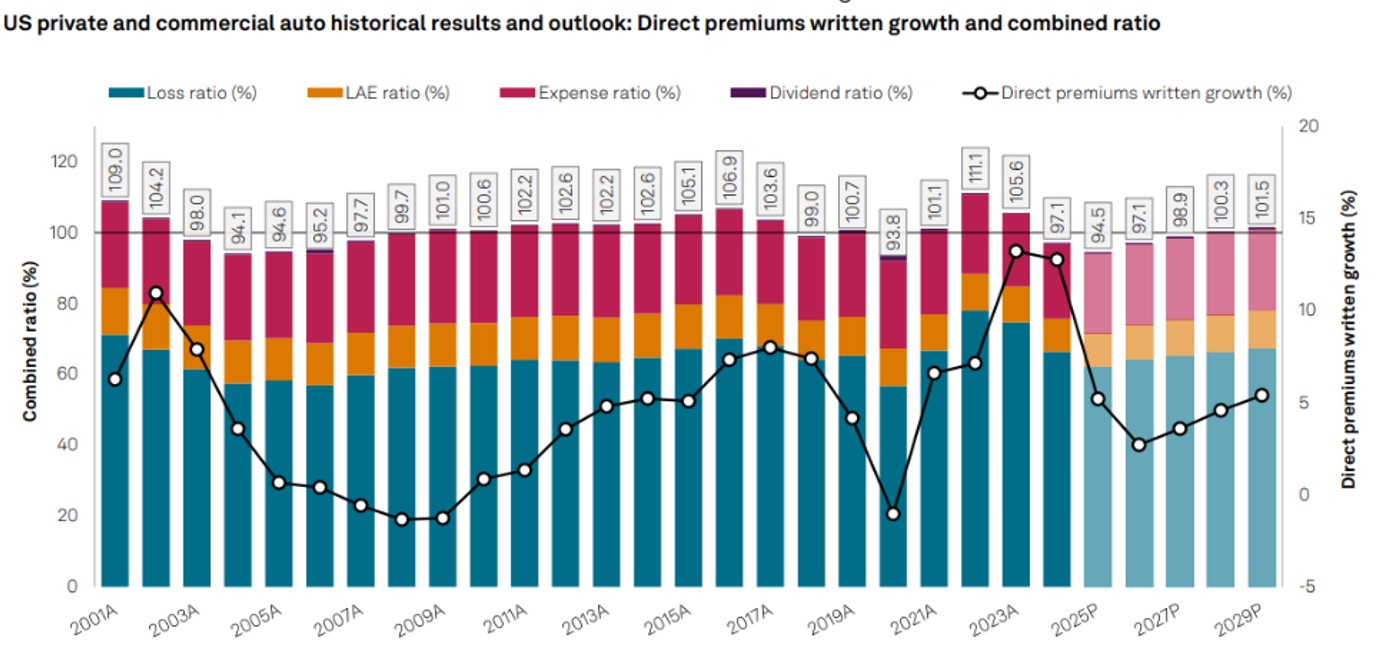
The projected combined ratio for auto insurance (personal and commercial) is 94.5, which contributes to the overall P/C combined ratio of 96.2, a decrease from 96.5 in 2024. This marks the first time since 2006-2007 that sub-97 results have been recorded in successive years, according to the media statement.
Several factors contribute to the industry’s anticipated success in 2025. S&P GMI points to “a generational hard market in personal lines” and a benign year for natural catastrophes. However, these conditions are unlikely to recur, suggesting that the current level of success may be fleeting.
The private auto sector has experienced intensified competitive dynamics, with rate decreases matching rate increases and heightened advertising spending. The report notes that the projected combined ratio of 94.5 for personal and commercial auto lines is significant, as the auto insurance business has only produced a better result once in the last two decades—93.8 in 2020, when COVID-19 lockdowns led to a sharp decline in claims frequency.
Looking ahead, S&P GMI anticipates that auto insurance combined ratios will breach the breakeven level again in 2028, with projections of 97.1 in 2026 and 98.9 in 2027. The report emphasizes that while strong underwriting results are expected in the near term, the market is not without risks.
Social inflation, characterized by rising claims severity due to adverse litigation trends, has long troubled the commercial auto sector and is increasingly becoming a significant threat to the private auto market, particularly among at-fault drivers with higher liability limits.
The political landscape also poses uncertainties, as policymakers propose and implement measures that could directly or indirectly affect auto insurance. The report notes that the generational hard market of recent years has prompted calls for revisions to rate filing regimes, which could intensify in 2026 if favorable profitability levels continue.
Additionally, while tariffs received considerable attention earlier this year, they did not impact auto physical damage results. However, S&P GMI suggests that future tariff developments cannot be entirely dismissed.
(Editor’s Note: S&P GMI projects a 92.7 combined ratio for personal auto in 2025, and 104.3 for commercial auto. If the personal auto combined ratio reaches 92.7, it would rival 2020’s 92.5, marking one of the best results in 30 years, without the pandemic-related changes in driving behavior.)
Revised Projections
The 2025 U.S. Auto Insurance report, published in late December, also includes full-year combined ratio projections for homeowners insurance in personal lines and various commercial lines, along with projections for direct written premium growth.
Comparisons to earlier projections from S&P GMI’s 2025 U.S. Property and Casualty Insurance Market Report, released in August 2025, are illustrated in the latest report on auto lines.
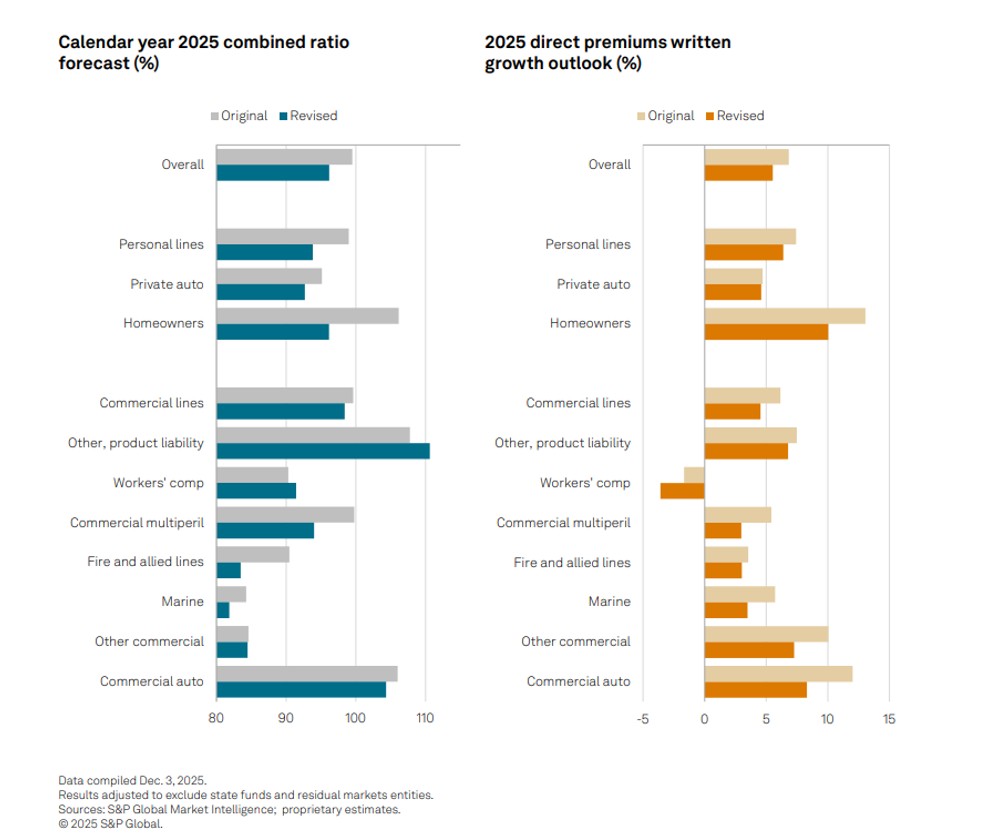
The latest combined ratio projections are generally more favorable than those from August, with the homeowners line showing the most significant change—falling from a forecast of 106.1 in August to below 100 (96.2) in December. The only line with an upward adjustment is commercial liability, which moved from 107.8 in August to over 110 in December.
Previously, the homeowners combined ratio projection had anticipated another active severe convective storm season in the second quarter and an average hurricane season in the third quarter—neither of which occurred.
“Meanwhile, adverse reserve development in certain casualty lines is running ahead of what we presumed to have been conservative projections,” the report states, particularly concerning the commercial liability lines. “This is particularly worrisome given that the fourth quarter, when companies occasionally implement ‘kitchen-sink’ reserve charges, lies ahead.”
Regarding premium growth, S&P GMI maintains its forecast of a 5% increase in personal auto for 2025 compared to 2024. However, analysts now expect commercial auto insurance direct premiums to expand at a slower pace than previously anticipated, dropping from a forecast of 12% in August to below 10%.
On the personal lines side, the projected growth rate for homeowners insurance has also been revised down to approximately 10%, down from 13.1% in the August analysis.
What Else is in the Auto Report
S&P GMI’s December auto insurance report also includes:
- A discussion of macroeconomic factors and their impact on the auto insurance business.
- Separate analyses of liability and physical damage combined ratios and growth rates for personal and commercial auto insurance segments.
- Lists of the top 20 personal and commercial auto insurers, showing five years of direct premiums and loss ratios for each insurer (2020-2024).
- Maps providing state-by-state loss ratio comparisons (five-year loss ratios for 2020-2024, presented separately for personal auto liability, personal auto physical damage, commercial auto liability, and commercial auto physical damage).
- Maps indicating 2025 rate-change relativities for personal auto by state, and cumulative rate changes from 2021 through 2024.
- A discussion and analysis of advertising spending by major personal lines direct writers.
- Crash frequency statistics for commercial trucks and an analysis of E&S growth in the commercial auto market.
Throughout the report, S&P GMI reminds auto insurers of long-term challenges on the horizon, as the potential shift towards autonomous vehicles necessitates planning for a future with different risk profiles and coverage needs.
While the promise of full autonomy within the private passenger fleet appears to be years away, the report advises that auto insurers must prepare for a future that may look very different from the present and past.
Topics
USA
Carriers
Auto
Property Casualty
In their latest report on the U.S. auto insurance market, analysts from S&P Global Market Intelligence predict the strongest overall U.S. property/casualty insurance underwriting results in 18 years for 2025, driven by favorable private passenger auto outcomes.
Despite this optimistic outlook, the projected combined ratio across all lines for 2025 is now 96.2, which is three points better than the midyear projection of 99.2 estimated in August. However, S&P GMI cautions that “success is anticipated to be temporary due to various market dynamics and challenges,” as stated in a December media release.
The media statement highlighted the publication of the firm’s 2025 U.S. Auto Insurance Market Report, emphasizing the significant role that auto insurance plays in the overall P/C insurance industry results.
S&P GMI estimates that private and commercial auto insurance will account for 41.1% of total U.S. P/C direct premiums written in 2025, slightly down from a five-year high of 41.2% achieved in 2024. This decline reflects the competitive pressures emerging in the private auto market.
The projected combined ratio for auto insurance (personal and commercial) is 94.5, which contributes to the overall P/C combined ratio of 96.2, a decrease from 96.5 in 2024. This marks the first time since 2006-2007 that sub-97 results have been recorded in successive years, according to the media statement.
Several factors contribute to the industry’s anticipated success in 2025. S&P GMI points to “a generational hard market in personal lines” and a benign year for natural catastrophes. However, these conditions are unlikely to recur, suggesting that the current level of success may be fleeting.
The private auto sector has experienced intensified competitive dynamics, with rate decreases matching rate increases and heightened advertising spending. The report notes that the projected combined ratio of 94.5 for personal and commercial auto lines is significant, as the auto insurance business has only produced a better result once in the last two decades—93.8 in 2020, when COVID-19 lockdowns led to a sharp decline in claims frequency.
Looking ahead, S&P GMI anticipates that auto insurance combined ratios will breach the breakeven level again in 2028, with projections of 97.1 in 2026 and 98.9 in 2027. The report emphasizes that while strong underwriting results are expected in the near term, the market is not without risks.
Social inflation, characterized by rising claims severity due to adverse litigation trends, has long troubled the commercial auto sector and is increasingly becoming a significant threat to the private auto market, particularly among at-fault drivers with higher liability limits.
The political landscape also poses uncertainties, as policymakers propose and implement measures that could directly or indirectly affect auto insurance. The report notes that the generational hard market of recent years has prompted calls for revisions to rate filing regimes, which could intensify in 2026 if favorable profitability levels continue.
Additionally, while tariffs received considerable attention earlier this year, they did not impact auto physical damage results. However, S&P GMI suggests that future tariff developments cannot be entirely dismissed.
(Editor’s Note: S&P GMI projects a 92.7 combined ratio for personal auto in 2025, and 104.3 for commercial auto. If the personal auto combined ratio reaches 92.7, it would rival 2020’s 92.5, marking one of the best results in 30 years, without the pandemic-related changes in driving behavior.)
Revised Projections
The 2025 U.S. Auto Insurance report, published in late December, also includes full-year combined ratio projections for homeowners insurance in personal lines and various commercial lines, along with projections for direct written premium growth.
Comparisons to earlier projections from S&P GMI’s 2025 U.S. Property and Casualty Insurance Market Report, released in August 2025, are illustrated in the latest report on auto lines.
The latest combined ratio projections are generally more favorable than those from August, with the homeowners line showing the most significant change—falling from a forecast of 106.1 in August to below 100 (96.2) in December. The only line with an upward adjustment is commercial liability, which moved from 107.8 in August to over 110 in December.
Previously, the homeowners combined ratio projection had anticipated another active severe convective storm season in the second quarter and an average hurricane season in the third quarter—neither of which occurred.
“Meanwhile, adverse reserve development in certain casualty lines is running ahead of what we presumed to have been conservative projections,” the report states, particularly concerning the commercial liability lines. “This is particularly worrisome given that the fourth quarter, when companies occasionally implement ‘kitchen-sink’ reserve charges, lies ahead.”
Regarding premium growth, S&P GMI maintains its forecast of a 5% increase in personal auto for 2025 compared to 2024. However, analysts now expect commercial auto insurance direct premiums to expand at a slower pace than previously anticipated, dropping from a forecast of 12% in August to below 10%.
On the personal lines side, the projected growth rate for homeowners insurance has also been revised down to approximately 10%, down from 13.1% in the August analysis.
What Else is in the Auto Report
S&P GMI’s December auto insurance report also includes:
- A discussion of macroeconomic factors and their impact on the auto insurance business.
- Separate analyses of liability and physical damage combined ratios and growth rates for personal and commercial auto insurance segments.
- Lists of the top 20 personal and commercial auto insurers, showing five years of direct premiums and loss ratios for each insurer (2020-2024).
- Maps providing state-by-state loss ratio comparisons (five-year loss ratios for 2020-2024, presented separately for personal auto liability, personal auto physical damage, commercial auto liability, and commercial auto physical damage).
- Maps indicating 2025 rate-change relativities for personal auto by state, and cumulative rate changes from 2021 through 2024.
- A discussion and analysis of advertising spending by major personal lines direct writers.
- Crash frequency statistics for commercial trucks and an analysis of E&S growth in the commercial auto market.
Throughout the report, S&P GMI reminds auto insurers of long-term challenges on the horizon, as the potential shift towards autonomous vehicles necessitates planning for a future with different risk profiles and coverage needs.
While the promise of full autonomy within the private passenger fleet appears to be years away, the report advises that auto insurers must prepare for a future that may look very different from the present and past.
Topics
USA
Carriers
Auto
Property Casualty