Utilities Take Proactive Measures to Cut Power Amid Increasing Fire Risk
States in the U.S. West are facing an unusually warm and dry winter, which is increasing fire risks in several regions. In response, utilities are taking drastic measures, including shutting off power to prevent their equipment from igniting potentially devastating fires.
In areas of Texas, New Mexico, and Colorado, fine grasses and brush have dried out significantly due to La Niña, which has kept substantial rain and snow at bay. This trend is expected to persist into the spring. As fire weather alerts from the U.S. National Weather Service were issued in December and January, Xcel Energy Inc. implemented multiple rounds of preventative power cuts in Colorado, affecting over 50,000 customers, particularly in the Boulder and Fort Collins regions, which are nestled in the Rocky Mountains.
Related: Massive Wildfire Liabilities Push Utilities to Use AI to Stop Blazes
These shutoffs, termed “public safety power shutoffs,” are enacted to prevent power lines from sparking fires during extreme weather conditions. Although unpopular, Xcel asserts that these measures are essential. Behind the scenes, Xcel executives consult with a team of weather scientists to determine when and where to cut power. “It all starts with meteorology,” explains Paul McGregor, the company’s vice president of wildfire risk management.
This approach reflects a broader trend in the utility industry, where companies beyond California—where PSPS programs originated—are striving to minimize their fire-starting risks and associated financial liabilities. While burying power lines underground can significantly reduce fire risks, it is a costly endeavor that can take years to complete. Depending on local conditions, power providers may notify customers of shutoffs lasting anywhere from 18 hours to several days. Proactive safety shutoffs are now common across utilities from Hawaii to Texas.
In Nevada, hundreds of customers near Carson City lost power shortly before Christmas due to high winds and escalating fire risks. Similarly, residents outside Cheyenne, Wyoming, were warned to prepare for potential shutoffs amid comparable weather conditions in January.
Before joining Xcel, McGregor worked at Pacific Gas & Electric Co. (PG&E), which serves northern and central California. PG&E initiated a shutoff program in 2018, building on an idea first implemented by San Diego’s utility. Since then, PG&E’s meteorology team has developed a system that has inspired other utilities to create their own shutoff protocols, advising on how to monitor conditions effectively.
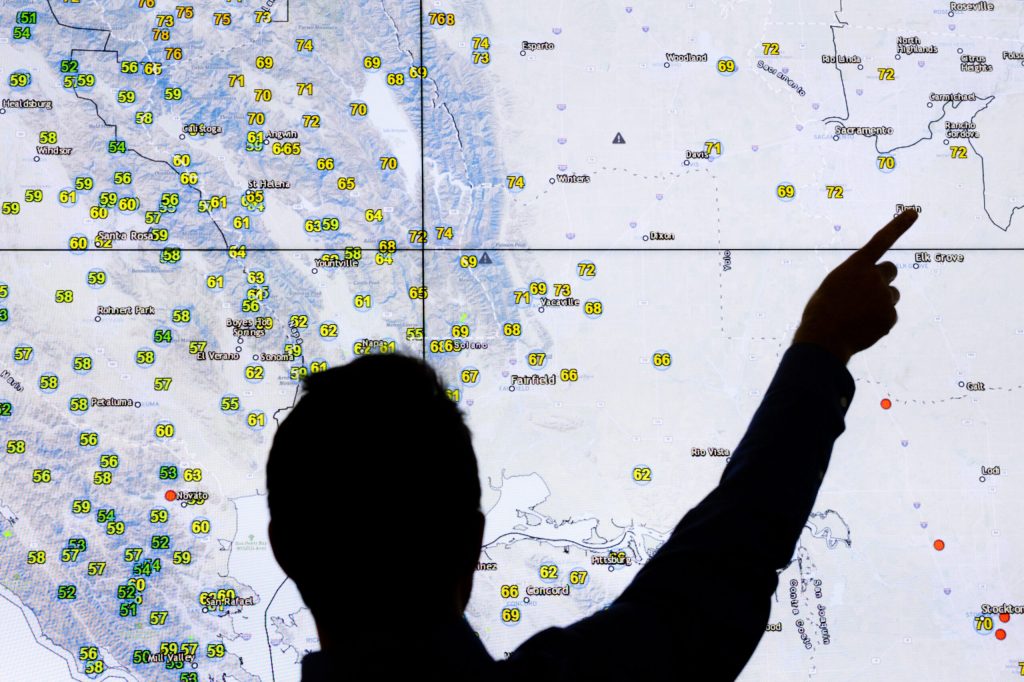
In PG&E’s San Ramon, California office, a large map displays transmission lines traversing mountains and valleys. Here, Scott Strenfel, PG&E’s senior director of meteorology and fire science, along with his team of forecasters, monitors weather conditions to determine when the fire risk is too high to maintain energy flow across the utility’s extensive system.
Strenfel, recognized as an industry leader in managing fire threats, has a deep passion for weather. He recalls being sent to the principal’s office in middle school for being disruptive during rainstorms. Strenfel was at PG&E in 2017 when the utility’s equipment ignited a series of catastrophic fires in Northern California, leading to lawsuits and public pressure that prompted the rollout of preventative shutoffs. PG&E filed for bankruptcy in 2019 following a series of wildfires.
The decision-making process for cutting power involves a complex interplay of data, technology, and human judgment. “It’s a man-machine mix,” Strenfel notes. “Models aren’t perfect.” Making the right call can be incredibly stressful.
Related: Could Utility Gear Set Your Neighborhood on Fire? California Risk Maps Are 8 Years Old
“I wouldn’t want that job,” says fire weather scientist Craig Clements from San Jose State University, who studied with Strenfel. “It’s probably the most stressful—and one of the more important—meteorology positions in the world.”
Data is at the core of their operations. PG&E, which serves over 5 million customers, operates more than 1,600 weather stations atop its power lines in remote mountain areas. These stations report real-time data on wind speeds, humidity, and temperature every ten minutes. The utility also tracks moisture levels in grasses and brush to assess ignition risks and utilizes global forecast models from various sources.
Recently, California has experienced a decrease in fire risk due to atmospheric rivers that brought heavy rains to the West Coast. However, the long-term forecast suggests that these favorable conditions may not last.

The meteorologists at PG&E remain vigilant. In daily meetings, Strenfel and his team review AI-powered models that assess both the likelihood of utility equipment igniting a fire and the potential damage. If conditions are precarious, meteorologists monitor the situation around the clock alongside a senior PG&E executive.
With so much at stake, the pressure is immense. For instance, Edison International’s Southern California utility is facing numerous lawsuits alleging its equipment caused the Eaton fire, which resulted in 19 fatalities and significant destruction in Altadena during a record-breaking windstorm.
Despite California’s recent history of catastrophic wildfires, the acreage burned last year nearly halved, dropping to about 525,000 acres from over one million in 2024, according to Cal Fire. PG&E has also reduced the scope and duration of its preventative outages, with a 64% decrease in customers affected by PSPS shutoffs in 2025 compared to the previous year.
However, unplanned outages remain high. PG&E and other utilities can activate “fast-trip” safety settings that quickly cut power to prevent fires if a tree limb or other object strikes a line. In 2025, approximately 839,000 customers experienced fast-trip outages, showing only slight improvement over the previous year.
Massive shutoffs are rare, such as the one PG&E implemented on October 27, 2019. Following the deadly Camp Fire, Strenfel advised the utility to cut power to nearly one million customers amid extreme wind conditions. This unprecedented action faced severe backlash, with reports of lost refrigerated insulin and disrupted medical equipment. PG&E was subsequently fined over $100 million by the state utility regulator. Strenfel recalls seeing a video of downtown Napa in total blackout, feeling “mixed emotions.” “It could have been done much better,” he reflected.
Yet, he takes solace in the fact that they likely prevented a larger disaster. After the widespread power shutoff, PG&E identified over 550 instances of damage on lines that could have sparked fires.
“Nobody is ever going to know that because it didn’t happen,” says atmospheric scientist Scott Capps, formerly with Technosylva. “It’s a damned-if-you-do, damned-if-you-don’t decision if you turn the power off.”
Top photo: Scott Strenfel in the Meteorology and Fire Science room. Photographer: Manuel Orbegozo/Bloomberg.
Copyright 2026 Bloomberg.
Topics
Trends
States in the U.S. West are facing an unusually warm and dry winter, which is increasing fire risks in several regions. In response, utilities are taking drastic measures, including shutting off power to prevent their equipment from igniting potentially devastating fires.
In areas of Texas, New Mexico, and Colorado, fine grasses and brush have dried out significantly due to La Niña, which has kept substantial rain and snow at bay. This trend is expected to persist into the spring. As fire weather alerts from the U.S. National Weather Service were issued in December and January, Xcel Energy Inc. implemented multiple rounds of preventative power cuts in Colorado, affecting over 50,000 customers, particularly in the Boulder and Fort Collins regions, which are nestled in the Rocky Mountains.
Related: Massive Wildfire Liabilities Push Utilities to Use AI to Stop Blazes
These shutoffs, termed “public safety power shutoffs,” are enacted to prevent power lines from sparking fires during extreme weather conditions. Although unpopular, Xcel asserts that these measures are essential. Behind the scenes, Xcel executives consult with a team of weather scientists to determine when and where to cut power. “It all starts with meteorology,” explains Paul McGregor, the company’s vice president of wildfire risk management.
This approach reflects a broader trend in the utility industry, where companies beyond California—where PSPS programs originated—are striving to minimize their fire-starting risks and associated financial liabilities. While burying power lines underground can significantly reduce fire risks, it is a costly endeavor that can take years to complete. Depending on local conditions, power providers may notify customers of shutoffs lasting anywhere from 18 hours to several days. Proactive safety shutoffs are now common across utilities from Hawaii to Texas.
In Nevada, hundreds of customers near Carson City lost power shortly before Christmas due to high winds and escalating fire risks. Similarly, residents outside Cheyenne, Wyoming, were warned to prepare for potential shutoffs amid comparable weather conditions in January.
Before joining Xcel, McGregor worked at Pacific Gas & Electric Co. (PG&E), which serves northern and central California. PG&E initiated a shutoff program in 2018, building on an idea first implemented by San Diego’s utility. Since then, PG&E’s meteorology team has developed a system that has inspired other utilities to create their own shutoff protocols, advising on how to monitor conditions effectively.
In PG&E’s San Ramon, California office, a large map displays transmission lines traversing mountains and valleys. Here, Scott Strenfel, PG&E’s senior director of meteorology and fire science, along with his team of forecasters, monitors weather conditions to determine when the fire risk is too high to maintain energy flow across the utility’s extensive system.
Strenfel, recognized as an industry leader in managing fire threats, has a deep passion for weather. He recalls being sent to the principal’s office in middle school for being disruptive during rainstorms. Strenfel was at PG&E in 2017 when the utility’s equipment ignited a series of catastrophic fires in Northern California, leading to lawsuits and public pressure that prompted the rollout of preventative shutoffs. PG&E filed for bankruptcy in 2019 following a series of wildfires.
The decision-making process for cutting power involves a complex interplay of data, technology, and human judgment. “It’s a man-machine mix,” Strenfel notes. “Models aren’t perfect.” Making the right call can be incredibly stressful.
Related: Could Utility Gear Set Your Neighborhood on Fire? California Risk Maps Are 8 Years Old
“I wouldn’t want that job,” says fire weather scientist Craig Clements from San Jose State University, who studied with Strenfel. “It’s probably the most stressful—and one of the more important—meteorology positions in the world.”
Data is at the core of their operations. PG&E, which serves over 5 million customers, operates more than 1,600 weather stations atop its power lines in remote mountain areas. These stations report real-time data on wind speeds, humidity, and temperature every ten minutes. The utility also tracks moisture levels in grasses and brush to assess ignition risks and utilizes global forecast models from various sources.
Recently, California has experienced a decrease in fire risk due to atmospheric rivers that brought heavy rains to the West Coast. However, the long-term forecast suggests that these favorable conditions may not last.
The meteorologists at PG&E remain vigilant. In daily meetings, Strenfel and his team review AI-powered models that assess both the likelihood of utility equipment igniting a fire and the potential damage. If conditions are precarious, meteorologists monitor the situation around the clock alongside a senior PG&E executive.
With so much at stake, the pressure is immense. For instance, Edison International’s Southern California utility is facing numerous lawsuits alleging its equipment caused the Eaton fire, which resulted in 19 fatalities and significant destruction in Altadena during a record-breaking windstorm.
Despite California’s recent history of catastrophic wildfires, the acreage burned last year nearly halved, dropping to about 525,000 acres from over one million in 2024, according to Cal Fire. PG&E has also reduced the scope and duration of its preventative outages, with a 64% decrease in customers affected by PSPS shutoffs in 2025 compared to the previous year.
However, unplanned outages remain high. PG&E and other utilities can activate “fast-trip” safety settings that quickly cut power to prevent fires if a tree limb or other object strikes a line. In 2025, approximately 839,000 customers experienced fast-trip outages, showing only slight improvement over the previous year.
Massive shutoffs are rare, such as the one PG&E implemented on October 27, 2019. Following the deadly Camp Fire, Strenfel advised the utility to cut power to nearly one million customers amid extreme wind conditions. This unprecedented action faced severe backlash, with reports of lost refrigerated insulin and disrupted medical equipment. PG&E was subsequently fined over $100 million by the state utility regulator. Strenfel recalls seeing a video of downtown Napa in total blackout, feeling “mixed emotions.” “It could have been done much better,” he reflected.
Yet, he takes solace in the fact that they likely prevented a larger disaster. After the widespread power shutoff, PG&E identified over 550 instances of damage on lines that could have sparked fires.
“Nobody is ever going to know that because it didn’t happen,” says atmospheric scientist Scott Capps, formerly with Technosylva. “It’s a damned-if-you-do, damned-if-you-don’t decision if you turn the power off.”
Top photo: Scott Strenfel in the Meteorology and Fire Science room. Photographer: Manuel Orbegozo/Bloomberg.
Copyright 2026 Bloomberg.
Topics
Trends